


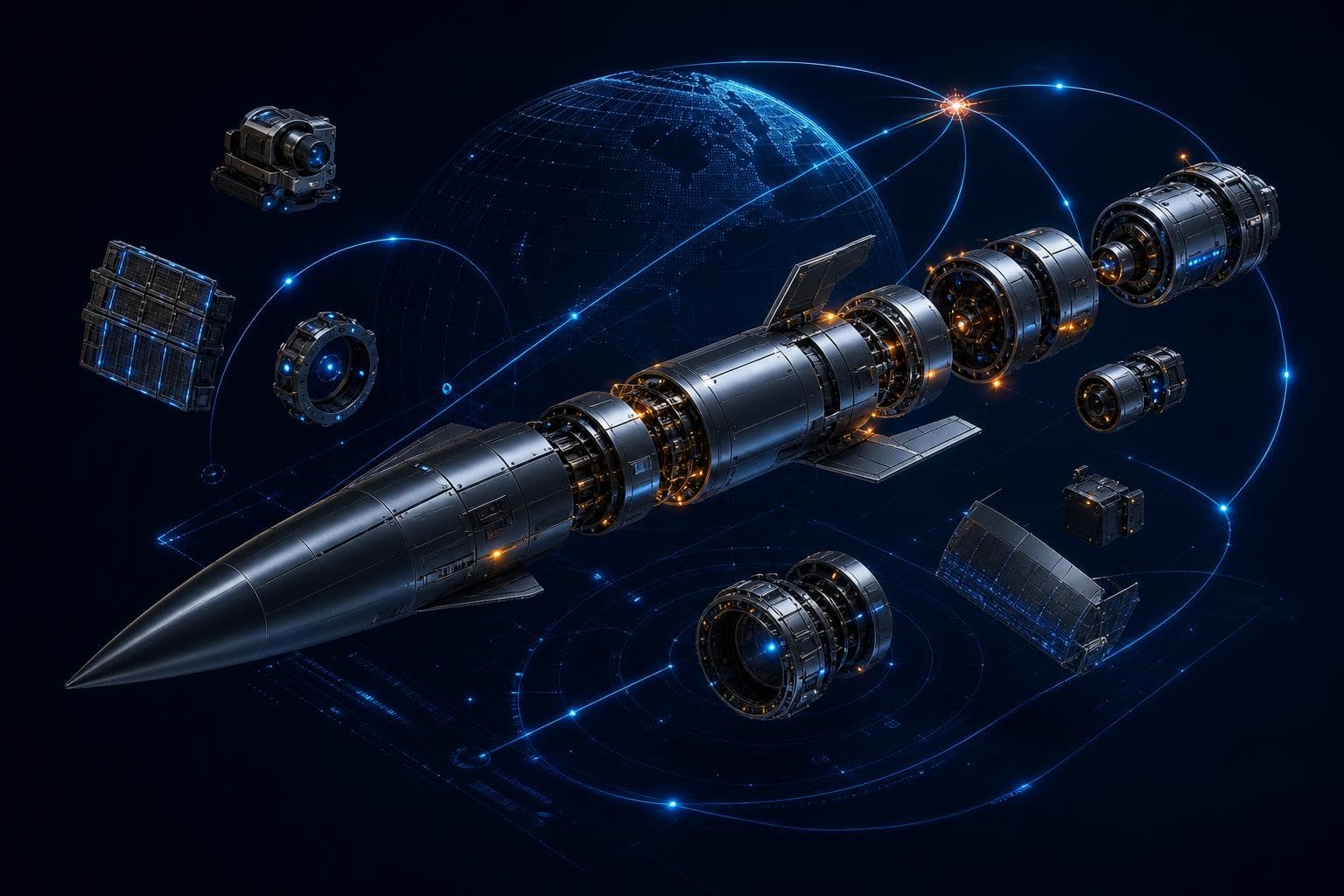

The Glide Phase Interceptor program spent most of 2025 in slow motion. Congress had demanded initial operational capability by 2029, but reduced funding in the FY2025 budget had quietly pushed the delivery timeline back to 2035 — a six-year slip that nobody wanted to advertise. Then a $475 million injection from the reconciliation bill landed at Northrop Grumman, and suddenly 2031 is back on the table.
That single funding move tells you more about where hypersonic defense investment is heading than any venture announcement.
The Problem That's Actually Driving the Money
Hypersonic threats are genuinely hard to defend against — not because the physics are mysterious, but because the intercept window is brutally compressed. The GPI is specifically designed to hit adversary weapons during their glide phase, the period after launch and before atmospheric re-entry when they're most vulnerable. Miss that window and you're out of options. As Air Force Gen. Gregory Guillot, head of NORAD and NORTHCOM, has called hypersonics "probably the most technologically challenging threat we're facing, as well as the most destabilizing" — and that's coming from someone whose job is to worry about everything.
China and Russia have both made substantial investments in hypersonic weapons. The threat is real, the timeline is compressed, and the U.S. is playing catch-up on the intercept side. That's the investment thesis in three sentences.
Testing Is the Bottleneck Nobody Talks About
Here's what the funding headlines miss: you can't develop a hypersonic interceptor without somewhere to test it. That's why the Rocket Lab–Anduril deal announced last week matters more than its quiet rollout suggested. Rocket Lab announced three hypersonic test flights for Anduril using its HASTE suborbital launch vehicle — a system specifically designed for experiments at speeds above Mach 5, launching from Virginia's Launch Complex 2 with the first mission expected within 12 months.
Separately, Rocket Lab confirmed it's working with Raytheon on space-based interceptor technology for the Space Force's Golden Dome program, one of 12 prime contractors selected for a program structured around Other Transaction agreements. Rocket Lab's CFO was candid about the procurement model: companies have to commit internal funding upfront to unlock larger production contracts later. "Skin in the game," he called it.
That structure — OTA-based, milestone-gated, requiring private capital commitment — is exactly the kind of procurement design that favors well-capitalized new entrants over legacy contractors running on cost-plus assumptions. It also explains why venture capital is flowing toward the sector at a pace that would have seemed implausible three years ago.
The Capital Is Structural Now, Not Cyclical
Defense tech VC hit approximately $17.8 billion in Q1 2026, just below the record $17.9 billion posted in Q2 2025. For context: quarterly investment in the sector ranged from roughly $4.7 billion to $9.5 billion between 2022 and 2023. The step-change isn't a blip — it reflects institutional allocators treating defense tech as a long-duration category rather than a geopolitical trade.
The capital concentration tells the story. Shield AI raised $2 billion at a $12.7 billion valuation. Saronic Technologies raised $1.75 billion in a Series D, more than doubling its prior valuation. These aren't seed bets on unproven technology — they're growth-stage commitments to platforms with demonstrated autonomy capabilities and clear demand signals from the Pentagon.
Hypersonic defense sits at the intersection of every theme driving those commitments: autonomy, sensing, space-based architecture, and the urgent need to counter threats that existing systems weren't designed to handle. The Space-BACN optical inter-satellite link program — critical for connecting Golden Dome's sensor-to-shooter chain — just transitioned from DARPA to DIU for on-orbit demonstration, another signal that the underlying infrastructure is moving from research to procurement-ready.
What to Watch
The GPI program's next milestone is preliminary design review, targeted for 2028, with Northrop's total program cost now at $1.31 billion. Watch whether the Space Force's space-based interceptor OTA process opens competitive bids to smaller primes — that's where the startup opportunity actually lives, not in the Northrop-scale prime contracts.
The Anduril-Rocket Lab hypersonic test flights are the near-term tell. If HASTE delivers on schedule within the next 12 months, it validates the commercial testing infrastructure that every other hypersonic defense startup needs to exist. That's not just one company's win — it's a capability unlock for the whole sector.
The funding is already there. The question is whether the testing pipeline can absorb it fast enough to matter.