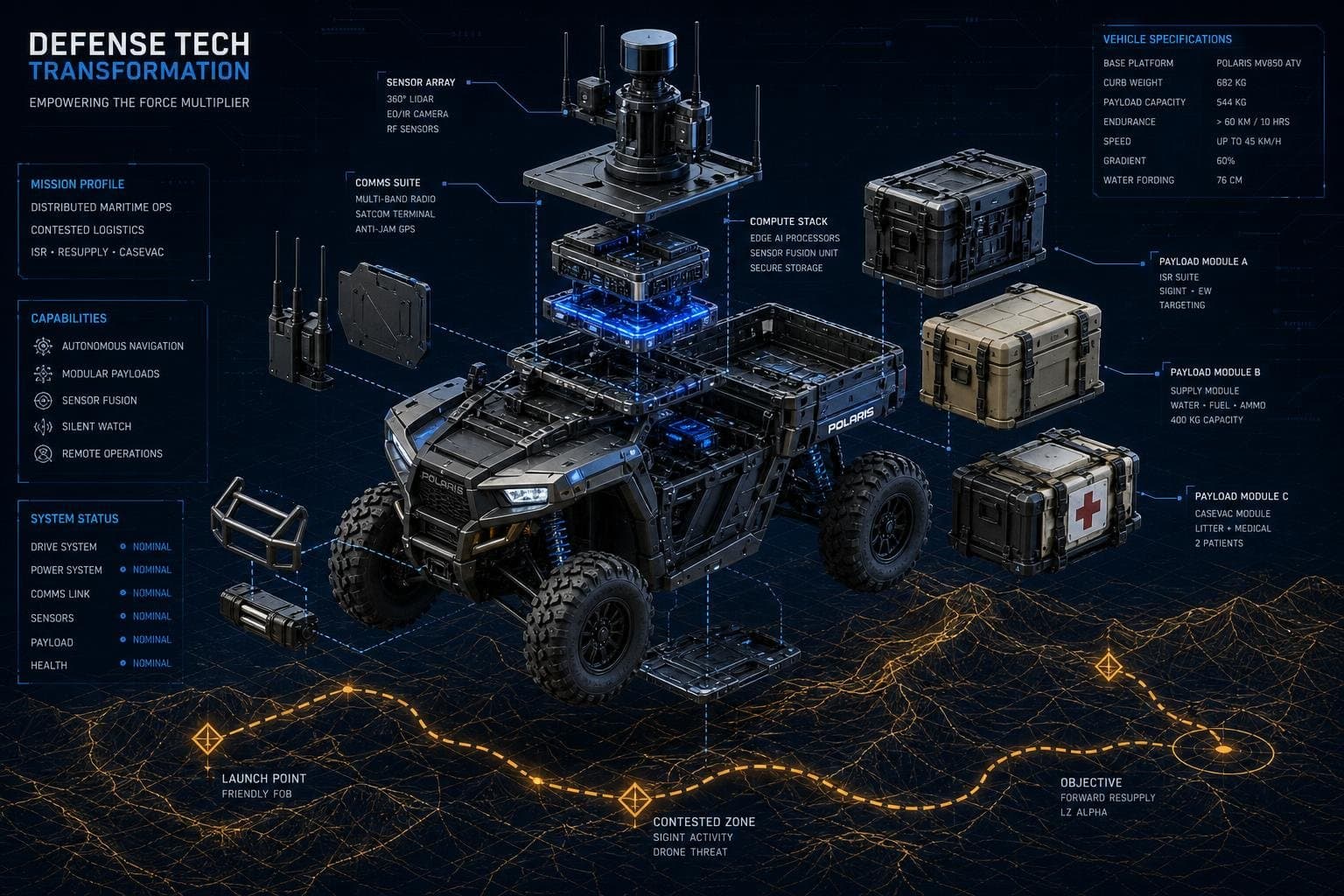

The assigned topic — venture-backed autonomous vehicle startups winning Marine Corps last-mile logistics contracts — points in the right direction, but the sources don't confirm a specific Marine Corps contract award. What they do confirm is something more interesting: the proof-of-concept phase is already over, and the operational data now exists to make that contract case compellingly.
777,440 Pounds of Cargo Is a Sales Pitch No Slide Deck Can Match
Forterra didn't announce a Marine Corps contract this week. What it announced was a combat record. According to TechCrunch, more than 100 of the company's autonomous Lancer vehicles — based on Polaris ATVs with a custom sensor and compute stack — have been operating in Ukrainian conflict zones for the past nine months. The numbers are specific enough to be uncomfortable for any legacy contractor trying to compete on paper specs: 2,500 miles driven, 1,100-plus missions completed, 777,440 pounds of cargo moved, 88 casualty evacuations.
That last figure matters most. Casualty evacuation under drone surveillance is exactly the scenario that keeps Marine Corps logistics planners up at night. The threat environment in Ukraine — where Sergeant Major Corey Wilkens, who leads an Army autonomous vehicle program, told TechCrunch that "there's nowhere to hide" from FPV drones, artillery, and mortar fire — maps almost directly onto the Indo-Pacific island-hopping scenarios the Marine Corps is actively designing for.
The Lancer's gas-powered drivetrain and 750-kilogram payload capacity aren't incidental details. Ukrainian forces were already fielding their own battery-powered UGVs limited to roughly 250 kilograms, per a Ukrainian soldier TechCrunch spoke with. Forterra's platform carries three times the load and doesn't die when the battery runs out mid-mission. The same soldier's assessment — "the most important UGV in Ukraine" — is the kind of unsolicited testimonial that procurement officers notice.
The Marine Corps Is Already Building the Ship That Needs the Robot
Here's the convergence worth watching. The same week Forterra's Ukraine deployment became public, Defense News reported that the Navy awarded a $2.2 billion contract to TOTE Services to manage construction of the new Medium Landing Ships — smaller, more agile vessels explicitly designed for Indo-Pacific island-hopping with troops, equipment, and supplies. The first LSM is scheduled for delivery in fall 2029.
Think about what that timeline implies. The Marine Corps is building the delivery mechanism for a distributed maritime operations concept that assumes contested logistics under persistent drone surveillance. The LSMs get troops and equipment to the beach. What moves supplies the last mile — from ship to fighting position, across terrain where a human driver is a target — is exactly the capability gap that autonomous ground vehicles fill.
Forterra's Ukraine data arrives at precisely the moment the Marine Corps is locking in the operational concept for those ships. That's not coincidence; that's the procurement window opening.
The Institutional Inertia Problem Has a Workaround Now
The traditional objection to fielding unproven autonomous systems in high-stakes logistics roles is the testing gap — you can't know how a vehicle performs until it's been stressed by real conditions. Forterra's Ukraine deployment eliminates that objection for the Lancer platform. The vehicles have been lost in combat (stuck in mud, targeted by Russian forces at leisure, per TechCrunch), which means the failure modes are documented. The modifications that made them operationally effective — including adding Starlink connectivity — are already incorporated.
Scott Sanders, Forterra's chief growth officer and a former U.S. Marine officer, put it plainly to TechCrunch: "Until you hit the realities of combat, you're just not going to know." The company now knows. That's a fundamentally different procurement conversation than a startup showing up with a prototype and a PowerPoint.
The broader investment thesis is also hardening. Defense News reported that Germany's Helsing just closed an $1.8 billion Series E — Europe's largest-ever defense startup round — at an $18 billion valuation, with investor demand exceeding available allocation. The capital flowing into autonomous and AI-driven defense platforms reflects a conviction that the Ukraine data is real and that Western militaries will act on it. Forterra's funding is U.S. defense dollars, per TechCrunch, which puts it in a different category than pure venture plays — the government is already a customer, not just a prospect.
The Marine Corps last-mile logistics contract hasn't been announced yet. But the operational case for it just got made in a Ukrainian conflict zone, the ship that needs the robot is now under contract, and the company making the robot has a former Marine as its chief growth officer. Watch for formal Marine Corps UGV solicitations tied to the LSM program timeline — the fall 2029 delivery date for the first ship suggests a procurement decision on autonomous logistics support needs to happen well before then.


