
A Saronic-built unmanned boat called Corsair has reportedly already been used in strikes against an Iranian submarine and a ship-maintenance facility, according to Breaking Defense. That detail, tucked into a photo caption, tells you more about where the Pentagon's money is actually going than most press releases do. The capability already exists in the field. What the Defense Innovation Unit just did is try to buy more of it, faster, and from more than one company.
DIU this week opened the second phase of its Suitable Warfighting Adaptive Payloads program for unmanned surface vessels — SWAP-USV, in the acronym-heavy house style — and the requirements list is the real story. It's not a wishlist for the future. It's a direct response to a problem the Navy is dealing with right now.
The Requirements Read Like a Confession
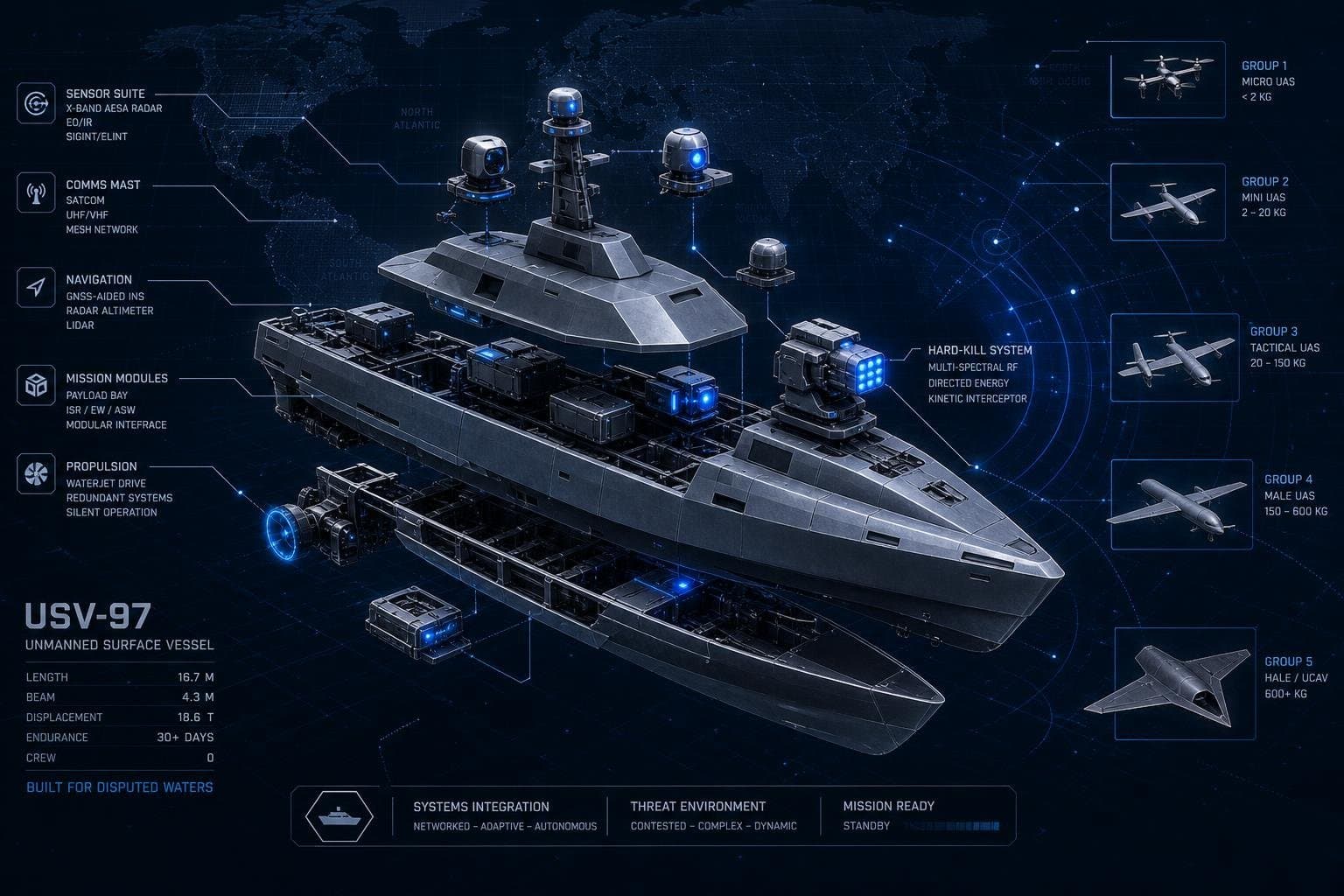
The program seeks "production-ready" USVs integrated with mature hard-kill counter-air effectors to address what DIU calls "a critical gap in affordable maritime air defense and organic fleet self-defense," per Defense Daily. Translate that out of procurement-speak: the Navy has been using expensive, exquisite ships to shoot down cheap drones, and the math doesn't work anymore.
Sprint 2 wants vessels carrying "clutter-resilient sensor suites" capable of hitting Groups 1 through 3 unmanned aircraft and rotary-wing threats, with the ability to reach larger Groups 4 and 5 systems listed as "highly desired" rather than required, according to Breaking Defense. The vessels need a minimum 200-nautical-mile range and a sustained 10-knot speed. Submissions are due November 30, with in-water testing starting in early 2027. A third and final sprint is expected to run from spring to summer 2027.
What I'd flag for investors: the goal is explicitly "favorably shifting the cost-exchange ratio" between a cheap drone threat and what it takes to stop one, per Breaking Defense. That's the whole thesis of counter-drone defense tech in one clause. The Pentagon isn't asking for a better missile. It's asking for a cheaper kill chain. Companies building toward exquisite performance at exquisite cost are solving a problem nobody's funding anymore.
The Money Is Real but Modest — On Purpose
Sprints 1 and 2 are each offering up to $40 million in prize money, with Sprint 3 capped at $20 million, according to Defense Daily. That's small by Pentagon standards and that's the design. DIU isn't trying to fund a company's existence — it's trying to buy proof, in water, on a 120-day clock, from whoever can actually deliver a working system. A startup that clears Sprint 2 walks away with a credible claim to Navy relevance that no amount of pitch-deck language can replicate. It's also a modest ask against a defense-tech capital environment where, more broadly, private investors are growing choosier about which bets justify billion-dollar valuations, as Bloomberg has tracked across the wider venture and private-equity market this year.
The Same Instinct Shows Up in Cyber, Not Just at Sea
The pattern isn't confined to ship-killing drones. The Air Force just awarded a $332.8 million contract to Enlighten IT Consulting, an HII subsidiary, to tie its Integrated Defensive Cyber System into the Joint Cyber Warfighting Architecture, running through September 2032, according to defence-blog. The mechanism matters as much as the dollar figure: the Air Force bought this through a Commercial Solutions Opening on the Tradewinds Solutions Marketplace, a platform that lets vendors pitch — sometimes via short video — and lets the government move faster than a traditional solicitation allows, per the same defence-blog report.
Put the two stories side by side and a pattern emerges that goes beyond any single domain. Whether it's a maritime prize challenge or a commercial-pitch contract vehicle, the services are converging on the same workaround: skip the multi-year requirements document, define the problem narrowly, and let companies prove they can solve it on a compressed clock. That urgency isn't happening in a vacuum — it's unfolding against a backdrop of unresolved great-power tension, with Washington still negotiating the shape of a Ukraine settlement even as it pushes hardware out the door, per Reuters video coverage of the ongoing diplomacy.
That doesn't mean the legacy procurement machine is going away. The same week DIU opened Sprint 2, the Pentagon signed a framework with BAE Systems for up to 25,000 APKWS guidance kits a year, a deal Congress still has to fund, according to Defense News. Big, multiyear, incumbent-heavy — the opposite shape of a DIU sprint. Both tracks are running simultaneously, which is the honest picture of where defense acquisition sits right now: fast commercial pathways for problems that need answers in months, and traditional framework deals for the munitions base that takes years to scale regardless of who's building it.
For the companies chasing Sprint 2, the clock is the thing to watch — submissions close November 30, and whoever gets picked for in-water testing in early 2027 will have a real claim on Navy budget conversations well before the fiscal year is out.


