
The math problem is almost embarrassingly simple. A U.S. ally once fired a $3 million Patriot missile to destroy a $200 consumer drone. The missile worked. The economics didn't. As drones have reshaped modern warfare, that mismatch has gone from an anecdote to a strategic liability — traditional air defense systems designed for human-piloted aircraft are badly mismatched against cheap, proliferating UAS threats.
Directed energy was supposed to fix this. Lasers draw from a generator or a ship's reactor — no magazines to exhaust, no per-shot cost measured in millions. The technology has been in development for decades. So why isn't it fielded at scale?
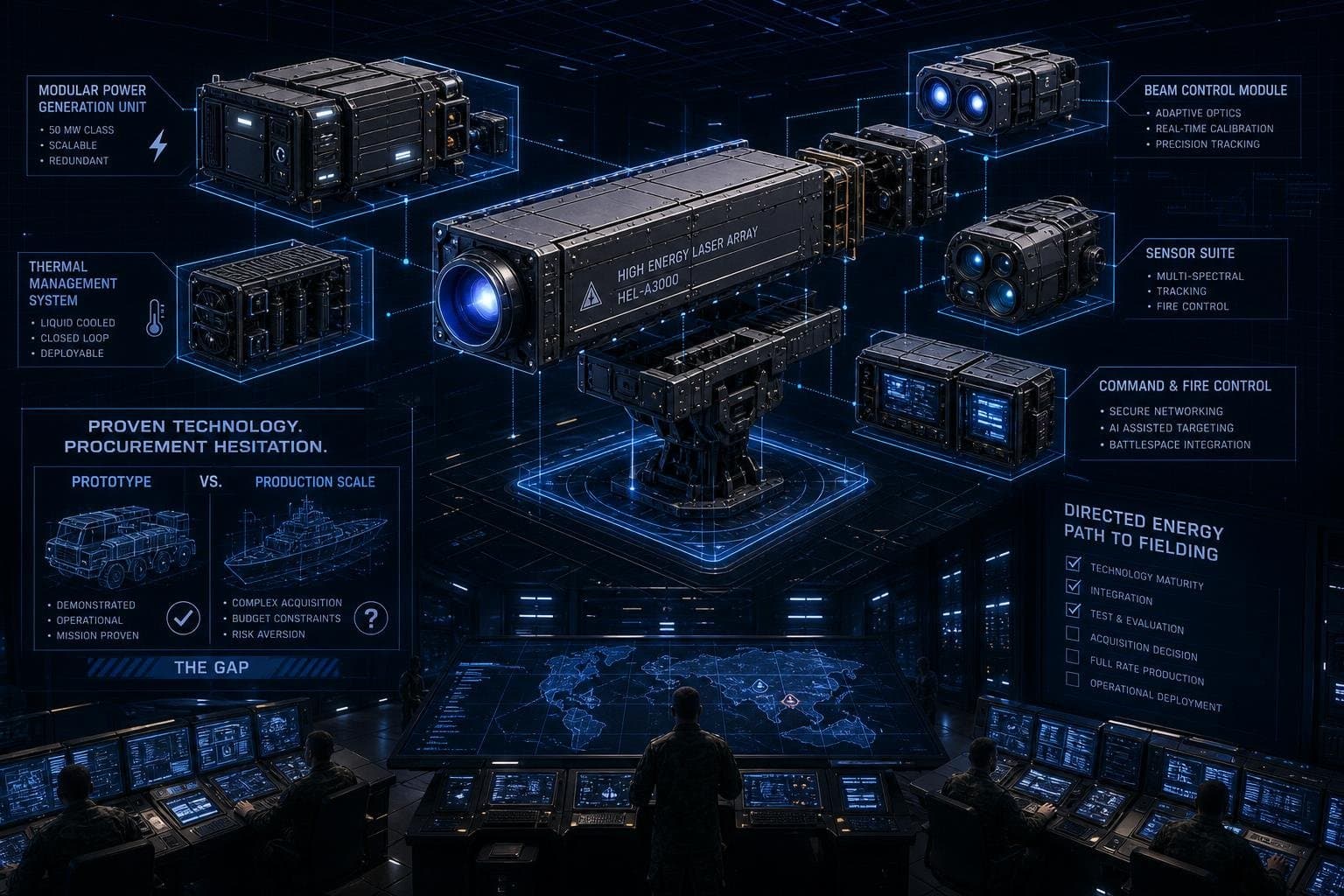
The answer, according to the Pentagon's own head of critical technologies, is procurement will, not physics.
The Technology Is Ready. The Services Aren't.
Mike Dodd, the assistant secretary of defense for critical technologies, made the case plainly at the National Defense Industries Association's Emerging Technologies Conference in August: the technology is proven and ready to scale, but the military services haven't committed to buying it in the quantities that would drive costs down.
"The cost per system is still high. That's because we're not scaling the systems," Dodd said. His office funds the early prototypes — "onesies-twosies, maybe up to low dozens" — but the services need to step up and procure by the dozens or hundreds before unit economics improve.
The Army has moved first. It awarded a contract to AeroVironment for the 30-kilowatt Enduring High Energy Laser program, and it has agreed to transition the Joint Laser Weapon System to a program of record. For JLWS, the Pentagon selected nLight and Lockheed Martin to develop prototypes — a pairing that reflects the current state of the industry: established defense primes working alongside specialized laser component companies.
The Army's use case is relatively tractable: counter-drone roles at lower wattage. The threat is dense, the targets are small, and the cost-per-shot argument is overwhelming. Dodd's office is "paying the most attention to counter-UAS," and the Army's buy-in reflects that priority.
The Air Force and Navy Are a Different Problem
Dodd says he's now targeting the Navy and Air Force — and both present harder challenges than the Army did.
The Navy wants systems at hundreds of kilowatts to a megawatt, with Chief of Naval Operations Adm. Daryl Caudle telling Aviation Week he needs that power level to counter cruise missiles threatening the fleet. That's a fundamentally different engineering problem than shooting down a small drone. The Navy has expressed interest but wants to be further convinced that the technology can scale to the wattage it actually needs — a skepticism that reflects how active conflict zones, including ongoing Houthi drone and missile campaigns in the Red Sea, are stress-testing existing air defense economics in real time.
The Air Force's situation is more complicated still. The service is simultaneously running a major procurement transformation — its Massed Modular Aircraft program, run with the Defense Innovation Unit, is trying to field cheap, attrition-tolerant replacements for the MQ-9 Reaper. Startup Swarm Aero, which debuted its Gamera drone at the Air and Space Forces Association conference this week, is pitching the Air Force on a platform optimized for extreme range over survivability — explicitly trading stealth and protection for distance and cost. The MMA program has set a target unit cost of $10 million a copy, a figure that reflects a service betting on mass and cheapness rather than permanence.
It's not obvious that a service committing to cheap, expendable aircraft is also going to commit to expensive directed energy ground systems in the near term. The Air Force is pursuing two procurement philosophies simultaneously. Directed energy fits the precision-and-permanence side. Whether the service has the budget and appetite for both is the open question Dodd's office hasn't answered yet.
Where Fusion Startups Enter the Picture
One underappreciated development: fusion power startups are increasingly finding defense applications as their primary climate-tech funding has stalled. Laser-based fusion companies are natural partners for directed energy weapons development — their core technology involves generating and focusing extremely powerful laser pulses.
Xcimer, a Denver-based startup that operates what it describes as the largest privately owned laser system in the world, recently announced a partnership with and investment from RTX Ventures, the venture arm of the Raytheon parent company. Pacific Fusion, meanwhile, signed a memorandum of understanding with the National Nuclear Security Administration for high-energy-density fusion experiments and broke ground on a demonstration facility in New Mexico near the Sandia and Los Alamos National Laboratories.
Neither of these is a direct Air Force tactical laser contract. But they represent the upstream technology pipeline that eventually feeds into fielded weapons — and the prime contractors' interest in laser-based fusion startups signals serious thinking about where next-generation directed energy power sources come from.
The Procurement Gap Is the Story
I've written before about directed energy moving past the demo phase. What Dodd's August comments confirm is that the deployment problem is exactly what it appeared to be: not technical readiness, but service-level procurement commitment.
The venture-backed startup story in directed energy is real, but it's upstream — laser components, power systems, fusion-adjacent technology. The contracts that will actually field systems at scale are going to flow through programs of record, and those require service buy-in that the Army has provided and the Air Force and Navy haven't yet matched.
Watch for whether the Air Force's MMA program acceleration — officials said in early September they've been tasked to speed up fielding — creates budget pressure that delays directed energy commitments, or whether counter-drone urgency forces both priorities forward simultaneously. That tension will define the next 18 months of Air Force modernization more than any single contract award.


