
Everyone in this sector loves to talk about the capital flood into defense tech. Fewer people want to talk about where that capital refuses to go.
A new study from the Aerospace Industries Association and Bain & Company, built on 50 interviews with primes, startups, investors and banks, lands on a line that should reframe how every reader of this newsletter thinks about the munitions bottleneck conversation: "Defense does not face a shortage of capital. It faces barriers that make expanded investment, particularly in critical bottleneck areas, more difficult," per Breaking Defense. Venture funding into defense has grown roughly tenfold since 2019, the study found, and public aerospace-and-defense market capitalization has nearly doubled 2019 levels to around $1.6 trillion in 2025. That is not a capital-starved sector. That is a sector awash in capital that keeps missing the parts of the supply chain that actually determine how fast a Patriot battery gets rebuilt or a solid rocket motor gets cast.
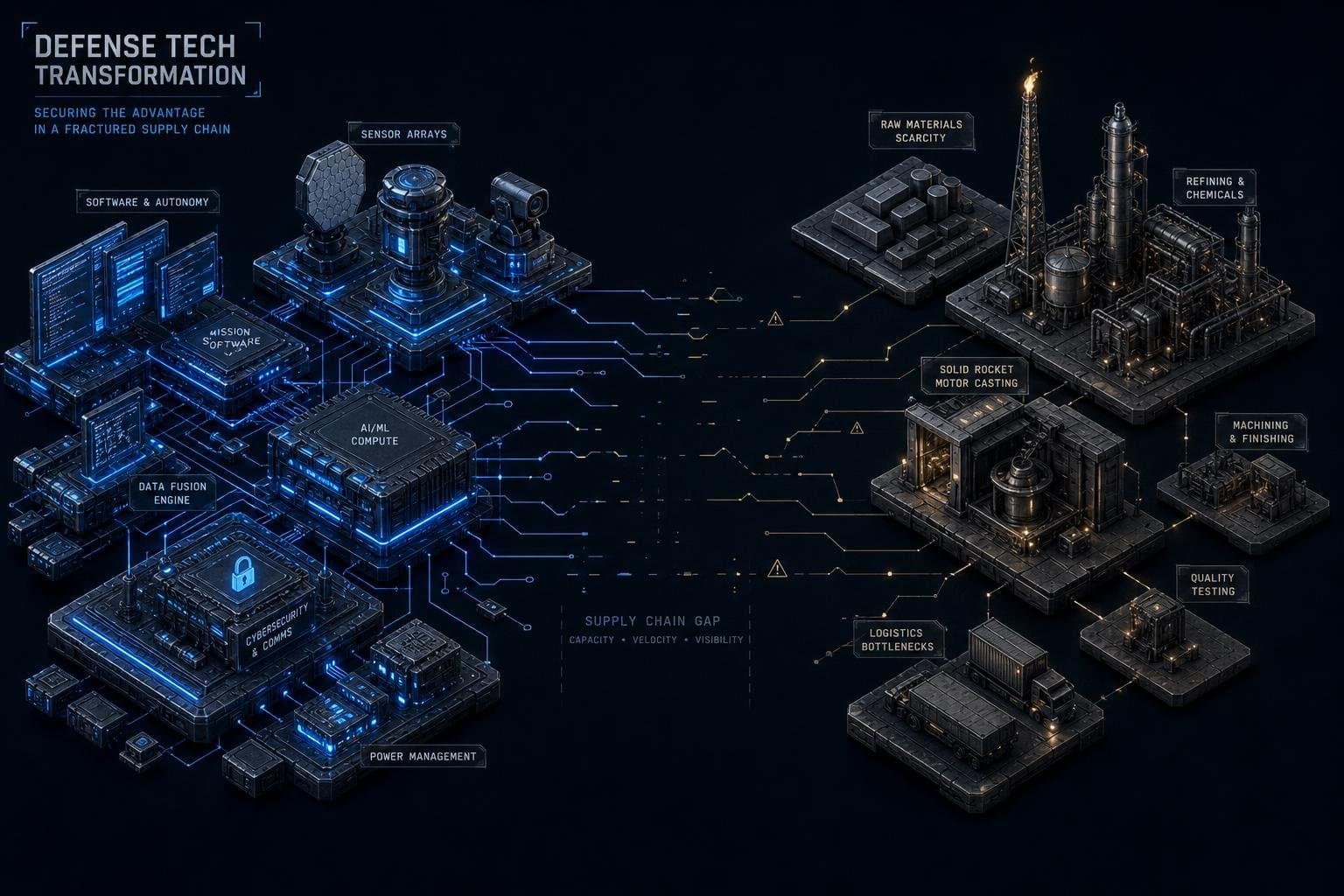
This is the real story hiding inside the "munitions bottleneck" topic. It is not that nobody wants to fund munitions. It is that the money chasing defense tech has sorted itself toward software, autonomy and sensors — the sexy, fast-iterating, VC-shaped parts of the business — while the unglamorous industrial inputs that actually gate production (critical minerals, semiconductors, solid rocket motors) sit in a financing dead zone, according to the same AIA-Bain analysis.
The Gap Is Specific, Not Abstract
AIA President Eric Fanning told Breaking Defense that the problem is less about volume of capital and more about matching: "Venture capital, private equity, retirement funds — they're all looking for different things, and you want to create that mix of investment return possibilities to attract that diversity of investment," per Breaking Defense. The study singles out domestic refining of critical minerals like gallium and germanium — inputs that show up in missiles, radar and magnets — as one of the "unseen gaps" that VC money structurally avoids. Venture firms want returns on five-to-seven-year horizons from software margins. A gallium refinery is a capital-intensive, decade-horizon bet with commodity-like returns. No venture fund is built to hold that position, and private equity, which is built for exactly that kind of patient industrial capital, has been largely untapped by defense so far, the study found.
That mismatch is the actual bottleneck. It is not that the Pentagon lacks money for munitions. It is that the financial instruments best suited to fund slow, capital-intensive production capacity have not yet found their way into the defense industrial base at scale.
Blackstone Just Showed What the Right Kind of Capital Looks Like
Which makes the timing of Blackstone's move this week instructive. Blackstone is committing roughly $1 billion in debt and equity to combine two companies it has acquired — Applied Systems Engineering and Technology Service Corp — into a single defense-technology venture aimed at the kind of production capacity strained by "inexpensive drones and other weapons that can be broadly deployed," according to Bloomberg. This is not a venture check into a 25-person startup pitching a slide deck. It is private equity doing what AIA-Bain says private equity should be doing more of: using patient, large-denomination capital to consolidate and scale existing production assets rather than funding another point solution.
I'd argue this is the shape of the next wave of defense investing that actually matters for the munitions question — not another Series B for a loitering munitions startup, but PE-scale roll-ups of the unglamorous engineering and manufacturing firms that make the parts nobody tweets about. The AIA-Bain study calls this out directly: the industrial base needs capital that can wait a decade, not capital that needs a Series D story by year four.
Contrast that with Protego Ventures, the Israeli defense-tech VC that just closed its debut fund at $125 million, per TechCrunch. Protego writes $5 million to $15 million checks into startups like drone maker XTEND and situational-awareness firm ASIO. That is exactly the kind of capital the AIA-Bain study says defense already has plenty of — fast-moving venture money chasing software-and-sensor startups with clear commercial analogs. Protego is a well-run fund doing exactly what venture funds do well. It is simply not the capital the munitions bottleneck needs. Co-founder Lital Leshem told TechCrunch the fund deliberately stayed smaller than its $150 million target so a single "fund maker" win like XTEND wouldn't get diluted — a VC logic that makes perfect sense for software and makes almost no sense for a gallium refinery.
Put the two deals side by side and you get a clean illustration of the AIA-Bain thesis: venture capital is overflowing into the parts of defense tech that look like normal startups, while the capital-intensive industrial base waits for PE-style vehicles like Blackstone's to show up in meaningful volume.
Why This Matters Right Now, Not Hypothetically
The urgency here isn't abstract. The U.S. military in recent weeks sent two additional Patriot missile batteries to protect energy facilities in Saudi Arabia and Qatar, reassurance moves tied to the possibility that President Trump could resume strikes on Iran, according to Axios. Every Patriot battery deployed forward is a battery drawn down from a production and sustainment pipeline that depends on exactly the inputs AIA-Bain flags as underfunded — specialty electronics, propellants, the kind of components that don't scale by writing a bigger check to a software company.
Meanwhile, on the aircraft side, the Air Force's $2.38 billion Lot 7 contract with Boeing for 22 F-15EX jets was explicitly shaped by "the effects of the 2025 production disruptions and inflation in the defense industrial base," per Defense News. Brig. Gen. Timothy Helfrich called it "a disciplined approach to executing available resources while balancing the realities affecting defense production." That is Pentagon-speak for: the industrial base is still catching up, and procurement officers are structuring contracts around that reality rather than pretending it away.
Read against the AIA-Bain findings, both data points say the same thing. Demand for munitions and production capacity is real and immediate. The capital to fix the upstream constraints — minerals, motors, components — is not flowing at the pace demand requires, even while headline VC numbers into defense tech look spectacular.
The Policy Wildcard: Project Meridian
There's a reason to watch the Pentagon's newly announced Project Meridian closely on this exact question. Defense Secretary Pete Hegseth tapped Elon Musk, Anduril co-founder Palmer Luckey, and former House Speaker Newt Gingrich to co-lead a 120-day effort to study "the battlefields of the future" and the technologies warfighters will need, working under DoD CTO Emil Michael, according to TechCrunch and Bloomberg. Hegseth also announced a new Autonomous Warfare Command alongside the project.
Here's my concern as an investor-minded reader: Musk and Luckey represent exactly the fast-iteration, software-and-autonomy wing of defense tech that already attracts capital in abundance. If Project Meridian's 120-day findings tilt toward more autonomous systems and strike drones — which is where both men's companies already compete — it will reinforce the capital misallocation the AIA-Bain study just diagnosed rather than correct it. The Ukrainian model offers a useful counterpoint: former Defense Minister Mykhailo Fedorov's new "Army of Robots" initiative explicitly plans three tracks — sensors and robots, cheaper anti-drone missiles, and AI strike systems — built around investing in companies with "weapons that have already been tested and shown some market viability," he told Defense News. Even Fedorov's wartime urgency defaults to backing proven production, not just promising prototypes — a discipline the U.S. industrial base could use more of.
What to Watch
The real test of whether this capital-allocation problem gets fixed will show up in deal structure, not deal volume. Watch whether Project Meridian's 120-day findings, due roughly in late January, name specific production-capacity gaps rather than just new weapons concepts. Watch whether more PE shops follow Blackstone's lead into industrial roll-ups rather than another wave of venture-style defense funds chasing the next XTEND. And watch whether the AIA-Bain recommendations actually move Congress or the Pentagon to create the kind of incentive structures — loan guarantees, multi-year offtake agreements, co-investment vehicles — that make a gallium refinery as investable as a drone startup.
The munitions bottleneck isn't a funding story in the way the headlines want it to be. It's a matching problem — plenty of capital, aimed at the wrong half of the supply chain. Whoever solves that matching problem first, prime or startup or private equity shop, is going to own the most durable advantage in this sector for the next decade.


