


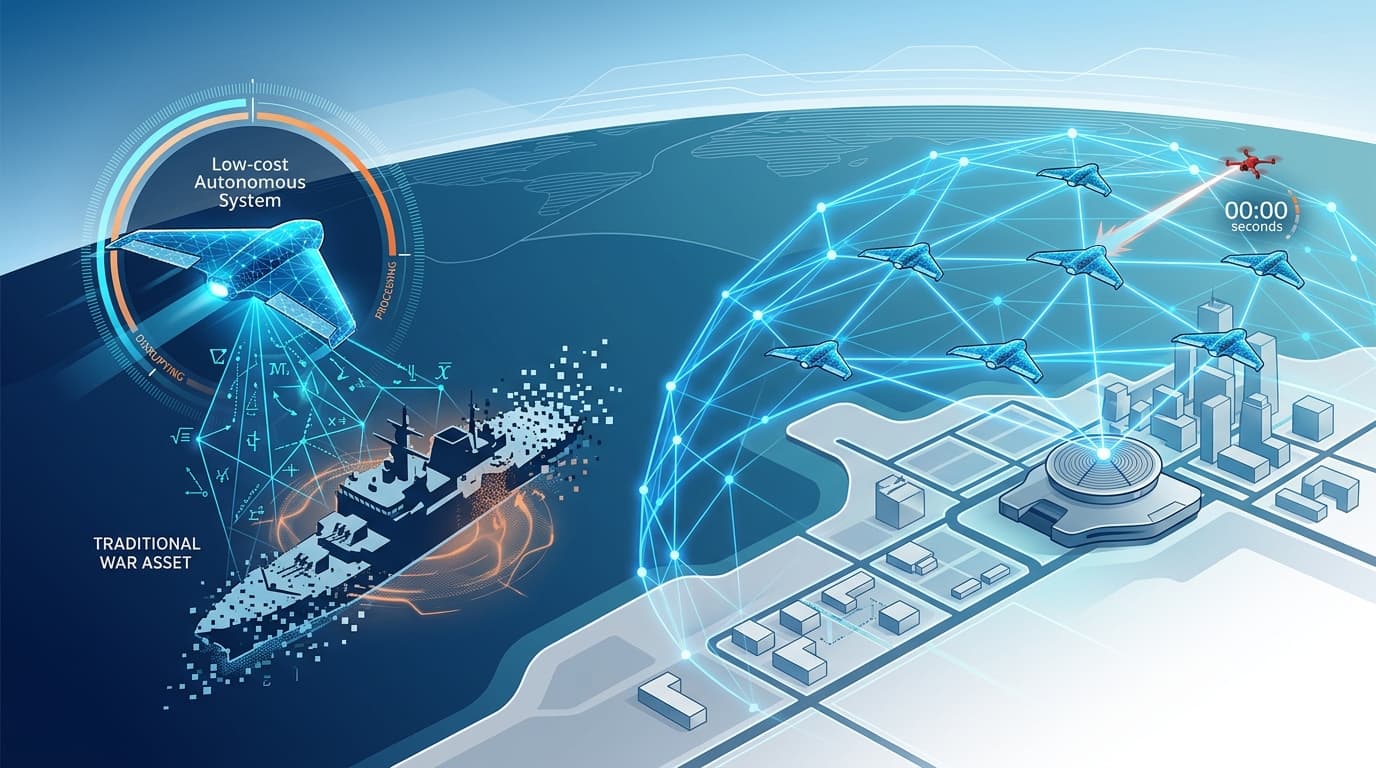

The calculus used to be simple: bigger platforms, longer range, more payload. A carrier strike group projected power because nothing else could reach that far and survive. That logic is breaking down, and Breaking Defense captured the shift bluntly — autonomy and networked systems now allow thousand-dollar consumer electronics to destroy multi-million-dollar conventional weapons systems.
That sentence should unsettle every defense planner still thinking in legacy platform terms.
The Lattice Award Is a Signal, Not Just a Contract
When the Army awarded Anduril an $87 million task order to deploy its Lattice software as the command-and-control backbone for counter-drone operations, the dollar figure was almost beside the point. What matters is what Lattice actually does: integrate sensors and effectors to detect, track, classify, and engage drone threats in seconds. That's not a procurement story — it's a force multiplication story. One software layer, distributed across a network, compressing the kill chain to a timeframe no human-in-the-loop system can match.
Anduril President Matthew Steckman was careful to note the $20 billion contract vehicle attached to this award carries no guaranteed money. But the architecture it establishes — an à la carte ordering guide for autonomous, AI-enabled capabilities across the entire federal government — is the real prize. Friction reduction at that scale changes what's operationally possible.
Meanwhile, Shield AI just raised $2 billion at a $12.7 billion valuation, more than doubling its worth on the back of its Hivemind autonomous flight software. The market is pricing in a world where autonomous systems aren't a niche capability — they're the backbone of future force projection.
The investor thesis here is straightforward: if autonomy compresses the cost curve for offensive capability while simultaneously threatening expensive legacy platforms, then the companies building the software layer that manages autonomous systems at scale are sitting on enormous strategic leverage. Not leverage as a buzzword — leverage as in: whoever controls the C2 software controls the operational tempo.
The policy framework hasn't caught up. As DefenseScoop noted, the Pentagon still relies on vague guidance about "appropriate levels of human judgment" rather than statutory rules governing autonomous lethal systems. That ambiguity is a risk — but it's also, for now, what's allowing the Anduril and Shield AI deals to move at the speed they are.
Watch for how JITF-401 structures its next Lattice task orders. The first award defined the architecture. The next ones will reveal whether the Army is actually willing to let the system operate at machine speed — or whether institutional caution quietly reinserts the human bottleneck that autonomy was supposed to eliminate.