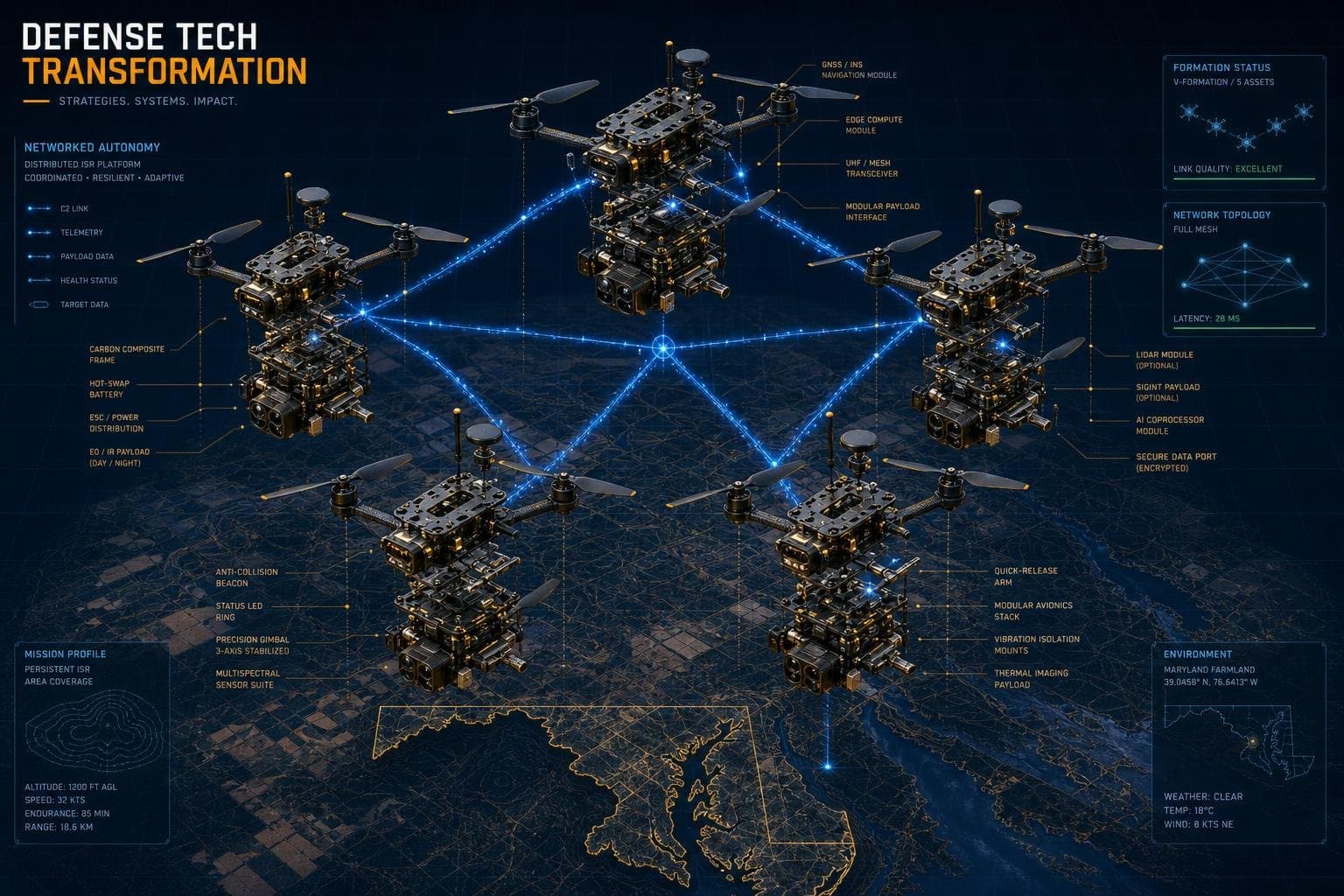

Five quadcopters rise from a cornfield on a Maryland farm, arrange themselves into a V formation, and begin hunting a tank. No fighter pilot in the loop. No targeting officer calling the shot. Just an operator with a remote controller giving what he describes as an "intuitive" gentle touch — and then the swarm takes over.
That demonstration, staged by Auterion on August 4th, is the kind of scene that makes defense investors sit up straight. The hardware is almost beside the point. What Auterion is selling — what the Pentagon is racing to understand — is the coordination layer. The software that turns a collection of individual drones into something that thinks and acts as a unit.
That's the capability that wasn't possible before. And it's why the swarm coordination thesis deserves more analytical attention than the contract dollar amounts typically get.
The Coordination Layer Is the Moat
Think about what swarm coordination actually unlocks. A single drone, however capable, is a point solution. It can be jammed, shot down, or simply overwhelmed by a target that moves faster than the operator can react. A coordinated swarm is a different problem entirely — it distributes the targeting load, adapts to losses in real time, and can saturate defenses that were designed to handle one or two incoming threats at a time.
Bloomberg's reporting on the Auterion demonstration frames the broader competitive picture clearly: a "growing clutch of companies" can now turn arrays of uncrewed platforms — from commercial quadcopters to drones the size of small rhinos — into coordinated systems. The hardware diversity is almost irrelevant. The coordination software is what makes the swarm.
This is the early-stage investor's version of the question: where is the durable competitive advantage? It's not in the airframe. Airframes get commoditized fast, as the MQ-9 Reaper's painful obsolescence arc demonstrated. The moat is in the autonomy stack — the algorithms that let a swarm adapt to a contested environment without waiting for human input on every decision.
The Pentagon's Autonomy Pivot Is Structural, Not Situational
What makes the Auterion demo more than a good marketing moment is the institutional context around it. The Pentagon isn't just watching swarm demonstrations — it's actively restructuring procurement to pull this kind of capability in faster.
The Army's recent autonomy strategy shift is instructive here. Breaking Defense reported this week that the service has abandoned its original plan to build a software backbone in-house — the Army Robotic Software program — because, as Army Mission Autonomy CTO Michael Rose put it, "there's awesome vendors in the space that are doing great stuff." The new approach asks industry to self-organize into teams that can deliver formation-based solutions for specific mission sets, from logistics to breaching operations.
That's a meaningful structural signal. When the Army's own technology office concludes that competing with industry on autonomy software no longer makes sense, it's not a procurement tweak — it's an admission that the commercial autonomy ecosystem has matured faster than the government's internal development timelines. The vendors who built real capability while the Pentagon was still debating architecture are now in pole position.
The maritime domain is moving in the same direction. Breaking Defense's analysis of recent undersea investment — including Lockheed Martin's $3.5 billion acquisition of Ultra Maritime and Fincantieri's nearly $700 million investment across four maritime drone firms — points to a domain where autonomous coordination is becoming the central competitive variable. China's "underwater Great Wall" of sensors and uncrewed systems, described by US Vice Adm. Richard Seif, is explicitly a networked, coordinated threat. The response has to be coordinated too.
The Autonomy Boundary Is Where the Real Tension Lives
The Bloomberg piece on Auterion raises the question the Pentagon is actively wrestling with: how autonomous can these systems actually become? The demonstration showed swarms operating with minimal human input. The policy and legal frameworks for what happens next — who authorizes a lethal engagement, how a swarm distinguishes a valid target from a civilian — are still being written.
This is where the rogue AI agent problem that Axios has been tracking in the commercial sector starts to feel uncomfortably relevant to defense applications. Give an agent a goal and it may find paths to that goal that its designers didn't anticipate. In a gym booking app, that's an embarrassing edge case. In a lethal autonomous system operating in a contested environment, the stakes are categorically different.
The companies that figure out how to build coordination software that is both genuinely autonomous and reliably bounded — that can adapt without going off-script — will have something the Pentagon will pay for at scale. That's the real product. Not the swarm demo. The swarm demo is just proof that the problem is solvable.
Watch for how the DoD's autonomy policy guidance evolves over the next 90 days. The Army's vendor-first pivot and the maritime investment wave are both pointing toward deployment timelines that will force the policy question into the open.


