


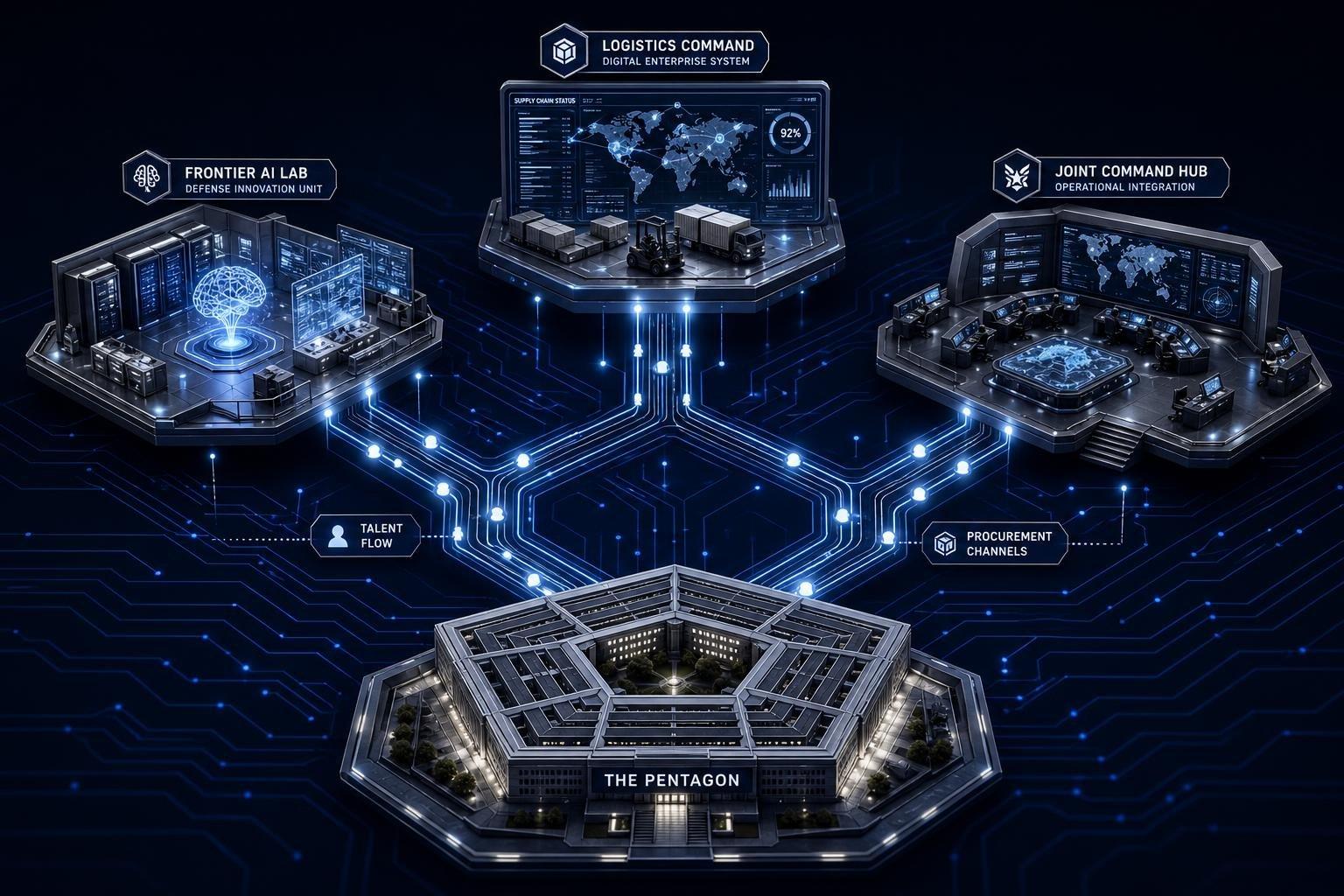

Three things happened in the same week that tell you more about Army modernization than any single program announcement could. A former Army Secretary took a job at an AI company. A CRM giant bought a battlefield logistics startup for $375 million. And a state's entire congressional delegation signed a letter begging the Pentagon to put a new four-star command on its soil. None of these are about Next Generation Command and Control specifically — I covered NGC2's contract structure last month and the source pool this week doesn't give me new specifics on that program to build on. But together, these three stories are the clearer signal of what "doors opening for startups" actually looks like inside the Army right now.
The Talent Pipeline Is Now Running Both Directions
Dan Driscoll resigned as Army Secretary in August after repeated clashes with Defense Secretary Pete Hegseth. This week, OpenAI announced he's joining the company as senior counselor for national security and modernization, tasked with expanding AI use for national and cyber security work, per Bloomberg.
I think this matters more than it looks like on the surface. The traditional defense-industry revolving door sends retired generals to Lockheed and Raytheon board seats. Driscoll going to a frontier AI lab — not a defense prime, not a venture fund — is a different kind of door. It tells you where the Pentagon's own leadership thinks the next generation of military advantage actually gets built: not necessarily inside the five-sided building, but at the companies writing the models. If that pattern holds, expect more senior DoD officials to land at AI labs rather than contractors over the next year, which should worry the primes more than any single contract loss.
Acquisition Reform Is the Real Story Out of AUSA
The Association of the United States Army's annual meeting this month put acquisition reform, not any single program, at the center of the conversation. Breaking Defense's after-action coverage framed the event around "autonomous warfare and drone innovation to acquisition reform and defense industrial base challenges" as the throughline of where Army leadership is pointing the force, per Breaking Defense. Defense News' own conference wrap framed it similarly — companies "of all sizes" showcasing capability as the Army "seeks new capabilities and advanced systems amid rapid change," per Defense News.
That phrase — companies of all sizes — is the tell. A decade ago, AUSA was a trade show for the five primes plus a handful of ammunition and vehicle suppliers. Now acquisition reform gets equal billing with hardware, because the Army has figured out that its procurement rules, not its budget, are the bottleneck on getting new autonomous and software capability into units faster. I'd argue that's the actual "door opening" story this cycle: not a single command-and-control contract, but an institutional posture where reform is treated as co-equal with capability.
The New Command Everyone Wants to Host
That reform logic showed up concretely in the fight over where the Pentagon's new Autonomous Warfare Command (AUTOWARCOM) will sit. North Carolina's congressional delegation, business groups, and the N.C. Chamber are lobbying Defense Secretary Hegseth to headquarter it there, pointing to drone testing already happening with Special Forces and the 82nd Airborne at Fort Bragg and the Marines at Camp Lejeune, per Axios. States don't lobby this hard for back-office commands. They lobby for the ones that pull in contractors, testing infrastructure, and a permanent flow of procurement dollars.
Meanwhile, Salesforce's acquisition of Rune Technologies — a four-year-old startup building AI logistics prediction software for the military, bought for $375 million after raising just $30 million total — shows the capital side of the same shift. Salesforce's Missionforce defense unit has grown 80% year over year on the back of a 10-year, $5.6 billion Army contract, and buying Rune lets it push from back-office planning into frontline battlefield logistics, per TechCrunch.
None of these three stories is the NGC2 headline I'd set out looking for. But a Secretary moving to an AI lab, a CRM company buying its way into frontline logistics, and a state fighting for an autonomous command headquarters describe the same underlying mechanism: the Army's doors for new entrants are opening through reform posture and acquisition dollars, not through any single marquee program. Watch where AUTOWARCOM's headquarters decision lands — that pick will tell you which region becomes the next hub for autonomy contractors chasing Army money.