



The Army just admitted, on the record, that its flagship command-and-control modernization effort didn't work the first time it left the lab. That's not a scandal. It's the most useful data point in defense tech this month.
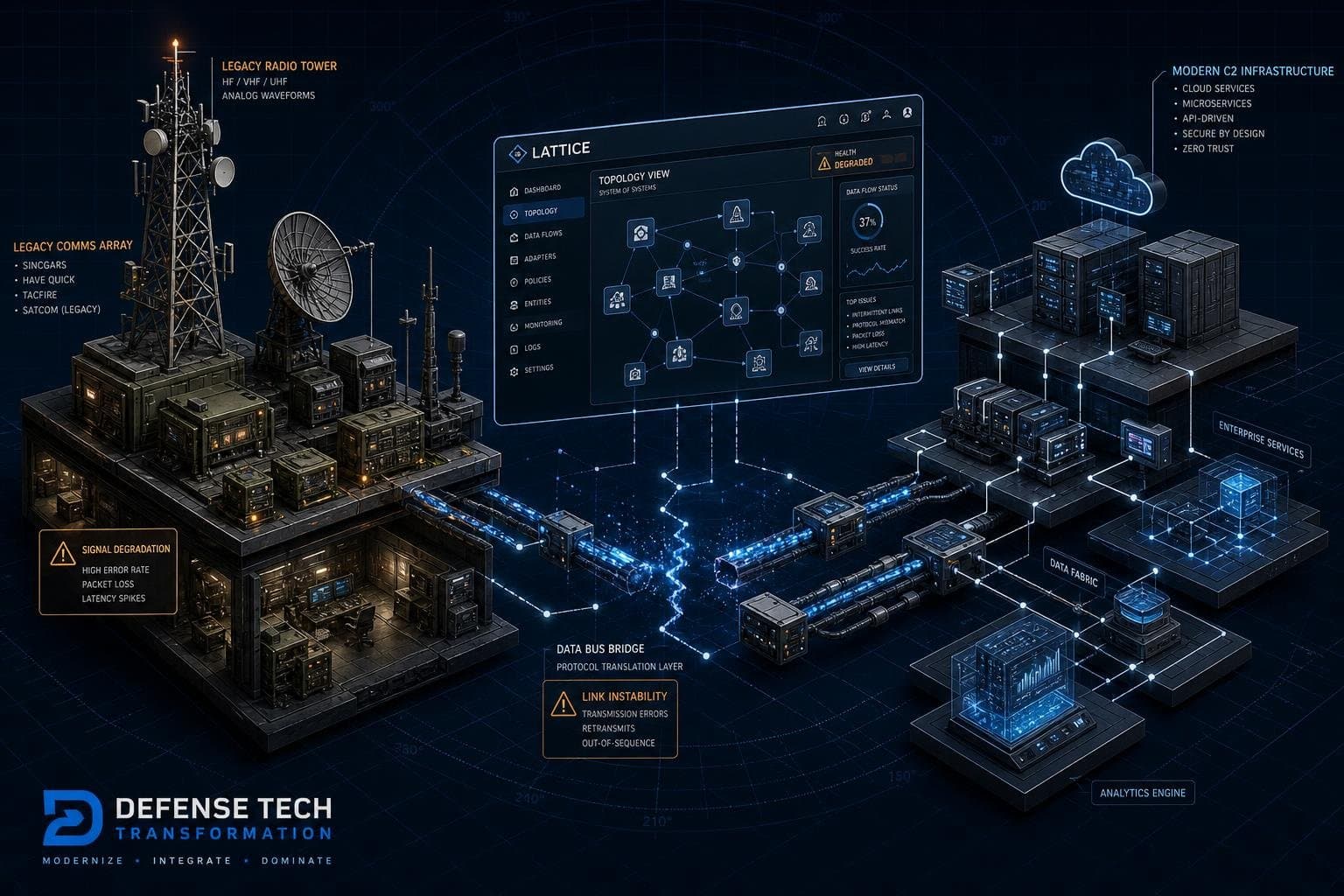
When the 25th Infantry Division tried running Anduril's Lattice platform during a field exercise in Hawaii called Lightning Surge 5, "it wasn't seamless, and we learned a lot," Brig. Gen. Shane Taylor told Breaking Defense. Lockheed Martin, which served as integrator on that portion of the Next Generation Command and Control build, was more blunt: scaling the Lattice software to pass data through legacy radio systems "just is not at the state it should be right now," according to Lockheed's Chandra Marshall, speaking to Breaking Defense. An Anduril program manager acknowledged the friction too, pointing to limitations in the Army's TSM radio architecture rather than the software itself.
This is worth sitting with, because the surrounding narrative at this year's AUSA conference was pure acceleration. Defense Secretary Pete Hegseth told attendees the Pentagon wants to scale autonomous and robotic systems from thousands of units into the millions, backed by roughly $50 billion in requested reconciliation funding, per Defense News. The Army stood up a new Futures and Autonomous Systems Command the same week. Everyone on stage was talking velocity. Meanwhile, out at Schofield Barracks, the actual plumbing between a venture-backed software platform and decades-old Army radios was buckling under real-world load.
I don't read this as a knock on Anduril. Every company that moves fast runs into legacy hardware that wasn't built to talk to anything new — that's the whole premise of modernization. What it tells you is where the real bottleneck sits right now: not in autonomy algorithms or drone swarm logic, but in the unglamorous layer of radios, data buses, and network architecture that nobody puts on a conference floor display. Compare that to the DIU's new unmanned surface vessel challenge, which is explicitly demanding "interoperable command-and-control architectures" as a submission requirement, not an afterthought. DIU learned the lesson the Army is living through in real time.
The companies worth watching next aren't just the ones building the flashiest autonomous platform. They're the ones solving the boring interoperability problem underneath it — because until that's fixed, every swarm demo is a demo, not a deployed capability.