


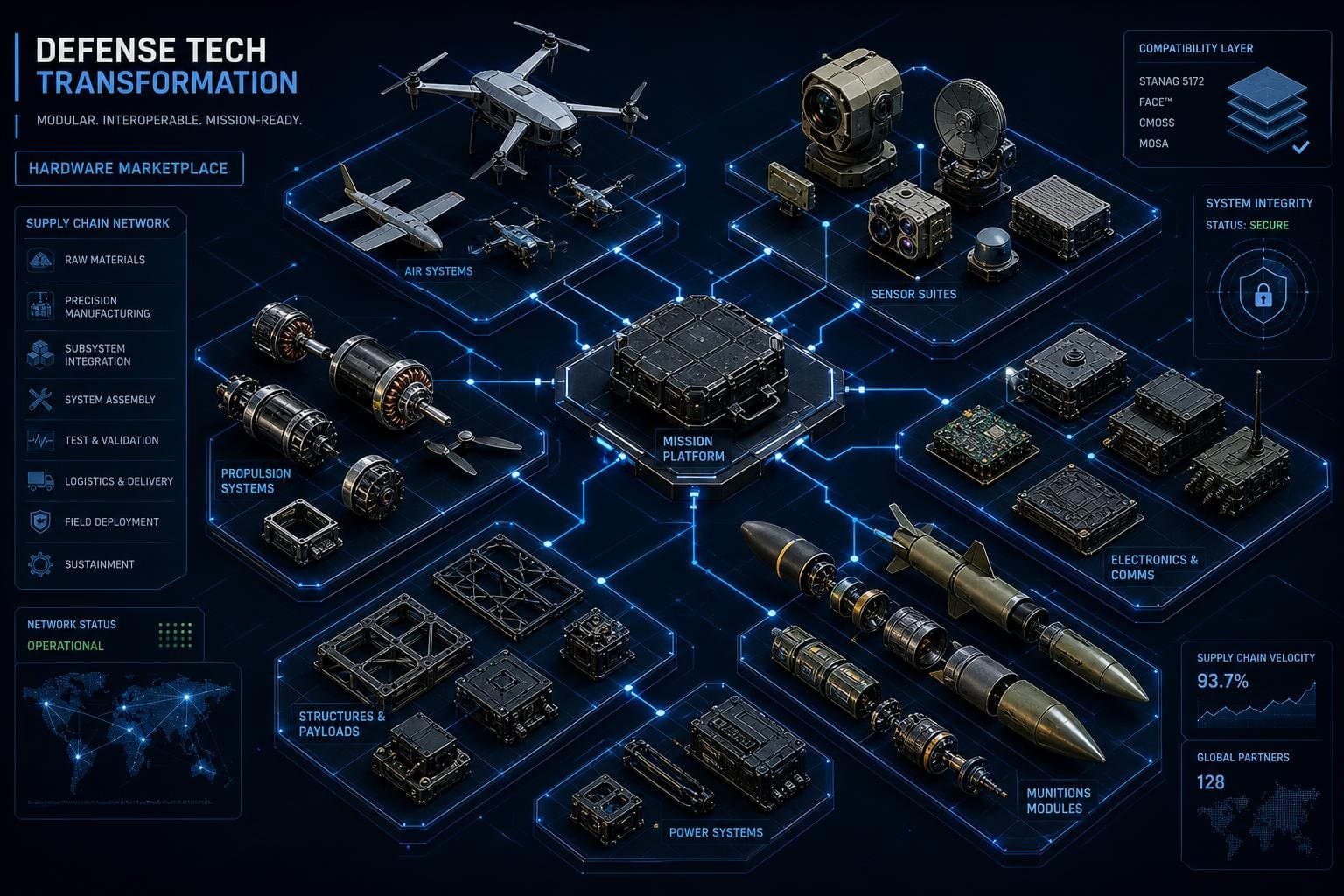

Everyone in this space keeps waiting for Anduril to go on a buying spree — snap up a sensor company here, a munitions shop there, roll up the industrial base the way private equity rolled up regional airlines in the 1990s. That's not what's actually happening. What Anduril just built is a supplier marketplace, and the distinction matters more than it sounds.
The Move Isn't Acquisition, It's Distribution
Last week Anduril quietly launched something called Armory — a browsable catalog of drones, jammers, motors, and other hardware the company has in stock and ready to sell. Chief business officer Matthew Steckman told Axios the company is "hoping we get a lot of original equipment manufacturer traffic and other types of A&D companies coming through," a direct pitch to become a supplier to other defense contractors rather than only a prime chasing large programs. I wrote about this shift toward B2B positioning when it launched, and the through-line holds: Anduril is trying to sit in the middle of the supply chain, not buy up the ends of it.
That's a meaningfully different growth strategy than acquisition. Buying companies means absorbing their overhead, their clearances, their culture friction — the stuff that kills timelines. Building a storefront means other companies bring their own capital and risk to you. If it works, Anduril grows its footprint across the industrial base without ever writing a check for another firm's balance sheet.
The Money Explains Why
A new study from the Aerospace Industries Association and Bain & Company, described to Breaking Defense, gives some texture to why this approach makes sense right now. Venture capital flowing into defense has grown tenfold since 2019, per the study, but private equity — the capital pool that typically funds roll-up acquisitions — remains largely untapped in the sector. AIA President Eric Fanning framed the issue as one of incentive structure, not capital scarcity: "There's a misunderstanding of how much private capital is in defense, how you incentivize it, move it towards defense, and things that you do that inadvertently create barriers to that type of investment."
That's the quiet tell. If PE were flowing freely into defense the way it does into healthcare or software, you'd expect to see the roll-up M&A wave that the "Anduril acquisition spree" framing assumes. Instead, the capital gap in areas like critical minerals and solid rocket motors, which the study flags as underfunded bottlenecks, means the industrial base still needs organic partnerships and supply relationships more than it needs balance-sheet consolidation. Anduril building a marketplace instead of a shopping list looks less like restraint and more like reading the capital environment correctly.
Partnership Is Becoming the Substitute for M&A
You can see the same logic play out overseas. Israeli loitering munition maker Uvision just signed a teaming agreement with Estonian autonomy firm Lendurai, reported by Breaking Defense, to integrate Lendurai's Neocortex autonomy software onto Uvision's Hero loitering munitions for an unnamed NATO customer. Neither company bought the other. Uvision gets battle-tested software; Lendurai gets a hardware platform with an established production line and an almost $1 billion U.S. Army contract already on the books. It's the same shape as Armory: two specialized companies wiring themselves together through a commercial deal rather than a corporate acquisition.
I'd argue this is the actual defense tech consolidation story right now — not fewer companies, but tighter commercial links between more of them. Primes and neo-primes are building distribution rails and integration partnerships because the capital structure rewards speed and specialization over ownership. An acquisition takes months of due diligence, security clearance transfers, and culture integration. A supplier listing or a teaming agreement takes a signature.
What to Watch
The AIA-Bain study is a signal that policymakers are actively trying to unstick private equity's reluctance toward defense — watch for whether that translates into actual fund commitments over the next two quarters, which would be the real precondition for a genuine acquisition wave. Watch too for whether Armory adds munitions listings; Steckman confirmed Barracuda and other weapons weren't on the platform as of this week, and that's the product line that would signal Anduril is ready to compete directly with legacy primes on lethality, not just components. Until then, the interesting story isn't who Anduril buys. It's who it plugs in.