


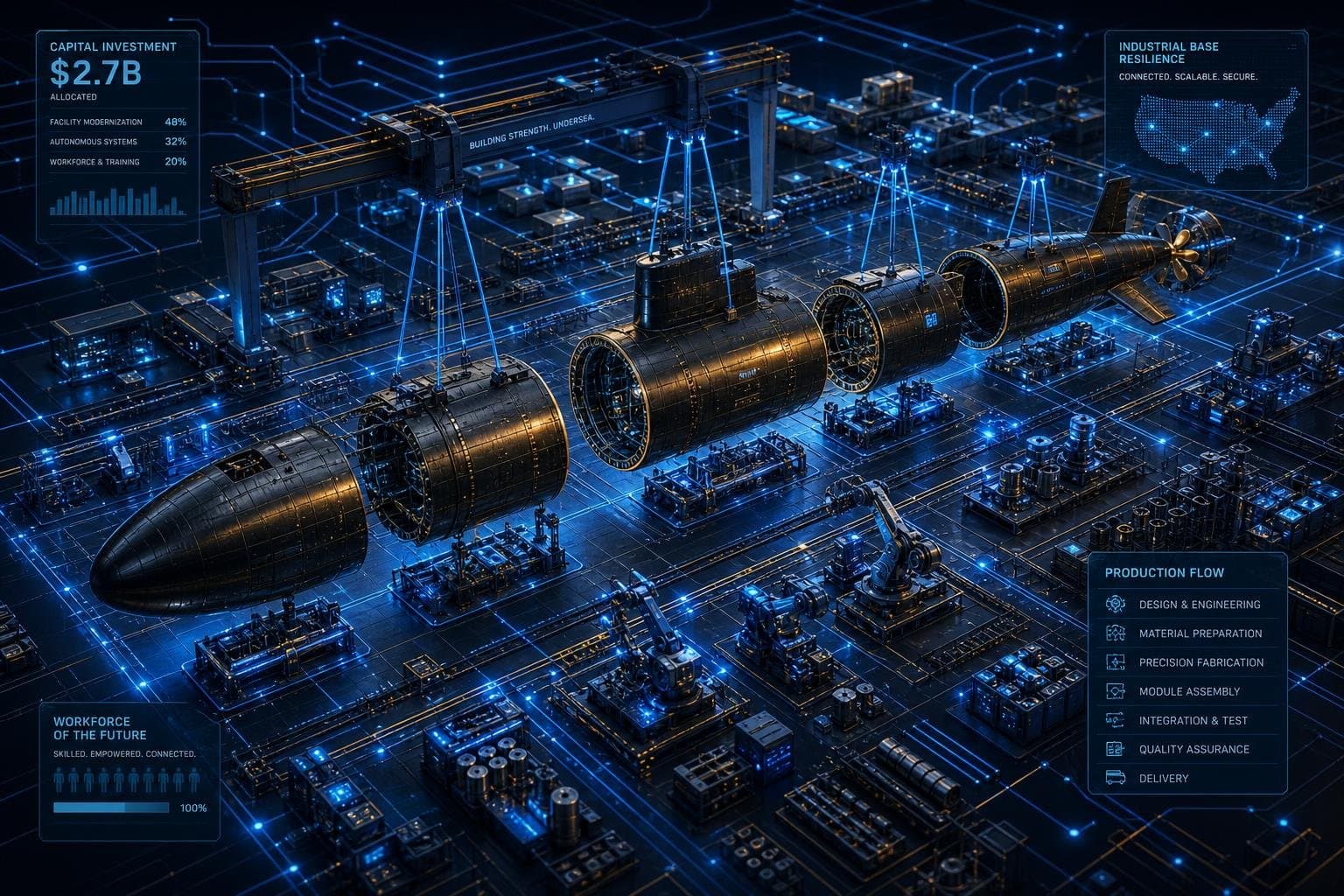

Anduril just did something no venture-backed defense startup has done at this scale: it agreed to eat the execution risk on a shipyard. The company said Tuesday it will spend $3.7 billion of its own money building a new Maryland facility, Arsenal-2, to produce components for Virginia-class submarines, with the Navy then awarding it a contract worth up to $2.9 billion tied directly to production outcomes. Chief strategy officer Christian Brose put it plainly: "It's really the government buying the results of what we're able to produce from the facility that we've invested in."
That financing structure is the story, not the submarine. Pentagon contracts historically pay for inputs — labor hours, cost-plus overruns, milestone reviews. Anduril is betting its own capital on a factory first and letting the government pay for what comes out the other end. That's a venture-style bet on manufacturing throughput, made by a company that was still mostly known for drones and software three years ago. It follows last year's $1 billion Arsenal-1 facility in Ohio, which is already producing autonomous combat drones, so this isn't a one-off — it's a pattern of self-funded industrial capacity that Anduril then monetizes through outcome-based contracts.
Compare that to how the Army structured its counter-drone IDIQ the same week: up to $7 billion spread across ten companies, from Echodyne to DroneShield to L3Harris, explicitly to avoid single-vendor lock-in as the threat evolves. That's the Pentagon hedging across a competitive field of sensors and effectors. Anduril's submarine deal is the opposite instinct: concentrate capital in one company willing to build the factory and own the risk.
Both moves make sense given where the capital is coming from. European defense startups are on pace to raise a record $10.5 billion this year, nearly four times last year's total, per Dealroom's forecast reported by Defense News, and private equity is now writing billion-dollar checks too — Blackstone just committed over $1 billion to merge two defense-tech acquisitions into a single platform company, per Bloomberg. Money is no longer just chasing software demos. It's chasing steel, shipyards, and production lines.
The investor read here isn't "which startup wins the next RFP." It's which companies are willing to put their own balance sheet behind physical capacity before the government commits a dollar. Anduril just showed what that looks like at submarine scale. Watch whether any other venture-backed firm tries to match that bet before the Navy's next Virginia-class procurement cycle.