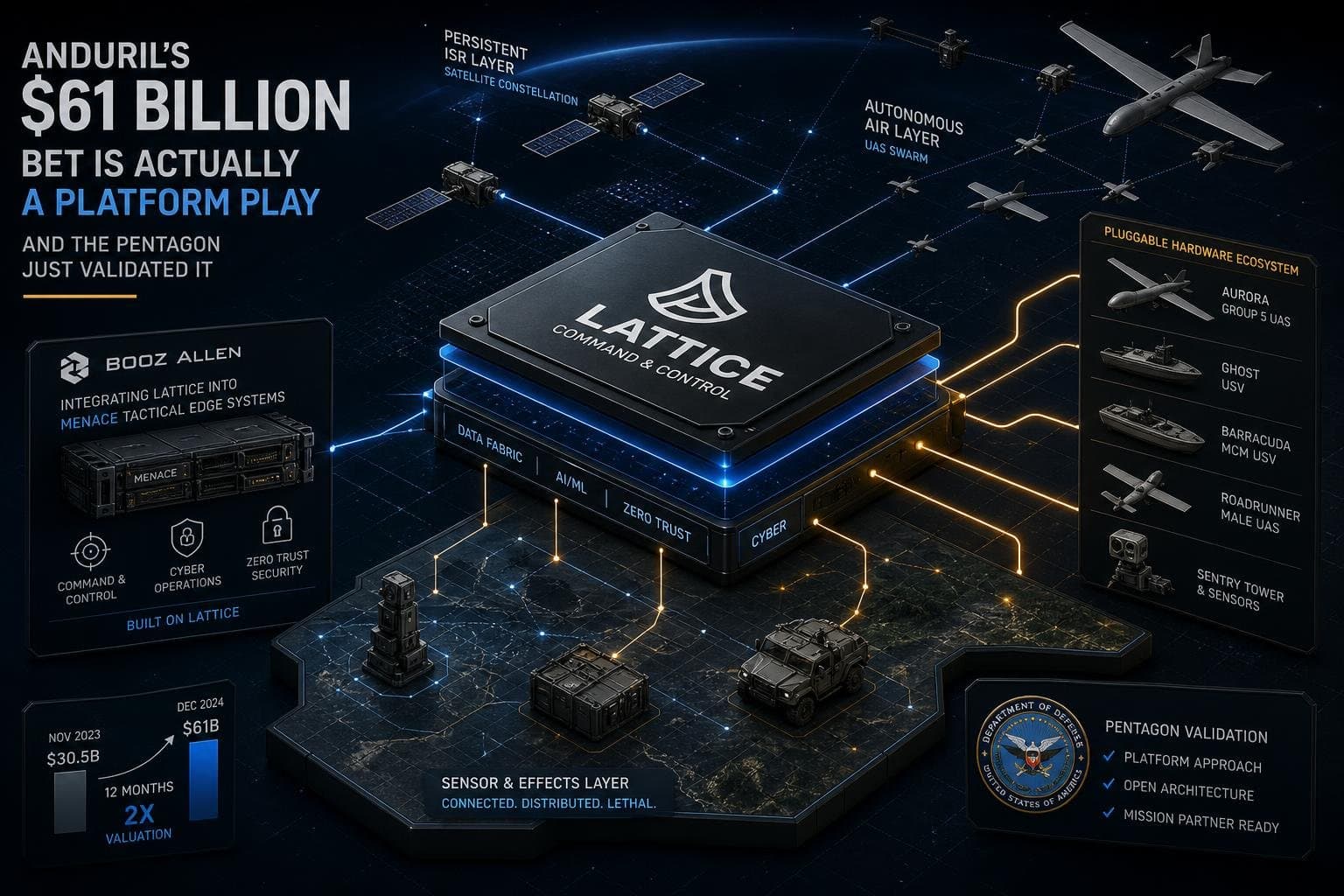

Twelve months ago, Anduril was valued at $30.5 billion. Today it's worth $61 billion. That doubling isn't a market anomaly — it's the Pentagon telling the defense industry something important about where procurement is heading.
Anduril's Series H round, led by Andreessen Horowitz and Thrive Capital, closed at $5 billion — a number that would have seemed implausible for a defense startup five years ago. But the valuation multiple is less interesting than what's driving it: Anduril isn't winning because it builds better hardware. It's winning because it built a platform that other hardware plugs into.
The Lattice Flywheel Is Turning
The clearest signal of Anduril's platform strategy isn't the fundraise — it's the partnerships accumulating around Lattice, its command-and-control software layer. Booz Allen recently integrated Anduril's Lattice platform into its Menace tactical edge compute systems, combining command-and-control, cyber, and zero trust capabilities for contested environments. That's a legacy defense giant essentially building on top of an Anduril foundation.
Nokia is doing something similar from the telecom side. At CANSEC 2026, Nokia announced a defense pivot that includes work with Anduril, positioning secure military-grade networks as a second growth engine alongside its AI infrastructure business. When a European telecom equipment maker is orienting its defense strategy around your platform, you've crossed a threshold that most defense startups never reach.
And then there's the Space Systems Command contract, where Anduril is using Lattice to support mesh networking for the Space Surveillance Network — tracking debris and satellites in orbit. The same software layer that runs counter-drone operations is now being applied to space domain awareness. That's what platform leverage actually looks like.
The Munitions Bet Changes the Risk Profile
The Lattice story is well understood by now. What's newer — and more strategically interesting — is Anduril's move into munitions manufacturing.
The Pentagon's Low-Cost Containerized Munitions program named Anduril as one of four companies awarded framework agreements to potentially supply over 10,000 containerized missiles over three years starting in 2027. The assessment phase begins with test missile purchases in June 2026. Under Secretary Michael Duffey framed the agreements explicitly as a move "beyond traditional prime contractors to expand the industrial base" — a demand signal aimed at exactly the kind of new entrant Anduril represents.
This matters for how you think about Anduril's valuation. Software platforms get premium multiples; munitions manufacturers historically don't. But Anduril is positioning itself as both simultaneously — a company that sells the kill chain software and some of the weapons that run on it. If that integration holds, the margin profile looks more like a software business than a defense prime. If it doesn't — if the munitions side becomes a cost-heavy manufacturing operation — the $61 billion number gets harder to defend.
The Pentagon's demand signal is real. General Dan Caine's written testimony cited over $26 billion in fiscal 2027 budget requests for multi-year munitions procurement contracts. Anduril is positioned to capture a slice of that. The question is whether it can do so without becoming the thing it was built to disrupt.
The Talent Exhaust Is Becoming Its Own Story
One underappreciated signal of Anduril's institutional weight: what happens when people leave. Zack Eakin, a former Anduril engineer, just raised $42 million in a Series A for Layup Parts, a startup building on-demand manufacturing for carbon fiber and fiberglass components. The round was led by Marlinspike, with participation from Cerberus Ventures, Pinegrove Venture Partners, Founders Fund, and LUX Capital.
The detail worth noting: before Eakin pitched investors, he workshopped the pitch with Anduril co-founders Palmer Luckey, Brian Schimpf, and Matt Grimm. Luckey coached storytelling. Schimpf pushed on strategy. Grimm helped him think about VC framing. That's not a company — that's an ecosystem. Anduril is now generating the kind of founder exhaust that SpaceX and Palantir produced a decade ago, seeding adjacent companies that solve problems the mothership identified but chose not to own.
Layup Parts is going after composite manufacturing specifically because Anduril couldn't find reliable suppliers for its own parts. That's a classic platform-company pattern: identify a supply chain bottleneck, spin out someone to fix it, maintain the relationship. Whether intentional or not, Anduril is building a gravity well.
What the $61 Billion Is Actually Pricing In
The valuation doubling in under a year reflects something specific: the Pentagon has moved from experimenting with defense tech startups to structurally depending on them. The LCCM program, the Lattice integrations, the Space Systems Command contract — these aren't pilots. They're production commitments with firm-fixed-price terms attached.
Watch for how Anduril navigates the munitions manufacturing ramp through late 2026. The test missile purchases beginning in June will be the first real stress test of whether a software-first company can execute on hardware at scale. That's the milestone that either justifies the multiple or forces a reckoning with it.
<!--IMAGE

