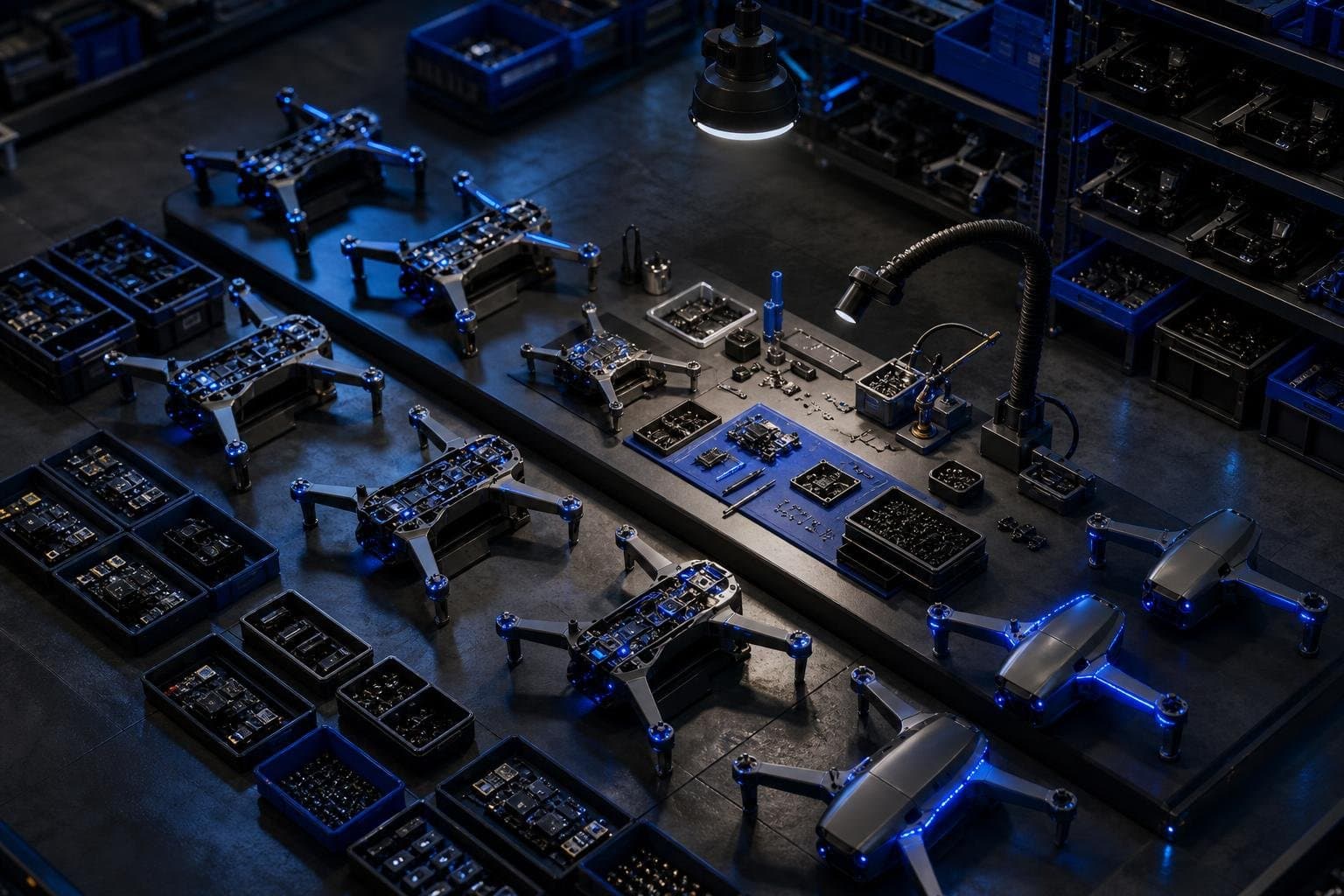

A company making "a few hundred" quadcopters a month and calling that an expansion is the most honest data point in defense tech right now.
That's Vector Defense Inc., a Bluffdale, Utah dronemaker ramping toward thousands of units a month after winning another Pentagon contract in September, according to Bloomberg. The Pentagon has spent years talking about mass-producing cheap, attritable drones to match China's manufacturing scale. The sourcing on any specific "Replicator"-style program numbers is thin right now, but the underlying industrial reality Bloomberg describes is not: the US is building this capability from close to nothing, one workstation at a time, inside facilities that look more like a scrappy startup shop than a wartime arsenal.
The Factory Floor Tells You More Than the Press Release
Bloomberg's reporting from the Vector Defense plant is useful precisely because it's unglamorous — tool-crammed work stations, a flag on the wall, a company scaling from hundreds to thousands of units per month off the back of a single contract win (Bloomberg). That's not Anduril-scale capital deployment. It's the unsexy middle of the supply chain — small manufacturers trying to go from prototype runs to actual production volume, which is exactly where defense tech ambitions have historically died.
The Marine Corps' parallel push reinforces the point. The Navy's Air Warfare Program Management Office has scheduled a cargo-drone demonstration for Jan. 25 to Feb. 5, 2027, in Huntsville, Alabama, under the Tactical Resupply Unmanned Aircraft System Increment II program (Defense News). The spec sheet is granular — a 100-pound payload carried 40 nautical miles with no refueling, a second flight profile hauling 150-plus pounds, minimum cruise speed of 50 knots scaling eventually to 150, autonomous landing-zone assessment, and collision-avoidance performance "comparable to a human pilot" (Defense News). That's the right way to read where the program actually is: not mass production yet, but a demonstration gate contractors have to clear before anyone talks about scale.
The Institutional Plumbing Is Catching Up, Slowly
The Pentagon created a new four-star Autonomous Warfare Command in September to run point on drone and unmanned-vehicle strategy, and the fight over where to headquarter it is already underway. North Carolina's congressional delegation — nearly the entire slate, per Sen. Ted Budd's office — sent Defense Secretary Pete Hegseth a letter this week arguing the state should land it, citing existing autonomy testing with Special Forces and the 82nd Airborne at Fort Bragg and the Marines at Camp Lejeune (Axios). Business groups like the N.C. Chamber are lobbying alongside the delegation (Axios).
I'd read this less as a parochial basing fight and more as a signal that the Pentagon is finally building the command structure a scaled drone force would need — procurement authority, testing infrastructure, a chain of command that isn't improvised across separate service branches. Standing up AUTOWARCOM doesn't manufacture a single drone. But it's the kind of institutional plumbing that has to exist before mass production targets mean anything operationally.
The Money Is the Real Variable Right Now
Here's the piece that should worry anyone betting on the next twelve months: drone-maker stocks are already sliding on fears that a shift in congressional control could squeeze the funding underpinning these scale-up plans, according to Bloomberg. That's a market reading risk into appropriations before a single budget line has actually moved, which is exactly what happens when an industry's growth story depends on sustained multi-year government spending rather than commercial demand.
This is the tension that doesn't show up in demo-day press releases: a Utah manufacturer ramping toward thousands of units a month, a Marine Corps program spelling out exact payload and speed thresholds for January flight tests, a new four-star command being fought over by state delegations — all of it assumes the appropriations keep flowing at the pace the Pentagon has been promising. The hardware problems are tractable. Vector Defense's production line and the TRUAS spec sheet both suggest companies know what to build and roughly how fast they can build it.
The harder problem is whether the money and the institutional authority stay aligned long enough for "a few hundred a month" to actually become "thousands a month" as routine, not as a press-release milestone. Watch whether AUTOWARCOM gets a headquarters decision on anything like its original timeline, and watch the TRUAS demo results out of Huntsville in February — that's the next point where claims about drone production readiness get tested against an actual flight line instead of a spec sheet.


