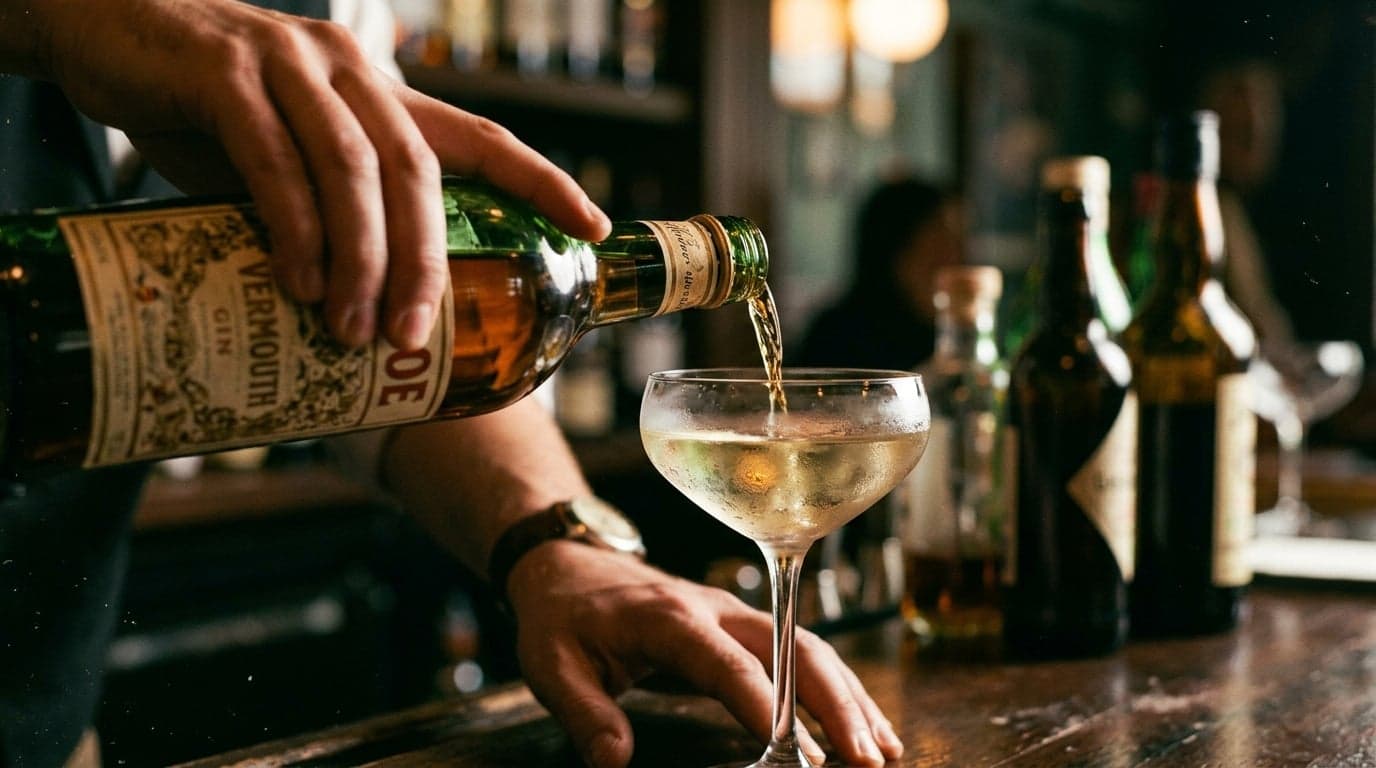

There's a tell at bad cocktail bars. Order a Martini and watch what happens to the vermouth bottle. If the bartender reaches for it without looking — pours a splash by feel, maybe a quarter ounce, maybe less — and then sets it back down like it's a formality rather than an ingredient, you're not drinking a Martini. You're drinking cold gin with a rumor of wine in it.
This is the vermouth problem, and it predates the craft cocktail era by decades. Dayton937's history of vermouth traces the arc bluntly: after vermouth arrived in the United States in the mid-19th century and became foundational to the Manhattan and the Martini, "the amount of vermouth became smaller and smaller until we set" — the sentence trails off, but the point lands. The ingredient that defined two of the most canonical American cocktails spent most of the twentieth century being systematically reduced to irrelevance in both of them.
What's strange is that the craft cocktail revival — which was supposed to fix exactly this kind of lazy bartending — only partially solved the problem. Vermouth got better. Vermouth got more interesting. And yet the cultural relationship with it remains confused, inconsistent, and in some ways more complicated now than it was before.
The Collapse Happened in Slow Motion, Then All at Once
The vermouth story is not a sudden fall. It's a long erosion with a few sharp drops.
The original sin was treating vermouth as a modifier rather than a co-equal ingredient. In the classic Martini — the pre-Prohibition version, before the drink became a vehicle for gin maximalism — vermouth held genuine weight in the glass. The Manhattan was conceived as a partnership between whiskey and sweet vermouth, not a whiskey drink with a splash of something red. Dayton937 notes that for over a hundred years, vermouth had a starring role in the cocktails the world enjoyed, with the Manhattan and Martini built on the herbal flavors vermouth brought to rye and gin respectively.
Then came the mid-century dry Martini arms race, in which the measure of sophistication was how little vermouth you could get away with. The joke versions — waving the bottle over the glass, glancing at a bottle of vermouth across the room — were funny because they reflected real practice. By the time the cocktail dark ages arrived in the 1970s and '80s, vermouth had been reduced to a vestigial ingredient in the drinks that needed it most, and a completely absent one everywhere else.
The craft revival corrected some of this. Bartenders started using proper ratios again. They started keeping vermouth refrigerated — a basic step that had been ignored for decades, since vermouth is wine and oxidizes like wine once opened. They started stocking more than one bottle. But the correction was uneven, and it exposed a deeper problem: most drinkers, and many bartenders, had never actually learned what vermouth tasted like on its own terms.
The Bifurcation Nobody Wanted to Name
Here's where it gets complicated. Caroline Lamb's analysis at Everyday Drinking identifies something the bullish trade press has been reluctant to say plainly: the vermouth category is bifurcating in a way that's creating confusion rather than clarity.
The headline numbers look good. Lamb cites data showing a 28.7 percent increase in vermouth sales beyond the traditional strongholds of France, Italy, and Spain from 2019 to 2025. The trade press has responded with the predictable "vermouth is having a moment" coverage. But Lamb's argument is that this growth conflates two very different things: rising demand for classic cocktail vermouth — driven by the continued spread of craft cocktail culture into suburban markets — and a much smaller, more niche demand for new-age sipping vermouth, the kind that comes in bottles with illustrated animals on the label and gets positioned as a standalone aperitif experience.
The craft cocktail revival, Lamb argues, "eventually left the headlines and colonized the suburbs." The millennial moms at the small-plates restaurant ordering riffed-on classics are driving vermouth consumption because vermouth is in their Negronis and their Manhattans and their Martinis — not because they've developed a personal relationship with the ingredient. The growth is real, but it's riding a wave that has nothing specifically to do with vermouth being understood or appreciated. It's incidental.
This matters because the industry has responded to the headline numbers by flooding the market with sipping vermouths and artisanal expressions positioned as standalone products, when the actual demand is mostly for cocktail vermouth that works reliably in classic applications. The boutique bottle shop Lamb describes — two from Pennsylvania, one from New York, one from Spain, one from France, several from Italy — is a product of this misread. The category has expanded in ways that serve producers and retailers more than they serve drinkers.
What the Craft Era Got Right, and What It Missed
The craft cocktail revival's relationship with vermouth is genuinely complicated. On the positive side: it restored vermouth to its proper role in the classics, introduced serious bartenders to the range of styles available, and created a culture in which keeping vermouth refrigerated and rotating it regularly became standard practice at good bars.
The Imbibe retrospective on the past twenty years of cocktail influence captures how the era worked: bartenders used classic templates as launching pads, and the Manhattan in particular became a vehicle for exploration. The Black Manhattan — swapping Averna for sweet vermouth at Bourbon & Branch in 2006 — helped drive what Imbibe editor Paul Clarke called "the wave of putting amaro into everything." The Brooklyn and its neighborhood variants (Red Hook, Greenpoint, Bensonhurst) treated the Manhattan's vermouth slot as a variable to be played with, subbing in Amer Picon, Cynar, or other amari.
This is interesting, but notice what it implies: the craft era's most creative vermouth-adjacent work involved replacing vermouth with something else. The amaro wave was partly a vermouth wave in disguise — bartenders were exploring the same bitter, herbal, wine-based flavor territory — but the cultural credit went to amaro, not to vermouth. Vermouth remained the thing you used correctly in the classics and then moved past.
The reverse Martini is a useful case study here. Punch's coverage of Somssi describes the Countermand, a mini reverse Martini that's vermouth-forward, as a drink that "in full-size, some find cloying." Head bartender Christian Gray serves it in a smaller format specifically because the vermouth-forward ratio is easier to accept when the total volume is lower. That's a creative solution, but it also reveals the problem: even at a bar thoughtful enough to put a reverse Martini on the menu, the assumption is that most guests will find vermouth-forward proportions off-putting. The ingredient is still being managed around rather than embraced.
The Storage Problem Is a Symptom, Not the Disease
Ask any serious bartender about vermouth and they'll eventually get to storage. Vermouth is wine. It oxidizes. A bottle left on the backbar at room temperature for three months is not the same product it was when it was opened. This is not a controversial claim — it's chemistry — and yet the practice of treating vermouth like a shelf-stable spirit persisted at most bars well into the craft era and continues at plenty of bars today.
The storage problem matters because it created a feedback loop. Bartenders used bad vermouth in small quantities, drinkers tasted the result and concluded they didn't like vermouth, bartenders responded by using even less of it, and the ingredient's reputation declined further. Dayton937's history notes that the wormwood-based wines that preceded modern vermouth were consumed specifically for their digestive properties — the bitterness was the point. The modern version of the ingredient retained that complexity, but the culture around it stopped treating that complexity as a feature.
The Barcelona vermouth revival offers an instructive contrast. Barcelona Metropolitan's account of the vermouth resurgence describes a culture in which vermouth is consumed as a standalone aperitif, served simply, at the right temperature, with the right accompaniments — olives, anchovies, a slice of orange. The hora del vermut is a ritual, not an ingredient decision. The vermouth is the point, not a component in something else.
That cultural context doesn't translate directly to American cocktail bars, and it probably shouldn't — the two traditions are doing different things. But the contrast is useful. In Barcelona, people know what vermouth tastes like because they drink it on its own. In American cocktail culture, most people have only ever tasted vermouth as part of something else, usually in quantities calibrated to be undetectable. The ingredient has been hiding in plain sight for a century.
What Actually Needs to Change
The vermouth problem has three layers, and fixing one without addressing the others doesn't work.
The first is ratio. A Martini at 5:1 or 6:1 gin to vermouth is not a Martini that uses vermouth well — it's a gin drink with a vermouth rinse. The classic proportions were closer to 2:1, and the pre-Prohibition versions were closer to 1:1. This isn't nostalgia for its own sake; it's an argument that the drink was more interesting when the vermouth was audible. Bars that have moved back toward wetter Martinis — and there are more of them now than there were fifteen years ago — are making better drinks.
The second is freshness. A bar that keeps its vermouth refrigerated, uses it within a few weeks of opening, and rotates stock regularly is working with a fundamentally different ingredient than a bar that doesn't. This is table stakes, not a point of distinction, but it's still not universal practice.
The third, and hardest, is education — not of bartenders, who mostly know this already, but of drinkers. Lamb's observation that the category's growth may be riding the craft cocktail wave rather than reflecting genuine vermouth literacy cuts to the heart of it. If drinkers are consuming more vermouth without understanding what they're consuming, the category will keep bifurcating: cocktail vermouth will remain invisible in the drinks it defines, and sipping vermouth will remain a niche product for people who already know what they're doing.
The Countermand at Somssi — served small, vermouth-forward, designed to slot into any part of a meal — is one answer to this. Punch's description frames it as "refreshing and aromatic," a drink that works as an opener or a closer. That's vermouth being treated as a protagonist, not a modifier. More of that, please. Less of the half-ounce pour from the room-temperature bottle that's been open since March.
The ingredient has been there the whole time. The problem has always been whether anyone was paying attention to it.


