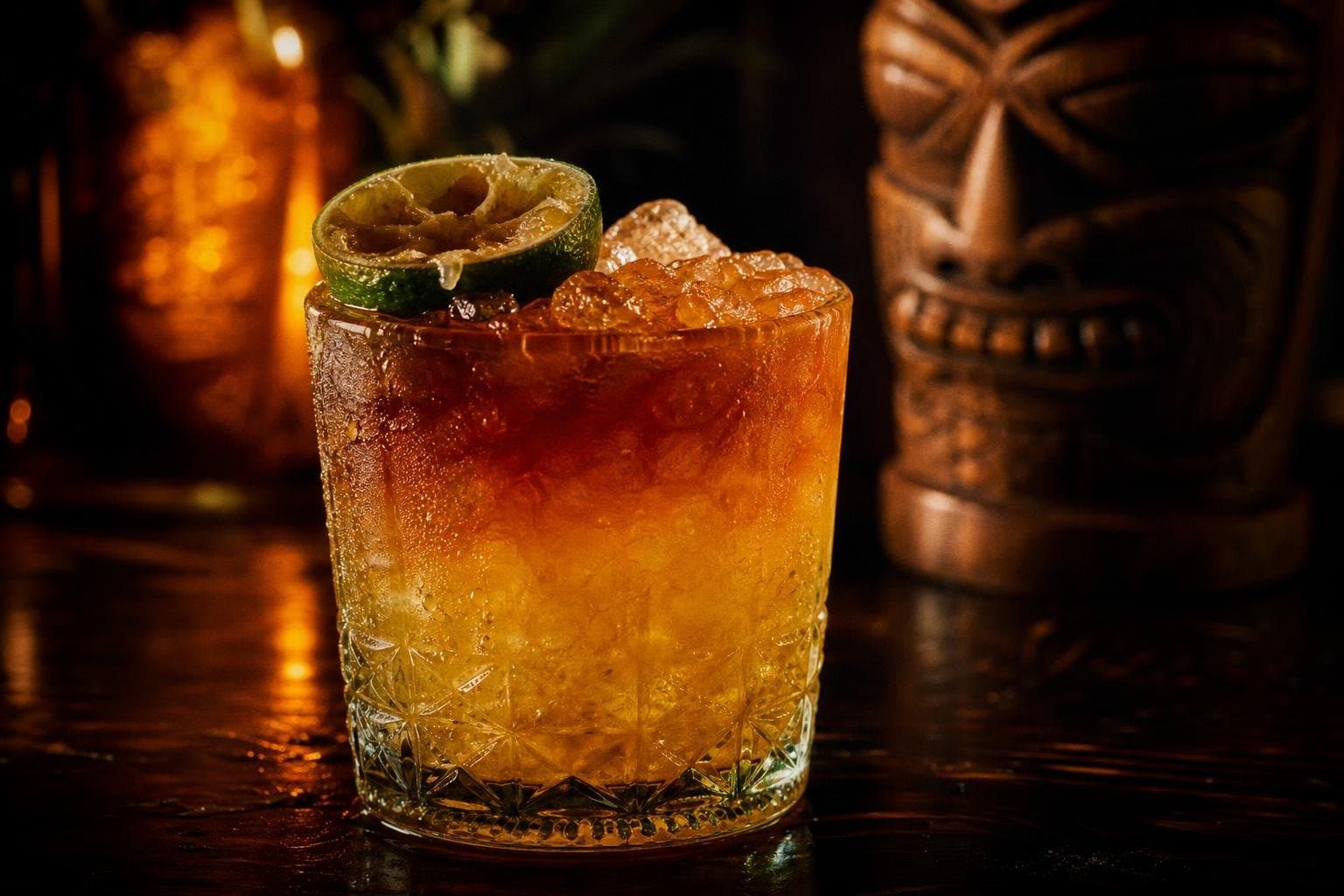

There's a version of the tiki conversation that goes like this: the whole thing was racist appropriation, the drinks are sugary garbage, and anyone still ordering a Mai Tai in 2026 is either ignorant or complicit. There's another version that goes: it's just cocktails, stop ruining everything, the Zombie is delicious. Both versions are wrong, and both are ways of avoiding the harder, more interesting question — which is what actually happened when mid-century America built a fantasy Pacific out of carved wood and rum, and what it means that we're still drinking from it.
I wrote about tiki's fabricated history a few weeks ago, specifically the way the genre's timeline gets mythologized. Today I want to go deeper into the cultural mechanics — what the fantasy was built on, who it erased, and whether the current revival has actually reckoned with any of that, or just redecorated.
The Fantasy Was Always the Product
Donn Beach — born Ernest Gantt, who traveled through Polynesia, Hawaii, and the Caribbean before opening his Hollywood bar in 1934 — didn't sell Polynesian culture. He sold the feeling of Polynesian culture, which is a different thing entirely. The bamboo, the carved tikis, the thatched roofs, the theatrical dim lighting: these were props in a stage set designed to produce a specific emotional state in American customers. Escape. Exoticism. The sense that somewhere out there, life was warmer and simpler and more sensual than the Depression-era mainland.
Vogue's recent tiki revival piece describes Beach transporting "mainland imbibers to these distant shores with his immersive interiors and 'rhum rhapsodies' made with fresh juices and homemade syrups." That's accurate as far as it goes. What it doesn't say is that the "shores" being evoked were themselves a composite fiction — a blended nowhere that borrowed aesthetics from Polynesia, Hawaii, the Caribbean, and Southeast Asia interchangeably, because the point was never geographic accuracy. The point was that it felt foreign enough to be escapist without being threatening.
This is the original sin of tiki, and it's worth naming precisely: the cultures being aestheticized were not consulted, credited, or compensated. The tiki gods carved into bar fixtures were sacred objects in their original contexts. The word "tiki" itself comes from Māori and other Polynesian traditions with specific spiritual meaning. None of that meaning survived the translation into cocktail-bar décor. What survived was the visual vocabulary, stripped of content, repurposed as atmosphere.
The Vietnam War, as Vogue notes, eventually held a mirror up to this hollow escapism — Americans who had spent years fighting across the Pacific found the fantasy harder to sustain. By the late '70s, tiki was in collapse, killed by a combination of moral exhaustion, artificial ingredients, and shifting cocktail trends.
The Revival Inherited the Problem Without Solving It
The modern tiki revival — which accelerated through the 2000s and 2010s and shows no signs of slowing — has done genuine work on the drinks. Jeff "Beachbum" Berry's archaeological excavation of original recipes, described in Vogue's account of the revival, recovered the actual craft that had been buried under decades of premix and artificial coloring. The drinks got better. The sourcing got more serious. Bars started caring about which rum came from which island and why it mattered.
What the revival has been considerably less rigorous about is the cultural framework. The aesthetic vocabulary — tiki gods, Polynesian motifs, vaguely Pacific imagery — largely came back intact. The new generation of tiki bars are often more thoughtful about ingredients than their predecessors were, but the question of whose culture is being borrowed has been handled inconsistently at best.
Consider what's happening in Denver right now. Hell or High Water, which recently reopened in RiNo after closing its original Blake Street location, describes itself as "a gay pirate ship meets Land of the Lost" — a concept that leans into the camp and kitsch of tiki while pushing the aesthetic into something more explicitly queer and self-aware. Owner Lexi Healy has built something genuinely original: the "Disco Dick" sculpture, the Glory Hole entrance, the pink leopard-print bar top. It's tiki filtered through a sensibility that's clearly not trying to sell you a straight-faced Polynesian fantasy.
That's one answer to the cultural problem: lean into the artifice so hard that no one can mistake it for ethnographic sincerity. It's not the only answer, and it sidesteps rather than addresses the underlying question, but it's at least honest about what it's doing.
The Hukilau, the annual tiki enthusiast gathering, takes a different approach. Its 2026 programming includes cocktail seminars on "modern riffs on tiki classics" — the focus is craft and technique, the drinks as objects of study. The cultural politics of the genre appear to be handled through enthusiasm rather than interrogation. That's a community making its own choices about what it values, but it does suggest that the reckoning, if it's happening, isn't happening uniformly.
The Colonialism Problem Doesn't Stop at the Bar
The tiki bar's relationship to Pacific and Caribbean cultures doesn't exist in isolation. It's part of a broader pattern in which Western leisure industries have historically extracted aesthetic and experiential value from non-Western cultures while the actual people of those cultures remain peripheral to the transaction.
A recent piece on Caribbean tourism addresses this dynamic directly — the experience of Black women in Afro-Caribbean countries feeling invisible in spaces nominally built around their culture's aesthetics. The piece is about tourism, not cocktail bars, but the structural logic is identical: the cultural product gets exported and monetized while the source community's relationship to that product is either romanticized or ignored.
This is the uncomfortable through-line. When a bar in Brooklyn or Denver or Fort Lauderdale serves a drink in a tiki mug with a paper umbrella, the aesthetic debt runs to specific places and specific people. The South Florida tiki bar roundup notes that "the word 'tiki' was originally used to describe Polynesian carved objects" before becoming "a catchall for all kinds of tropical cocktails and the kitsch-loving kahuna subculture that adores them." That's a remarkably clean description of cultural erasure — a sacred object becomes a genre label, and the transformation is presented as natural evolution rather than loss.
None of this means the drinks are bad. A well-made Zombie — properly bitter, properly strong, built on the tension between aged rum and fresh citrus — is one of the more technically demanding cocktails in the canon. The craft is real. The problem is that the craft and the cultural politics have been treated as separate conversations, when they're not.
What a Genuine Reckoning Would Actually Look Like
The Disney angle is instructive here, in a sideways kind of way. The Los Angeles Times recently covered the Enchanted Tiki Room's near-death experience in the '90s — Disney explored remaking it as an ecological show or a Lion King tie-in before preserving it essentially intact. The artists who fought to save it framed it as preserving "a vital piece of Disneyland history." That framing is telling: the Tiki Room is understood as American cultural heritage, not as a borrowing from Polynesian cultural heritage. The original source has been fully absorbed into the borrower's tradition.
A genuine reckoning with tiki would require reversing that absorption — not destroying the drinks or the bars, but being specific about what was taken, from whom, and what acknowledgment or reciprocity might look like. Some bars have started doing this: sourcing rum from the specific islands whose cultures they're invoking, working with Pacific Islander artists for their visual programs, being explicit in their menus about the difference between "inspired by" and "authentic to." These are small gestures, but they're different in kind from simply making better cocktails.
The harder version of this conversation involves the drinks themselves. The Mai Tai — whose disputed origin between Trader Vic and Don the Beachcomber has been argued for decades — is built on Jamaican and Martinican rum, orgeat, orange curaçao, and lime. Every ingredient in that drink has a colonial history. The sugarcane that produces the rum was grown on plantations. The lime trade was built on imperial infrastructure. Orgeat's almond base traveled through Mediterranean trade routes. You can follow the supply chain of almost any classic cocktail back to extraction and exploitation somewhere. Tiki just makes that history unusually visible because it aestheticizes the source cultures rather than hiding them.
That visibility is, paradoxically, tiki's most interesting quality. It's a genre that can't pretend to be culturally neutral, which means it's forced to have a conversation that most of the spirits industry avoids entirely. The marketing-to-substance ratio problem I keep returning to in this newsletter is partly a problem of mystification — brands selling you a story about Scottish highlands or Kentucky limestone without mentioning the labor history underneath. Tiki can't do that. The fantasy is too explicit.
The bars that are doing this well — and some are — treat the genre as a starting point for specificity rather than an excuse for vagueness. They name the rums. They credit the cultures. They make drinks that are actually good rather than just evocative. They understand that the Zombie isn't a "tropical drink," it's a specific recipe with a specific history, and that history includes both Donn Beach's genius and the broader context in which that genius operated.
The ones that aren't doing it well are still selling the same fantasy Beach sold in 1934, just with better ice programs and more Instagram-friendly glassware. The aesthetic has been updated. The reckoning hasn't.
A well-made Mai Tai is worth defending. The culture that built it deserves more than a paper umbrella.


