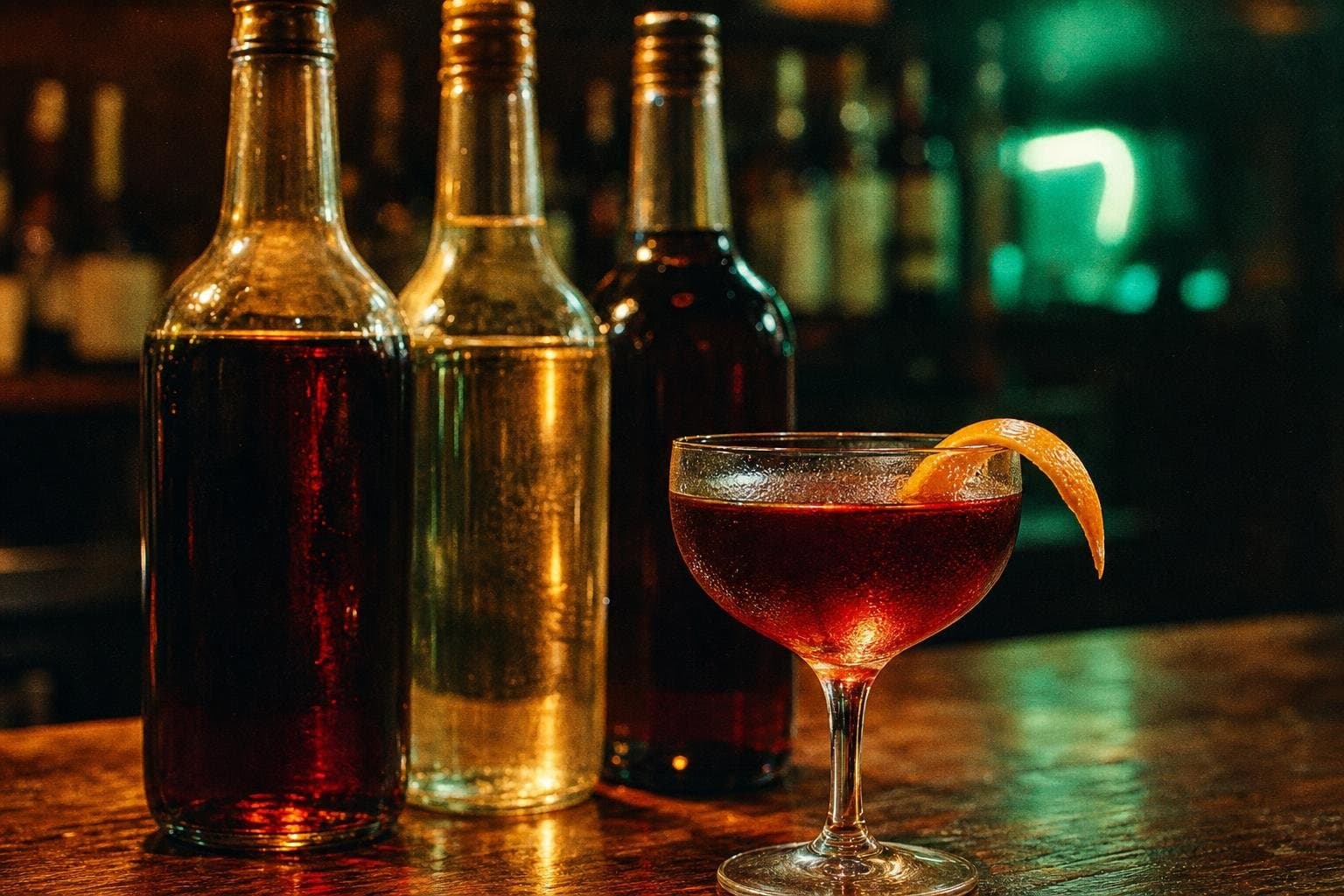

There's a bottle of Noilly Prat in most home bars. It's been there since 2019. The cap is sticky.
This is the actual state of vermouth in America, and it coexists, somehow, with a category that The Spirits Business reports is on track to exceed $19.7 billion in global value by 2033, up from $11.1 billion in 2024. Those numbers are real. The narrative being constructed around them — that vermouth has finally arrived as a sipping category, that La Hora del Vermut is colonizing American drinking culture, that we are all about to start treating fortified wine the way the Spanish treat it in Palma — is a different thing entirely, and it deserves some scrutiny.
The drinks press has been predicting vermouth's American moment for roughly a decade. At some point, the prediction becomes a self-fulfilling press release.
The Growth Is Real. The Cause Is Being Misread.
Caroline Lamb, writing in Everyday Drinking, makes the most useful observation anyone has written about vermouth this year: the sales data is being misinterpreted. The numbers show a 28.7 percent increase in vermouth sales beyond the traditional strongholds of France, Italy, and Spain from 2019 to 2025. That's a real number. But what's driving it?
Lamb's argument is that the growth isn't a vermouth story — it's a craft cocktail story. The cocktail revival that launched in major American cities in the mid-2000s never stopped spreading. It just moved to the suburbs. The millennial moms at the small-plates restaurant ordering riffed-on classics with clever names are ordering Negronis and Manhattans, which require vermouth. They are not ordering vermouth. The distinction matters enormously for how producers and retailers should be positioning the category, and most of them are getting it wrong.
The Spirits Business frames the same data differently, crediting bartenders who are "casting vermouth in lead roles in their cocktail programmes rather than leaving it to fade into the background." Giorgio Bava of Giulio Cocchi is quoted saying bartenders are "educating consumers" and "demystifying" the product. Leonardo Todisco of Strucchi adds that presentation has been "key to rewiring consumers' perceptions." This is the industry's preferred narrative: vermouth is being discovered, consumers are being educated, the category is ascending.
Both things can be true. Bartenders are absolutely more thoughtful about vermouth than they were twenty years ago. And the growth in vermouth sales is substantially explained by more Americans drinking more classic cocktails, not by Americans developing an independent relationship with vermouth as a category. Conflating the two leads to a specific kind of confusion — the kind Lamb experienced standing in a boutique bottle shop, staring at $140 worth of bottles she wasn't sure what to do with.
What Vermouth Actually Is, and Why That Gets Buried
The marketing conversation around vermouth's renaissance tends to skip past what vermouth is, which is worth pausing on. Edible Boston's account traces aromatized wines back millennia — to Chinese, Middle Eastern, and Mediterranean traditions of adding herbs, spices, roots, and botanicals to fermented beverages, partly for flavor, partly for the plants' medicinal properties. The current form of vermouth descends from ancient Absinthiatum vinum (wormwood wine), shaped by the spice trade beginning in the 15th century, and eventually crystallized into three traditional styles between the 1780s and 1820s: sweet red, dry white, and sweet white.
Vermouth cocktails enter the written record in 1869, with the Vermuth Cocktail appearing in the Steward and Barkeeper's Manual. By 1882, Harry Johnson's New & Improved Bartender's Manual was featuring a Vermouth Cocktail with vermouth as the base spirit, sweetened with syrup and Maraschino liqueur, modified with bitters. This is not a new idea. Vermouth as a base, not a modifier, is the original idea.
The twentieth century buried this. Vermouth became the thing you waved over a Martini glass or poured too much of into a Manhattan. The bottle sat on the back bar for months, oxidizing. The category's reputation suffered accordingly — not because vermouth was bad, but because bad vermouth was everywhere, and nobody was treating it with the care that a wine-based product requires. You wouldn't leave an open bottle of Burgundy on the back bar for six months. Vermouth is wine. It behaves like wine.
This is the actual problem the "renaissance" is solving, and it's a more modest and more interesting story than the one being told. Bartenders started refrigerating their vermouth. They started using it faster. They started caring about producers and regions. The drink got better. Consumers noticed the drink was better. Sales went up. That's the whole story, and it doesn't require a cultural revolution.
The Sipping Vermouth Trap
Here's where the narrative gets genuinely confused, and where some producers are going to get hurt.
The growth in vermouth sales is being read by a segment of the market as a signal that consumers want to drink vermouth on its own — that the Spanish vermutería tradition is about to go global, that Americans will start ordering a glass of chilled Rojo with an olive before lunch. The Spectator Australia covers the tradition warmly, describing the vermouth hour in Palma's downtown bars as a genuine cultural practice, and noting producers like Lacuesta and Fernando de Castilla making age-worthy, complex vermouths designed for exactly this kind of consumption. Fernando de Castilla's Vermut Rojo, aged eight years with Pedro Ximénez grapes and 27 botanicals, is described as "rich and full-bodied, perfect to enjoy on the rocks."
That product is real and it sounds excellent. The question is whether there's a meaningful American market for it, and the honest answer is: not yet, and possibly not soon.
The Spirits Business notes that the aperitivo moment is "most commonly enjoyed in European countries," and that other markets are using apéritifs for "flexible, early-evening imbibing" — which is a polite way of saying they're drinking Aperol Spritzes at happy hour, not sitting with a glass of aged Rojo and a plate of anchovies. The cultural infrastructure for sipping vermouth — the vermutería, the pre-lunch ritual, the understanding that this is a destination rather than a vehicle — doesn't exist in most American cities.
The Advanced Mixology piece on Monte Carlo Vermouth quotes its founder comparing vermouth's current trajectory to craft gin's ten years ago. That comparison is instructive, but not in the way intended. Craft gin's explosion was driven by gin and tonics — a simple, accessible serve that required no cultural education. Sipping vermouth neat requires considerably more buy-in. The gin comparison suggests a category about to go mass; the actual product category suggests something more niche.
None of this means sipping vermouth is a bad idea. It means the market is bifurcating, as Lamb argues, between cocktail vermouth (growing steadily because cocktail culture is growing steadily) and artisanal sipping vermouth (growing from a much smaller base, for a much more specific consumer). Producers who understand which market they're in will do fine. Producers who read the aggregate growth numbers and assume they're riding a sipping wave may be in for a correction.
What the Cocktail Bar Actually Needs From Vermouth
Set aside the sipping question. The more immediately useful conversation is about what's happening to vermouth inside cocktails, because that's where the real quality story lives.
The 50/50 Martini — equal parts gin and dry vermouth — is the clearest test case. A bartender quoted in Business Insider puts it plainly: "I feel like people were taught to dislike vermouth in martini orders because it's been shamed for so long." The 50/50 is not a new invention. It's closer to what a Martini looked like before the mid-century push toward bone-dry, vermouth-as-afterthought construction. Ordering one at a bar is still a mild act of subversion, which tells you something about how far the rehabilitation still has to go.
The Negroni is the more visible data point. Advanced Mixology notes that the Negroni has been ranked among the world's most-ordered cocktails for four consecutive years. Every Negroni requires sweet vermouth. If bartenders are now more careful about which sweet vermouth they're using — and the evidence suggests they are — that's a genuine quality improvement that flows directly to the drinker, whether or not the drinker knows anything about vermouth as a category.
This is the understated version of the vermouth renaissance, and it's the one that actually holds up: not that Americans are about to start drinking vermouth the way Mallorcans do, but that the vermouth going into their Negronis and Manhattans is better than it was fifteen years ago, because the people making those drinks care more about it. That's not a revolution. It's professionalism. It took long enough.
The Bottle Shop Problem
Back to Lamb in the bottle shop, staring at $140 worth of vermouth she couldn't contextualize. This is the category's actual challenge, and it's more pressing than any market projection.
Vermouth's style diversity — dry, sweet, bianco, rosso, rosé, aged, unaged, Spanish, Italian, French, American — is genuinely exciting if you have a framework for it. Without one, it's paralyzing. The craft spirits boom has produced a proliferation of small-batch American vermouths that are interesting and poorly distributed, sitting next to European classics that are widely available but rarely explained, next to artisanal imports that require a specialist to decode.
The industry's response has been to lean on bartender education and hope it trickles down. That works, slowly. What would work faster is simpler: treat vermouth like wine at the retail level. Tell people what it tastes like, what to drink it with, how long it keeps after opening. The refrigerate-after-opening message alone would do more for the category's reputation than any number of trend pieces in fashion magazines.
The growth numbers are real. The renaissance is real, in the specific sense that vermouth is better-made, better-handled, and better-understood by serious bartenders than it was a generation ago. What's not real — not yet — is the broader cultural shift that would make vermouth a destination rather than a component. The category deserves that shift. It hasn't earned it yet from consumers, and the industry isn't quite telling the right story to get there.
The sticky cap on that bottle of Noilly Prat is still the more honest data point.


