


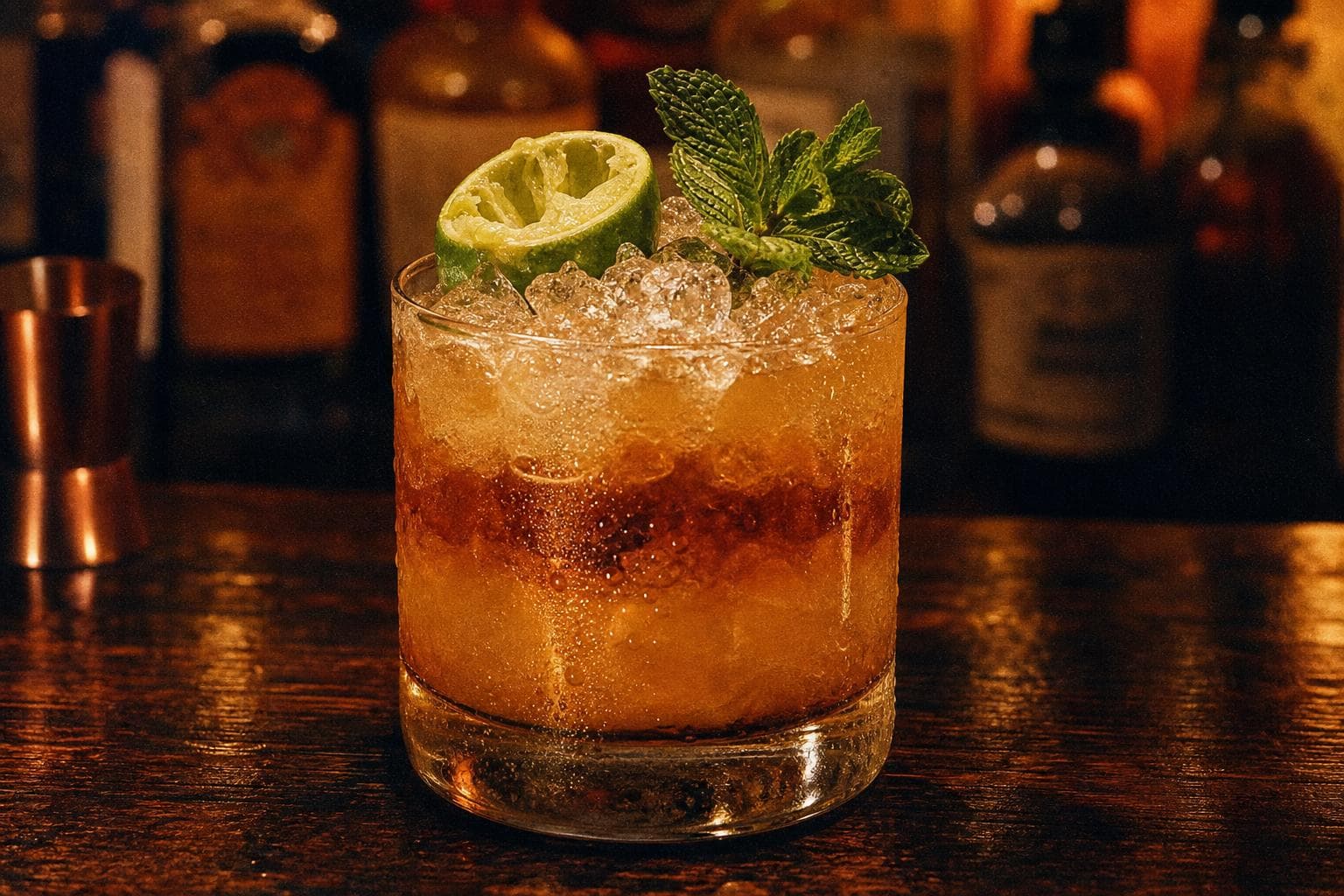

There's a particular confidence with which bartenders present the Zombie. "Don the Beachcomber, 1934" — said with the same reverence you'd give a Negroni or a Sazerac. And sometimes that's accurate. But tiki culture has a mythology problem that makes the spirits industry's marketing-to-history ratio look almost honest by comparison.
The short version: tiki has a genuine canon, and it has a much larger body of invented tradition. Knowing which is which matters — not for pedantry, but because the drinks built on real foundations are almost always better.
The Actual Canon Is Smaller Than the Menu Suggests
The legitimate classics are real and worth defending. The Mai Tai traces to 1944, when Trader Vic Bergeron built it around a 17-year J. Wray & Nephew rum at his Oakland restaurant — a specific bottle, a specific place, a documented moment. Don the Beachcomber's work in the 1930s and '40s established the foundational vocabulary: rum-forward, layered with citrus and spice, built for balance rather than spectacle. The Mai-Kai in Fort Lauderdale, open since 1956, runs a menu that traces directly to that era — and it remains one of the few places where you can taste what the original project actually was.
That project was serious. The best tiki drinks are technically demanding: multiple rums, precise citrus ratios, housemade syrups that take days to produce. The Zombie, the Painkiller, the Jet Pilot — these are cocktails that reward attention.
The problem is what got layered on top.
What the Revival Added (and Passed Off as History)
The craft cocktail revival of the 1990s and 2000s was genuinely good for tiki. It brought back quality ingredients, proper technique, and serious practitioners. It also created an incentive to dress new recipes in old clothes.
I'd argue that a meaningful portion of what gets presented as "classic tiki" on contemporary menus dates to the revival period, not the golden era — recipes developed by Jeff Berry, Martin Cate, and others who were doing legitimate historical research but also, inevitably, filling gaps. Berry's reconstructions from the 1990s onward are well-documented as reconstructions. The issue is what happens downstream: a bar opens, puts "classic tiki cocktails" on the menu, and the provenance gets quietly dropped.
The tell is usually the recipe itself. Authentic pre-1960s tiki drinks are built around rum and citrus with supporting modifiers — falernum, orgeat, Angostura. When you see a "classic" that prominently features aged agricole, multiple amari, or barrel-aged anything, you're almost certainly drinking the 1990s. Which is fine. But call it what it is.
The Drink Worth Building: The Real Mai Tai
The original Trader Vic recipe is the benchmark. Everything else is commentary.
Mai Tai (Trader Vic, 1944 interpretation)
- 2 oz aged Jamaican rum (Appleton Estate 12 Year, ~$35, widely available)
- ¾ oz fresh lime juice
- ½ oz orange curaçao (Pierre Ferrand Dry Curaçao, ~$30, specialty shop)
- ¼ oz orgeat (Small Hand Foods, ~$18, online/specialty)
- ¼ oz simple syrup
Shake hard with crushed ice. Pour unstrained into a double rocks glass. Garnish with a spent lime shell and a mint sprig.
What you're tasting: The rum is the drink. The citrus and orgeat exist to frame it, not compete with it. If your Mai Tai tastes like a fruit punch with rum in it, someone used bad orgeat and too much of it.
Substitution note: The original called for a 17-year J. Wray & Nephew that no longer exists commercially. Appleton 12 is the closest widely available approximation. Some practitioners split the base with a Martinique agricole for complexity — that's a legitimate modern variation, not the original.
The Verdict
Tiki's canon is worth taking seriously precisely because it's smaller than the menus suggest. The drinks that trace directly to Donn Beach and Trader Vic are genuinely sophisticated — technically demanding, historically grounded, and built to be drunk rather than photographed. The revival-era additions are often excellent too, but they deserve their own provenance.
The fraud isn't malicious. It's the natural result of a culture that romanticizes its own mythology. The fix is simple: ask when the recipe is from. If the bartender doesn't know, the drink probably isn't as classic as the menu implies.