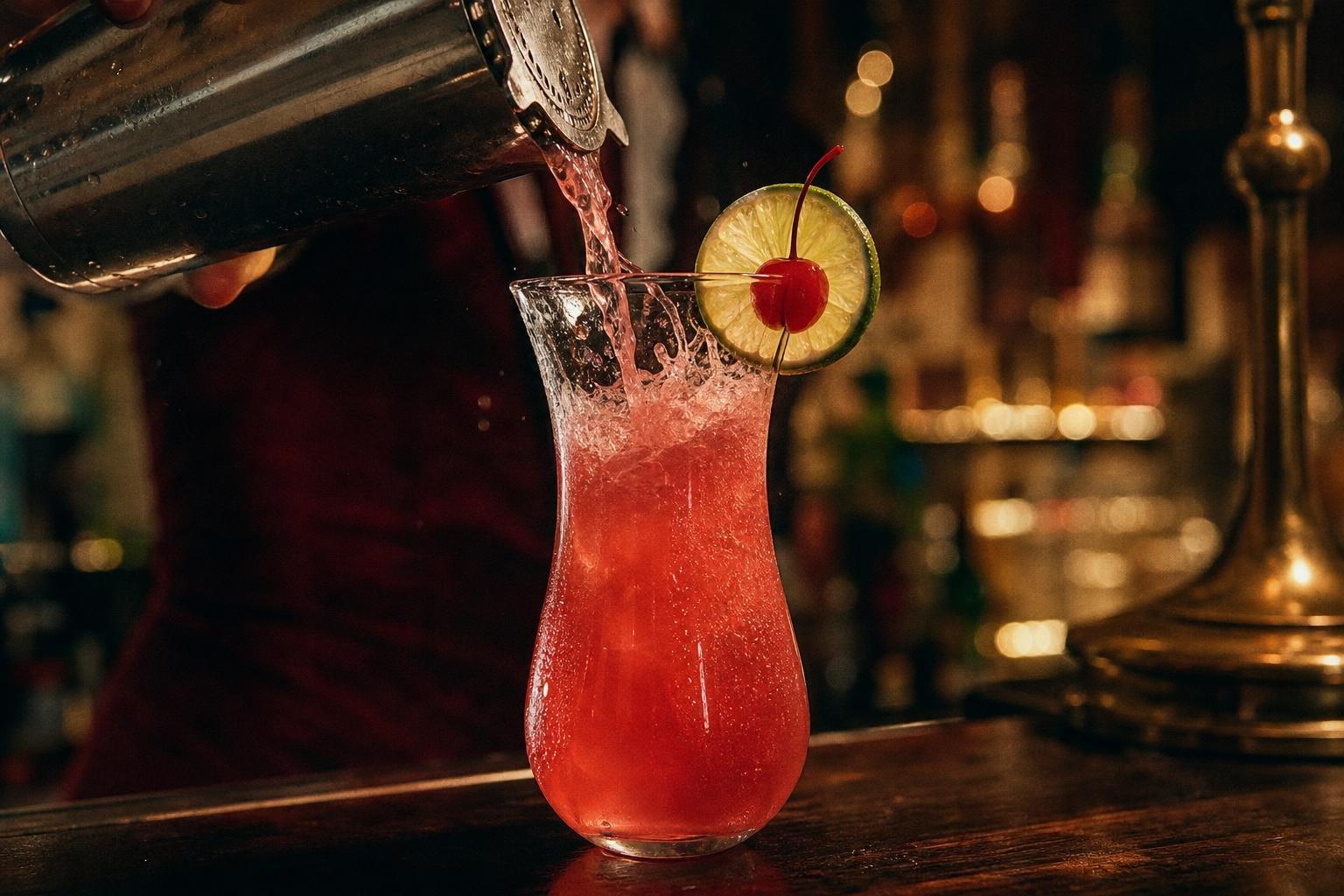

A hand-cranked cast-iron machine at the Long Bar in Raffles Hotel can shake eighteen Singapore Slings at once. It looks like it's been there since the Ngiam Tong Boon era. It was installed in 2018, and according to reporting by Nicholas Yong for the New York Times, cited in a writeup at The Libation Lounge, the shakers inside it are sometimes not even filled when the machine is running for show.
That detail tells you most of what you need to know about how this drink is marketed versus how it's actually understood. The Singapore Sling is the rare classic cocktail with an owned, trademarked, continuously operating origin myth — a hotel bar that has spent a century selling the story alongside the drink. The story is vivid, specific, and repeated verbatim across tourism sites, recipe blogs, and gin brand marketing copy. The recipe underneath it, the thing you'd actually need to verify any of that, is a mess nobody agrees on.
The Official Version Is Suspiciously Tidy
Every source in the tourism-and-recipe ecosystem tells the same story with the same beats: a Hainanese bartender named Ngiam Tong Boon invented the drink at the Long Bar around 1915, and he built it pink and fruity so that women — socially barred from drinking spirits in public at the time — could order what looked like fruit punch. Klook's listing for the bar repeats this almost word for word, down to crediting Ngiam personally for the cocktail's "pretty pink hue." The Libation Lounge's summary of the Times piece frames it the same way, explicitly sourcing the claim to "Raffles Hotel's official history" — language that's doing real work, because an institution telling its own founding story is not the same thing as a documented historical record.
That's the piece almost every retelling skips. A single named inventor, an exact year, and a motive this clean and marketable is the kind of origin story that cocktail history almost never actually produces undisputed. The Manhattan, the Martini, the Daiquiri — every major classic has competing claimants, muddled timelines, and at least one bartender whose descendants are still arguing about it. The Singapore Sling gets a clean just-so story because the hotel that tells it also owns the bar, sells the $40 version of the drink, and has a life-size cutout of Ngiam standing at the entrance, per the same Libation Lounge piece. None of that makes the story false. It makes it unverifiable in the way that matters — there's no independent 1915 source confirming any of it, just a century of the hotel repeating its own account and everyone else citing the hotel.
Nobody Can Agree on What Was Actually in the Glass
Here's where the myth really falls apart under its own weight. If the 1915 original were a known, stable formula, every recipe claiming to reproduce it would look roughly the same. They don't.
Naught Distilling's version runs gin, pineapple, lime, Cherry Heering, Benedictine, curaçao, grenadine, and Angostura — eight ingredients, shaken hard, served long. Bartender's Cabinet lands close to that on paper — gin, cherry liqueur, Cointreau, Benedictine, pineapple, lime, Angostura — but tops it with club soda, which the first version doesn't call for at all. The Libation Lounge's own working recipe, built from research rather than brand copy, drops Benedictine entirely and uses Cointreau or Grand Marnier instead, while keeping the soda top. Klook's description of what the Long Bar itself serves lists curaçao and Benedictine both present, with grenadine and cherry liqueur providing color, no soda mentioned.
That's four meaningfully different drinks, each presented as the real or correct version. Some have club soda. Some don't. Some use Cointreau, some use plain curaçao, some use both and call them different things. The through-line that's believable is the Naught blog's own flat statement: "the original recipe was lost in the chaos of the Second World War and not reconstructed until the 1970s," and that "whether that version is true to Ngiam's original is hotly debated." Credit where due — that's an honest admission buried in the middle of a gin brand's sales copy. But it's also exactly the kind of claim that shouldn't be taken as settled history just because a distillery's blog states it plainly. A brand telling you its drink carries an authentic lost-and-found lineage has an obvious incentive to make that story compelling, and "lost in the war, reconstructed decades later by the people who now sell it at $40 a glass" is a compelling story whether or not it's precisely what happened.
A Drink Built to Survive Its Own Documentation Gap
What's actually interesting here isn't whether the Raffles version is "authentic." It's that the drink was engineered, from whatever starting point it had, to be flexible enough that nobody would ever be able to tell the difference. A sling built from gin, a cherry liqueur, an orange liqueur, an herbal liqueur, pineapple, lime, grenadine, and bitters has enough moving parts that you can swap any one component and the drink still reads as "Singapore Sling." Drop the Benedictine, nobody notices. Add soda, nobody notices. Swap Cointreau for curaçao, nobody notices. That structural slack is probably why the drink survived the documentation gap at all — there was never one fragile formula to lose, just a style of drink loose enough to be reconstructed differently by every bar that tried.
Compare that to something like a Daiquiri or a Martini, where the ratio between two or three ingredients is the entire argument. The Sling can't have that argument. There are too many variables and not enough consensus on any single one of them. That's not a knock on the drink — a well-built eight-ingredient sour that still tastes coherent is a real achievement in balance — but it does mean treating any single modern recipe as "the original" is a category error. There isn't a recipe to return to. There's a style that got reinvented at least once, possibly more, by people with every incentive to make the reinvention sound like a recovery.
What's Actually Verifiable, and What You Should Pour Instead of Worrying About It
Strip away the provenance argument and what's left is genuinely good: Cherry Heering is a real, still-produced Danish cherry liqueur with documented roots going back to 1818, per the Naught Distilling writeup — notably less sweet and more bitter-edged than American maraschino or grenadine substitutes, which is why it gives the drink actual depth instead of just color. Benedictine is likewise still in full production and widely distributed, not some fading relic you need to hunt down through specialty importers. Both sit comfortably in the widely-available tier at any well-stocked liquor store; neither has gone anywhere, they've just been poorly represented by decades of bars substituting grenadine and calling it close enough.
If you want to actually taste what the fuss is about, build the version with Cherry Heering and real Benedictine rather than the stripped-down soda-and-Cointreau variant — the extra liqueurs are what separate a Singapore Sling from a pink Collins. Shake it hard, as Naught's instructions and Bartender's Cabinet's both specify, rather than building it in the glass. The eight-ingredient version earns its complexity; the four-ingredient version mostly tastes like fruit punch with a vague gin backbone, which, if the origin story is to be believed at all, was precisely the point for about five minutes in 1915 and nothing more since.
The Peanut Shells Are the Honest Part
There's one detail in the Long Bar's current presentation that I'd argue tells you more than the cocktail history does: guests are invited to shake peanut shells onto the floor, a deliberately theatrical callback to the bar's early-1900s "Rendezvous of Planters" days, according to Klook's description of the space. Nobody pretends the peanut-shell tradition is unbroken or that the floor has been continuously littered since the Edwardian era. It's understood as atmosphere, a performance of history rather than a claim to it.
The drink deserves the same honesty. Order the Sling for what it is — a genuinely well-constructed, pre-Tiki tropical sour, built by someone in a bar that no longer has records to confirm the finer details, periodically reconstructed by people with a financial stake in making the reconstruction sound seamless. Drink it at home with real Cherry Heering and real Benedictine, not the soda-stretched shortcut, and stop worrying about whether you've found the authentic 1915 pour. Nobody has. The hotel just has the better cutout.


