


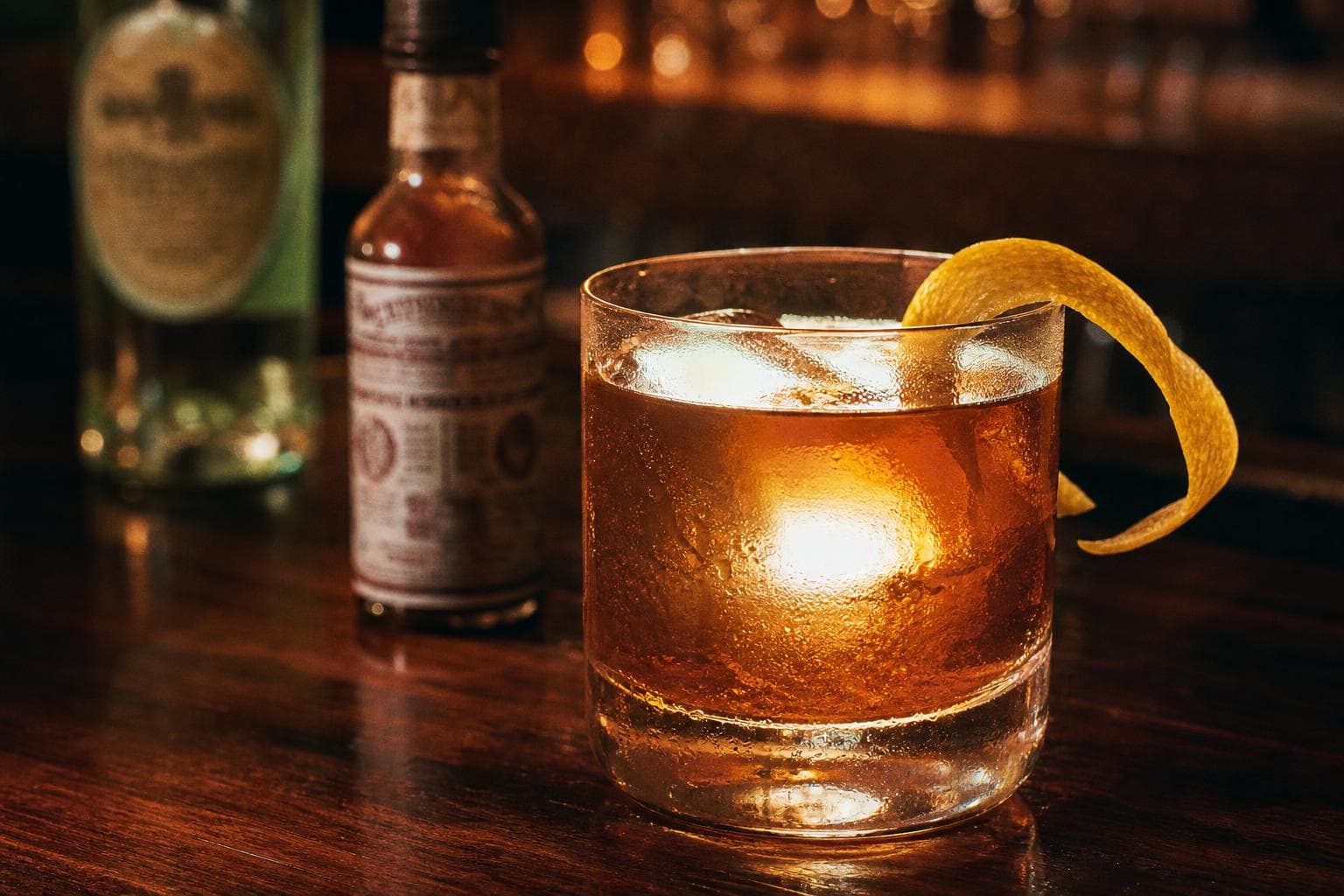

Order a Sazerac at ten different bars and you'll get ten different drinks. Some will be rye. Some will be cognac. A few will be both. The absinthe rinse will be generous at one place and invisible at another. Someone will drop the lemon peel in. Someone else will express it and throw it away like they're disposing of evidence. The glass will be chilled, or it won't. The Peychaud's will be measured, or it'll be eyeballed by a bartender who's done this a thousand times and trusts their wrist.
This is not a sign of a cocktail with room for interpretation. It's a sign of a cocktail whose history is genuinely contested — and whose contested history has been used to justify every variation imaginable.
The Cognac Question Nobody Agrees On
The Sazerac's origin story is, as David Wondrich writes in Imbibe!, so "intricate and entangled in myth" that it "requires a monograph of its own" — and Wondrich reportedly reached page sixteen of his Sazerac treatise before his editor made him stop. That's the cocktail historian's equivalent of tapping out.
What's reasonably established: the drink has roots in early 19th-century New Orleans, and Antoine Amédée Peychaud — a local pharmacist — created his own bitters using brandy, sugar, and water, which became central to the drink's identity. The brandy in question was almost certainly cognac. Rye whiskey entered the picture later, likely as cognac became harder to source in the United States following the phylloxera epidemic that devastated French vineyards in the late 1800s. The rye substitution stuck. Then it became canonical. Then people started arguing about whether cognac was the "authentic" base or a historical footnote.
The honest answer is: both have legitimate claims. The cognac version is older. The rye version is what most people mean when they say Sazerac. A split base — half rye, half cognac — is a reasonable synthesis that some bartenders swear by, pairing the spice of the rye against the rounder sweetness of the brandy. I'd argue the split base is actually the most interesting version to drink, even if it's the hardest to defend historically, because cocktail history is not a rulebook.
What the Absinthe Rinse Is Actually Doing
Here's where bartenders lose the plot most consistently: the absinthe rinse.
The rinse exists to perfume the glass, not to flavor the drink. A proper rinse coats the interior, you discard the excess, and what remains is aromatic — anise in the background, not the foreground. The chilled glass matters too: since the Sazerac is served neat with no ice in the glass, the chill is your only temperature management once the drink is strained.
What happens in practice: bartenders either over-rinse (leaving enough absinthe to make the drink taste like a Pernod accident) or skip the chill entirely (serving a room-temperature drink that goes warm in four minutes). Neither is a capital offense, but both miss the point of the technique. The rinse is a frame, not a feature.
Peychaud's bitters are non-negotiable. This is not a Peychaud's-or-Angostura situation. The Creole bitters — intensely aromatic, with anise, dried fruit, and warm spice — are what make a Sazerac a Sazerac rather than a whiskey Old Fashioned with delusions of grandeur. Angostura makes a fine drink. It's a different drink.
Build It Right
Sazerac (rye base)
- 2 oz rye whiskey (Rittenhouse 100 is the workhorse; Sazerac 6-Year if you want to stay on-theme)
- ¼ oz simple syrup, or one sugar cube dissolved with a few dashes of water
- 3–4 dashes Peychaud's bitters
- Absinthe rinse (Herbsaint if you want New Orleans-authentic; St. George Absinthe Verte works well)
- Lemon peel, expressed over the glass and discarded
Chill two rocks glasses. Rinse one with absinthe, discard excess. Stir rye, syrup, and bitters over ice until cold — about 30 seconds. Strain into the rinsed glass. Express lemon peel over the surface, run it around the rim, and set it aside or discard it. Do not drop it in. The peel has done its job.
For the cognac split: replace 1 oz of rye with 1 oz of VS or VSOP cognac. Pierre Ferrand 1840 is the standard recommendation and earns it.
The Verdict
The Sazerac confuses bartenders because it looks simple and isn't. Three ingredients, a rinse, a garnish — but every element has a specific function, and the margin for error is narrow precisely because there's nowhere to hide. No citrus juice to balance a heavy pour. No egg white to smooth over a rough spirit. Just whiskey, sugar, bitters, and the ghost of anise in a cold glass.
That's what makes it worth arguing about. And worth getting right.