


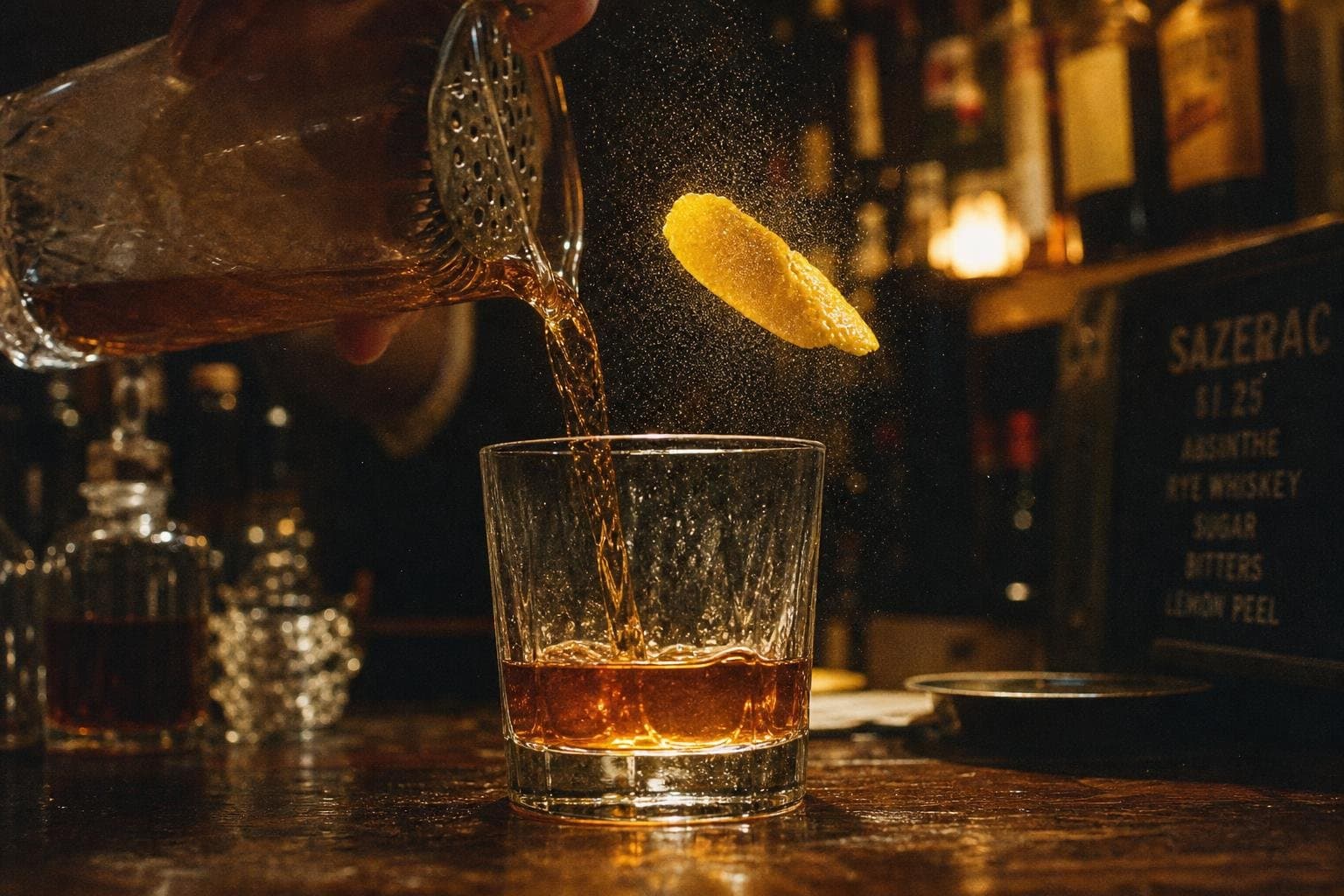

Walk into almost any serious craft cocktail bar opened in the last fifteen years and you'll find the same thing: a stirred, spirit-forward drink with a rinse of something aromatic, a single expressed citrus peel, no ice in the glass, served in a rocks glass that costs more than the spirit inside it. The Sazerac's fingerprints are everywhere. The question worth asking is whether that's because the Sazerac is genuinely the ur-text of the craft revival — or because the story we tell about it is too good to complicate.
The drink's history is already complicated enough, if anyone bothers to look. Source 1 presents the origin as settled fact — Antoine Peychaud, Royal Street apothecary, early 1800s, full stop. That's the marketing version, and it's been repeated so many times it has the texture of history. What it leaves out: the drink evolved substantially over decades, the cognac-to-rye substitution happened well after Peychaud's time, and the Louisiana legislature declaring it the official cocktail of New Orleans in the 21st century is a civic branding exercise, not a historical verdict. The Sazerac's origin is genuinely disputed in the ways that most cocktail origins are disputed — which is to say, the clean founding-myth version should be held loosely.
None of that diminishes the drink. The Sazerac is excellent. Rye whiskey, Peychaud's bitters, a sugar cube, an absinthe-rinsed glass, a lemon peel expressed and discarded — as the comparison at Gusto Meadow lays out, it's the most structurally distinctive of the three great American stirred whiskey cocktails, the one where technique and ritual are most visibly load-bearing. The absinthe rinse isn't decoration. The expressed peel isn't garnish. These are functional steps that change what you're drinking. That's worth respecting.
The Template Problem Is a Story Problem
Here's what actually happened: the craft cocktail revival of the early 2000s needed a creation myth, and the Sazerac was available. It's old, it's American, it's technically demanding, it rewards the kind of bartender who wants to explain what they're doing and why. It became the drink that serious bars used to signal seriousness. Order a Sazerac at a new bar and you're running a diagnostic — if they make it correctly, they probably know what they're doing. If they muddle the lemon peel into the drink, leave.
The problem is that "template" implies the Sazerac taught the craft revival something it didn't already know. The stirred, spirit-forward, aromatically complex drink is not a Sazerac invention — it's a category that includes the Manhattan, the Old Fashioned, the Vieux Carré, the Toronto, and a dozen others. The Sazerac became the symbol of that category's revival, not its source. There's a difference, and collapsing it does something subtly damaging: it makes the Sazerac's specific techniques look like universal principles when they're actually one expression of a broader logic.
The absinthe rinse, for instance, is a Sazerac technique. Applied to every spirit-forward cocktail as a default gesture toward complexity, it's a tic. The expressed-and-discarded citrus peel is a Sazerac technique. As a blanket policy applied to drinks that might benefit from the peel left in, it's cargo-cult bartending. The craft bar that learned from the Sazerac's principles — balance, restraint, technique in service of flavor — is doing something different from the bar that learned from its gestures.
What the Drink Actually Teaches
The Sazerac's real lesson is about proportion and restraint. It's a short drink with nowhere to hide. The rye has to be right — something with enough backbone to push through the bitters and the absinthe ghost. The bitters have to be Peychaud's, not because of tradition for its own sake, but because Peychaud's is lighter and more floral than Angostura, and the drink is calibrated for that. Substitute Angostura and you haven't made a Sazerac, you've made a different drink that happens to have an absinthe rinse.
That specificity is the actual inheritance worth claiming. The Sazerac is a drink where every element is doing exactly one thing and nothing else. The absinthe rinse provides aroma without weight. The expressed lemon peel provides brightness without acid. The sugar provides just enough sweetness to keep the rye from being austere. Remove any element and the drink collapses. Add anything and it becomes something else.
Most craft cocktail bars learned that lesson. The ones that didn't are the ones with twelve-ingredient drinks where the Sazerac's ghost is visible in the technique but the point has been entirely lost. The Sazerac didn't create a template for complexity. It created a template for sufficiency — the idea that a drink should contain exactly what it needs and nothing more.
That's the harder lesson. It's also the one that gets cited least often when bars invoke the Sazerac's authority.