


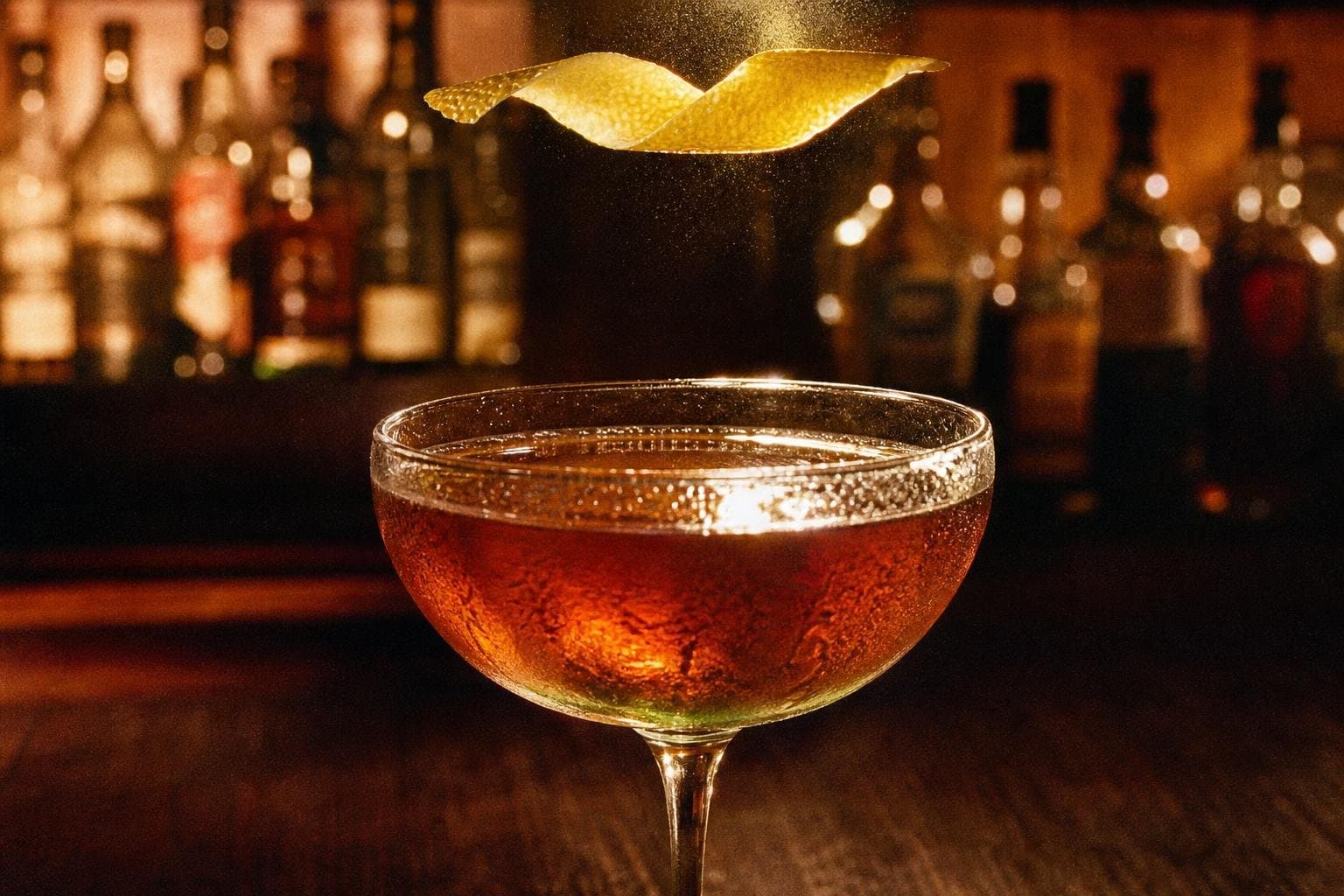

There's a version of the Sazerac story that gets told at every craft bar orientation: Antoine Peychaud, Creole apothecary, 437 Royal Street, cognac and his proprietary bitters served in an egg cup. It's a good story. It's also, like most cocktail origin stories, contested at the edges and smoothed in the retelling.
What's less often discussed is the strange doubling that happened over the next century and a half — a drink becoming a symbol, and then a company absorbing that symbol so completely that most people now associate "Sazerac" less with rye whiskey and absinthe than with a privately held spirits conglomerate that, as of late July, renewed a $15 billion bid to acquire Brown-Forman. The drink and the company have become almost impossible to disentangle. That's worth examining.
The Drink Earned Its Reputation the Hard Way
The Sazerac's foundational recipe — rye whiskey (originally cognac), Peychaud's bitters, sugar, and an absinthe-rinsed glass — is widely regarded as New Orleans' signature cocktail, and the description holds up. It's a drink that resists simplification. The ritual matters: the rinse, the chill, the absence of ice in the finished glass, the lemon twist expressed and discarded. Every step earns its place.
The cognac-to-rye substitution is where the drink's history gets genuinely interesting. Source 5 frames this correctly: the early form was built on French brandy, not whiskey, and the shift to rye reflects supply pressures and shifting trade realities rather than any deliberate reinvention. The drink that Americans now treat as a monument to rye whiskey tradition was, for a significant portion of its early life, a cognac drink. That's not a footnote — it's the whole argument about what "authentic" means when you're talking about a recipe that's been alive for nearly two centuries.
What the Sazerac also demonstrates, better than almost any other American classic, is how much New Orleans' cocktail identity was built on imported ingredients and immigrant knowledge. PUNCH's survey of New Orleans classics notes that the Brandy Crusta — another foundational city drink — was invented by an Italian bartender named Joseph Santini, predating even the rye-era Sazerac. The city's "homegrown" cocktail canon is, on closer inspection, a record of port traffic, French taste, and Creole synthesis. The Sazerac is the most famous product of that collision.
The Company That Took the Name
Here's where it gets uncomfortable for anyone who wants to keep the drink and the brand cleanly separated.
Sazerac Company — owner of Buffalo Trace, Barton 1792, and A. Smith Bowman — has spent the last two decades building one of the largest American whiskey portfolios in existence. According to Forbes, the company reported net sales of $6.6 billion as of March 2026, up from $300 million in 2007. That's not a craft spirits company that grew up. That's a conglomerate that used the cultural weight of a single cocktail name to build a global distribution machine.
The July acquisition drama — Sazerac's renewed $15 billion bid for Brown-Forman, rejected by the Brown family as not aligned with their "vision for Brown-Forman's future" — has nothing to do with the drink. It's a story about market consolidation, route-to-market strategy, and two Louisville-based family businesses fighting over the American whiskey category's future. But the name on the letterhead is still Sazerac. The apothecary's egg cup is still in the logo.
This is the marketing-to-substance ratio problem in its most concentrated form. The company didn't invent the drink. It appropriated the drink's cultural authority and used it to build a portfolio that now includes brands the drink's originators never heard of.
What the Drink Still Tells You
None of this diminishes the Sazerac in the glass. A well-made one — proper dilution, cold glass, the anise just present enough to frame the rye without announcing itself — remains one of the most technically demanding simple drinks in the canon. The balance point is narrow. Bad vermouth can't hide in a Sazerac because there's no vermouth. Bad technique can't hide either.
That's the thing about drinks with no cover. The Sazerac has been New Orleans' calling card long enough that it's absorbed a lot of mythology, a corporate name, and a century of arguments about cognac versus rye. It's still just four elements and a rinse. Make it right and it tells you everything about the bar. Make it wrong and the history doesn't save you.
The company named after it is trying to buy Jack Daniel's. The drink is still just trying to be itself.