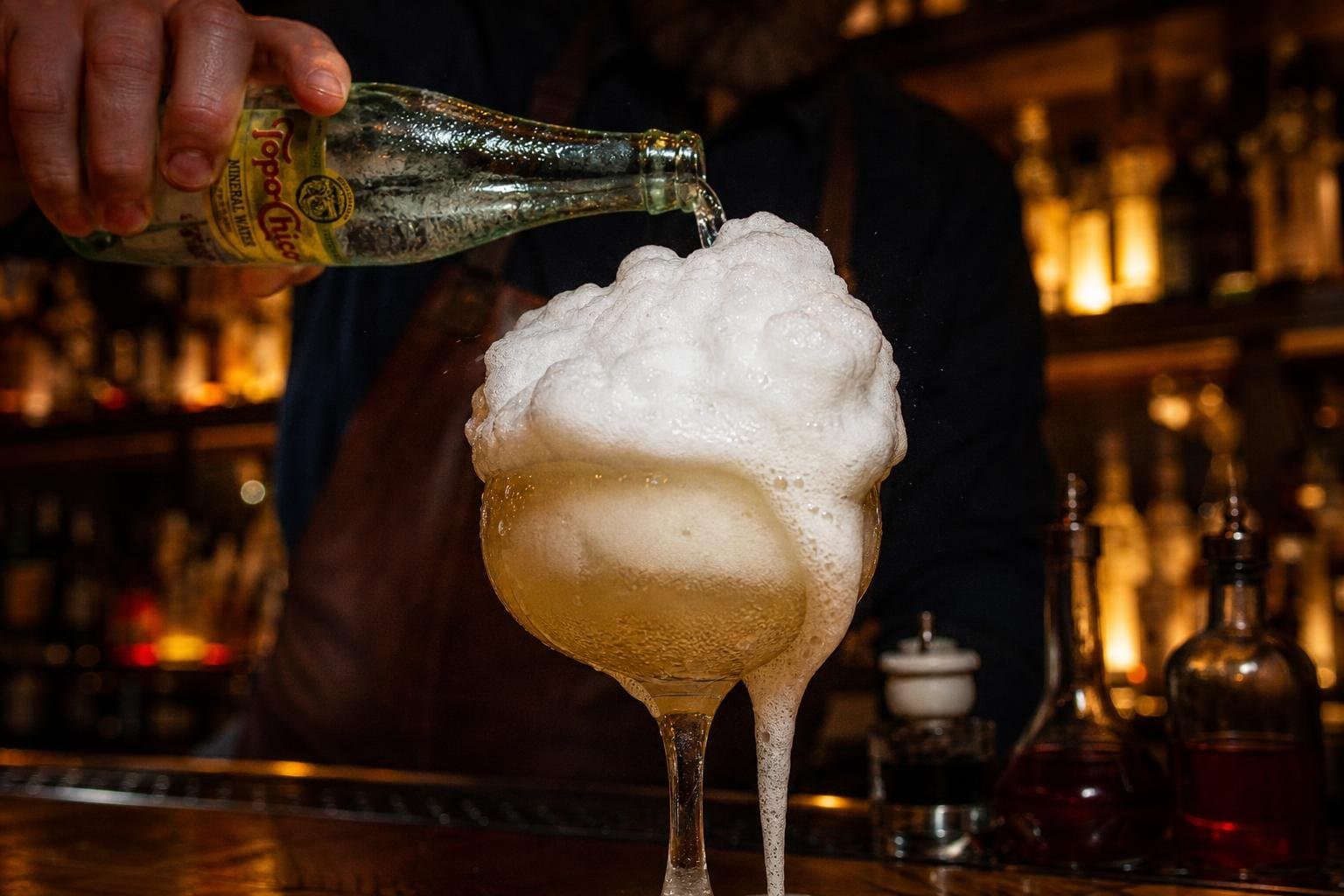

There's a version of cocktail history that gets repeated so often it calms into fact: Henry C. Ramos invented a drink at his Imperial Cabinet Saloon in New Orleans in 1888 so punishing to make that he kept a relay team of bartenders — "shaker boys" — passing the tin down the bar so no single arm had to carry the whole shake, with some accounts putting the total time at twelve minutes or more (Gincave). It's a great story. It's also the kind of story that's survived a century of retelling with no obvious way to check it against a primary source, which is true of most pre-Prohibition cocktail lore and worth saying out loud every time one of these anecdotes gets passed off as documented fact rather than bar-room folklore that's calcified into canon.
What isn't folklore is the chemistry. The Ramos Gin Fizz is gin, lemon and lime juice, cream, egg white, sugar, and orange flower water, shaken until it transforms into something closer to a drinkable meringue, then topped with soda so the foam climbs above the rim of the glass (Gincave). That foam is the entire point of the drink. No foam, no Ramos — you've just made a slightly odd gin sour with cream in it. And building that foam properly requires more mechanical effort than almost anything else behind the bar, which is exactly why most bars quietly gave up trying.
The Technique Nobody Argues With, Even If They Skip It
Set aside the shaker-boys legend and look at what the drink actually demands. The modern consensus method is a two-stage shake: a hard dry shake with no ice first, to emulsify the egg white, cream, and citrus into a thick, cohesive base, followed by a second, equally vigorous shake with ice to chill and aerate it (Gincave). This isn't Ramos-specific — it's the same logic behind any good egg-white sour. A dry shake works because the ice, while useful for chilling, actually absorbs some of the shaking energy and makes it harder to build foam fast; separating emulsification from chilling gives the egg white more direct, uninterrupted agitation (Bar6). Some bartenders push further with a reverse dry shake — shake with ice first, strain the ice out, then shake again without it — which can produce an even finer, more stable foam, though it adds a step and a straining headache most bars at volume don't want (Bar6).
What makes the Ramos different from a Whiskey Sour or a Clover Club is dosage of effort, not a different idea. Every source describing the drink agrees on the same basic point: you cannot over-shake it. The foam height and stability scale directly with how hard and how long you go at both stages (Gincave). That's an unusual thing to be able to say about a cocktail. Most drinks have a point of diminishing returns where more shaking just means more dilution and a flatter drink. The Ramos is the rare build where "as hard as you can manage" is simply the instruction, full stop, and the twelve-minute legend exists precisely because that instruction is physically exhausting to follow to its logical end.
The Blender Is Not a Cheat. It's an Admission.
Here's where it gets interesting for anyone trying to make this drink without hiring a shaker-boy relay team. One recipe approach skips the extended hand-shake entirely and builds the drink in a blender with a few ice cubes, blending until the ice sound disappears, then pouring the result into a chilled glass topped with soda and letting it rest in the freezer for five minutes so the head firms up (olive magazine). It even uses the same trick the hand-shaken version relies on for its final flourish — a hole poked into the center of the drink with a straw, with extra foam poured down through it so the head rises above the rim like a dome (olive magazine).
I'll say the thing the recipe itself won't: a blender isn't a shortcut, it's a confession that the hand-shaken version is genuinely too hard to do consistently at scale. That's not an insult to the technique. It's a fair trade. A blender applies more raw mechanical energy in ninety seconds than most forearms can produce in three minutes, let alone twelve. If the entire function of the shake is aeration and emulsification, and a blender achieves both faster and more reliably, the purist objection collapses into aesthetics — the ritual of the long shake, not the result in the glass. I happen to think the ritual matters at a bar that wants to sell the Ramos as a spectacle, a drink people order because they've heard it's a production. At home, where nobody's watching you suffer for art, the blender is the correct call and anyone who tells you otherwise is more attached to the bit than the drink.
The Industry's Real Answer Wasn't a Better Shake. It Was a Different Ingredient.
The more honest story of why bars "gave up" on the twelve-minute shake isn't about blenders at all — it's about egg whites becoming a liability nobody wants to manage during a Friday rush. Raw egg whites need refrigeration, careful separation, and strict hygiene discipline, and those requirements are hard to hold consistent across a long shift with turnover stacking up at the rail (Bar6). That's a legitimate operational problem, and it's spawned a predictable industry response: shelf-stable foaming agents marketed as drop-in replacements for egg white, sold hard on the promise of consistency and zero food-safety risk.
I'm not going to pretend that pitch is neutral reporting, because it isn't — it's product marketing dressed up as technique journalism, complete with the breathless claim that a proprietary foaming powder "performs better" than egg whites and the kind of unfalsifiable language about "neutral" mouthfeel that every ingredient brand uses when it wants you to stop asking what's actually in the bottle. I'd put real weight behind the food-safety argument and real skepticism on the performance claims, because nobody shaking a Ramos by hand for a minute-plus is chasing "consistency across every pour" — they're chasing a specific, theatrical foam that's inseparable from the labor that makes it. Swap in a powder and you've solved a logistics problem. You haven't made a better Ramos. You've made a drink that looks like one and skipped the part that made the original worth ordering in the first place.
This is the industry's marketing-to-substance ratio problem in miniature: real operational pain (egg whites are annoying) gets used to sell a solution whose actual case rests on taste and texture claims nobody's independently verified, while the thing that genuinely made the drink special — the absurd, inefficient, borderline-masochistic shake — gets quietly engineered out of the equation.
What Reviving the Shake Actually Means
Reviving the twelve-minute shake isn't really about historical accuracy, since nobody can confirm the shaker-boy relay actually ran that long on any given night in 1888. It's about refusing the shortcut that strips the drink of its only interesting feature. A Ramos made with a thirty-second shake and a squirt of foaming powder will look passable in a photo and taste thinner than it should, because the foam built fast collapses fast, and the whole architecture of the drink depends on a foam dense enough to hold a dome above the glass rim while soda works its way underneath it.
If you're making this at home, the blender route is defensible and the dry-shake-then-wet-shake method is the honest hand-made version — do both stages as hard as your arm allows, and don't stop at the point where your shoulder starts complaining, because that's usually about ten seconds before the foam actually locks in. If you're ordering it out, ask what's in it. A bar willing to tell you they still use egg white and still do the full shake is telling you something about how they run service generally. A bar that's switched to a powder because it's faster isn't lying to you, exactly. It's just selling you a drink that traded its one real virtue for throughput.


