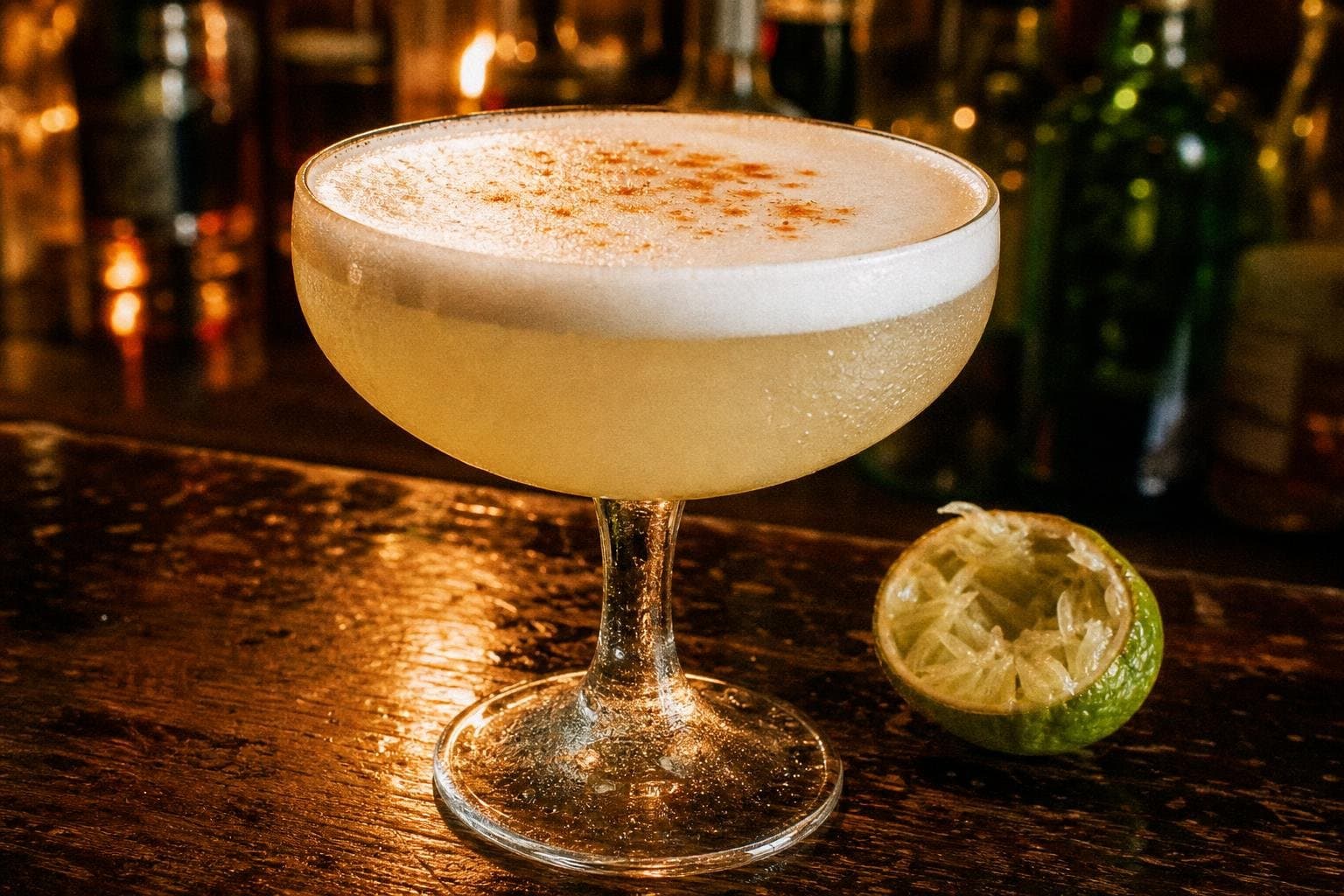

There's a cocktail that's been made in Lima for over a century, and American bartenders are currently "discovering" it. This happens every decade or so. The drink gets a write-up, a few craft bars put it on the menu, someone calls it "underrated," and then it quietly recedes again while the industry moves on to the next thing. What's different now — and worth examining carefully — is that pisco is accumulating a genuine foothold in American cocktail culture, not through a single trend moment but through something slower and more durable: bartenders who've actually been to Peru, and who are building drinks around what they found there rather than what the marketing materials promised.
That's a meaningful distinction. And it's worth pulling the thread.
San Francisco Already Had This Conversation. In the 1870s.
The American relationship with pisco is not new. It's just been badly remembered.
San Francisco's Bank Exchange Saloon made pisco punch one of the city's signature drinks during the Gold Rush era — a fact that recipe developer Kim Laidlaw leaned on when she built a modern riff on the drink for her cookbook Spirits of '76, adding yuzu and a pineapple-pomegranate shrub to the Peruvian brandy. The Bank Exchange's version was famous enough that it drew international visitors specifically to try it. Then Prohibition arrived, the saloon closed, and American pisco culture essentially evaporated for the better part of a century.
This matters because the current "discovery" narrative — pisco as an exotic South American spirit newly arriving on American shores — is historically illiterate. The spirit had deep roots in California before most of the cocktail canon existed. What happened wasn't that Americans discovered pisco; it's that they forgot it, and now they're relearning it with the confidence of people who think they're the first to notice.
The forgetting had structural causes. Peru established an official Denomination of Origin for pisco in 1991, a move that protected the spirit's provenance and integrity but also signaled how recently the international market had started taking it seriously. For most of the 20th century, pisco was Peru's national drink in the sense that it stayed in Peru. Distribution into American markets was thin, inconsistent, and largely confined to Peruvian restaurants. The craft cocktail renaissance of the 2000s created the conditions for a revival, but the revival has been slower and more uneven than the industry tends to acknowledge.
What Peru Actually Makes, and Why the Category Resists Easy Explanation
Part of pisco's American problem is that it's genuinely difficult to explain without either oversimplifying or losing the room.
Latin America's spirits extend far beyond rum, and pisco sits in a category that American drinkers have no ready framework for. It's a brandy — distilled from grapes — but it doesn't taste like Cognac or Armagnac or any of the European brandies that American drinkers might have encountered. It's unaged or minimally aged, which puts it closer to eau-de-vie in texture, but the grape varieties used are specific to the Ica and Pisco Valleys, and the flavor profile is its own thing: floral, sometimes funky, with a clean finish that makes it work in cocktails in ways that aged brandies often don't.
The Denomination of Origin question also creates confusion. Both Peru and Chile produce pisco and have competing claims to the spirit's origins — a dispute that has been running for decades and shows no signs of resolution. Peruvian pisco is made from specific grape varieties, distilled to proof (meaning no water is added after distillation), and cannot be aged in wood. Chilean pisco operates under different regulations and can be aged. They taste different. They behave differently in cocktails. Treating them as interchangeable — which American menus frequently do — is like treating Scotch and Irish whiskey as the same category because they're both made from grain.
Amanda Barnes, MW, author of The South America Wine Guide, has noted that "the top piscos of Peru are still relatively untapped and certainly deserve more attention" — and that more of these piscos are traveling further into international markets than they used to. The distribution problem is real but improving. This is the "hard to find" category, not "out of production": Peruvian pisco is being made, in quantity, by producers who've been at it for generations. The bottleneck is American import infrastructure and retailer willingness to stock a spirit that requires explanation.
The Bartender Who Actually Went There
The most interesting thing happening with pisco in American bars right now isn't a trend. It's a handful of bartenders who've done the work.
Dillon Raaz, named one of Punch's Best New Bartenders of 2026, spent time in Lima's Miraflores neighborhood — drinking, he says, "more Pisco Sours than I can remember" — and came back to his bar at Atoma in Seattle with something more useful than a recipe: an understanding of how local produce integrates with the spirit. His cocktail Missing Miraflores uses brandy from an Oregon-based distiller and plums grown in Seattle, with fermented plum brine as a structural element. It's not a Pisco Sour. It's a drink that uses the logic of a Pisco Sour — the interplay of spirit, acid, and something that bridges them — and rebuilds it from Pacific Northwest ingredients.
This is the right approach, and it's worth saying clearly: the drink works because Raaz understood what he was riffing on before he started riffing. The fermented plum brine isn't a gimmick; fermentation introduces a complexity that mirrors what the egg white does in a traditional Pisco Sour — it softens, it rounds, it makes the acid feel integrated rather than sharp. The dehydrated blackberry garnish, blended with sugar into a powder, adds textural contrast and a Pacific Northwest anchor. The drink is an ode to Lima filtered through Seattle, and it holds together because the underlying structure is sound.
Compare this to what most American bars do with pisco: they make a Pisco Sour, usually with a recipe they found online, using whatever pisco was easiest to source, and they put it on the menu as an "exotic" option next to the Aperol Spritz. The drink is fine. It's not a conversation. It doesn't tell you anything about the spirit or where it came from or why it matters.
The difference between those two approaches is the difference between cocktail culture as excavation and cocktail culture as decoration.
The Pisco Sour as Diagnostic Tool
I wrote earlier this year that a well-made Daiquiri tells you more about a bar than its most expensive creation. The Pisco Sour is the same test in a different key.
The drink has three load-bearing elements: pisco, fresh citrus, and egg white. There's no sugar rush to hide behind, no aged spirit's complexity to carry the weight, no bitters to add intrigue. The pisco has to be good and has to be appropriate — not all piscos work equally well in a Sour, and the choice of grape variety matters. The citrus has to be fresh. The egg white has to be properly integrated, which means dry shaking before the ice goes in, which means the bartender knows what they're doing.
When a bar makes a Pisco Sour badly — and most bars make it badly — the failures are diagnostic. Bottled citrus means the bar doesn't care about freshness. A foamy but flat result means they skipped the dry shake. A spirit that tastes like rubbing alcohol means they bought the cheapest bottle available and didn't taste it first. These are the same failures that show up in every other drink on the menu; the Pisco Sour just makes them visible because there's nowhere to hide.
When a bar makes it well, the reverse is true. A properly made Pisco Sour — silky, tart, with the spirit's floral character coming through the foam — is one of the more beautiful drinks in the canon. It's also genuinely difficult to execute, which is why bars that can do it tend to be worth your time.
Lynnette Marrero, award-winning bartender and Speed Rack cofounder, has been making the case for Latin American spirits as a category worth serious attention — not as novelty, but as a range of traditions that American drinkers have systematically underexplored. Her framing is useful: the Pisco Sour, the Daiquiri, and the Caipirinha are entry points, not endpoints. They're the drinks that introduce you to the logic of a spirit; what you do after that depends on how curious you are.
What a Real Pisco Revival Would Actually Look Like
The current moment is promising but incomplete. Pisco is appearing on more menus, more bartenders have firsthand experience with it, and Peru's wine and spirits scene is generating genuine international attention in ways that create a halo effect for the spirit. The cookbook Spirits of '76 treating pisco punch as California's signature cocktail — the Pisco Solstice recipe builds on that Gold Rush legacy with yuzu and shrub — suggests that the spirit's American history is starting to be recovered rather than ignored.
But a real revival requires more than menu placement. It requires American bartenders to understand the category well enough to make meaningful choices within it — which grape variety, which producer, which style of pisco for which application. It requires retailers to stock more than one or two bottles. It requires the industry to resist the temptation to flatten pisco into a single "exotic South American spirit" story and instead engage with its actual complexity: the regional variations, the production differences, the centuries of history that predate the craft cocktail movement by a considerable margin.
The Pisco Sour is a great drink. It was a great drink before American bartenders started putting it on their menus, and it will be a great drink after the trend cycle moves on. The question is whether the current moment produces bartenders who understand why — or just more menus with a Pisco Sour on them.
The Bank Exchange Saloon figured it out in the 1870s. We've had enough time to catch up.


