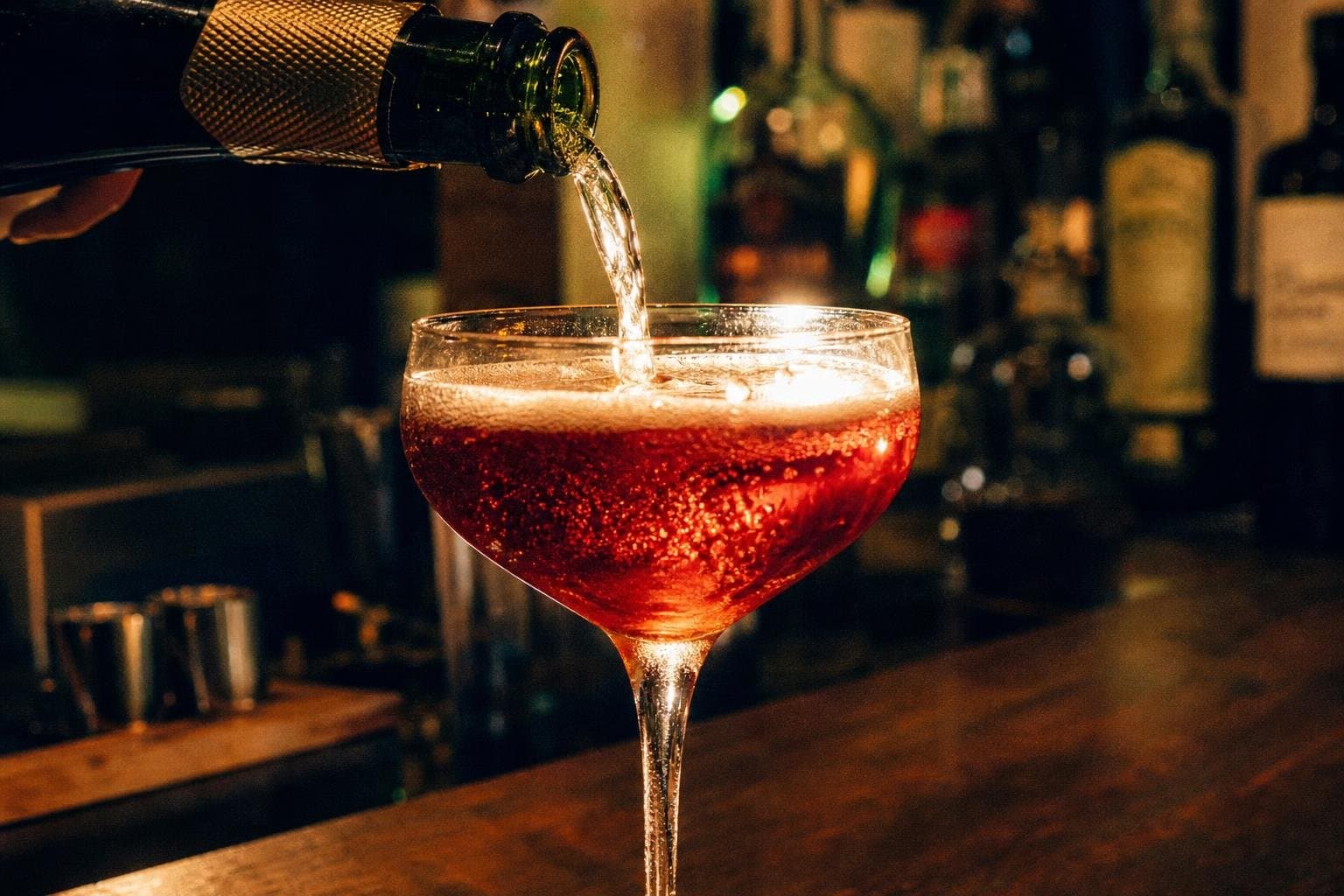

Open TikTok and search "Negroni Sbagliato" and you'll land on a page built entirely around one meme format — bartenders miming the gesture, captioning it with a pop culture reference, stacking prosecco bottles like trophies — alongside a mashup video pairing the drink with a Lil Yachty remix, directed by a creator credited as Johnyboz. That's not a cocktail story. That's a content format with a drink attached to it. And it tells you most of what you need to know about how a 170-year-old habit — dressing up a simple drink until it photographs better than it drinks — has found its newest delivery mechanism.
I've spent a few issues this year taking the Negroni family seriously, from the standard riffs worth knowing to the white Negroni's quieter corner of the shelf. The Sbagliato sits in that family as the easy one: swap the gin for prosecco, keep the Campari and sweet vermouth, and you get something lighter, fizzier, and — crucially — easier to film pouring. That's the part that matters here. The question worth asking isn't whether the drink is good. It's whether its online moment tells you anything the drink itself didn't already know.
Spectacle Has Always Been the Business Model
Stunt cocktails aren't a social media invention; they're a bar tradition that predates photography entirely. Jerry Thomas built his reputation in the 1850s on the Blue Blazer, a whiskey-sugar-and-boiling-water drink whose entire value proposition was the moment he set it on fire and arced it between two mugs to create a ribbon of blue flame before topping it with lemon. Tiki bars in the 1940s and '50s swapped metal mugs for carved bowls and turned the garnish itself into the show — a hollowed lime packed with overproof rum, lit tableside. By the '70s and '80s, bars were lighting shots on fire and dropping them into beer, the move that eventually calcified into the Flaming Dr Pepper. Even the more recent wave of "elevated" theater — Eben Freeman pairing bourbon and Coca-Cola with tableside smoke in 2007 — follows the same logic as the Blue Blazer did a century and a half earlier: the drink is the excuse, the gesture is the product.
What's changed isn't the impulse. It's the distribution. A flaming cocktail in 1858 could only impress the people standing at the bar. A pour today gets looped, remixed, and recirculated to an audience that will never taste it. The theatrics used to be a tip-generating performance for a room. Now they're a thumbnail.
The Sbagliato's Advantage Is That It Doesn't Need the Theatrics
Here's where the Sbagliato is a genuinely interesting case rather than just another stunt-cocktail footnote: it doesn't require fire, dry ice, or a live snail garnish to generate attention. The format that circulates on TikTok is almost entirely verbal — a meme built on the phrase itself, a mashup video pairing the drink's name with a 2026-adjacent rap remix — rather than anything happening in the glass. That's a different kind of virality than an escargot garnish or a blood-bag margarita, and it's worth separating from the broader stunt-cocktail churn that gave us cocktails built around dry ice, insects, and novelty props as a kind of arms race between nightlife-heavy markets. The Sbagliato went viral on branding, not production value. No bar had to invest in a torch or a smoke gun to ride the wave. They just had to have prosecco in the well and a bartender willing to say the name on camera.
That's a lower bar to clear, and it's also a lower bar for substance. A flaming drink at least demonstrates some competence — timing, nerve, a working knowledge of what alcohol does near an open flame. A meme format demonstrates nothing except that a bartender owns a phone.
What the Drink Actually Asks of a Bar
Strip away the meme format and the Sbagliato is a three-ingredient build: Campari, sweet vermouth, prosecco, built or stirred and topped. There's no technique to hide behind and nowhere for a bad bar to disguise itself. The proportions are the whole test — too much prosecco and it's candy soda with a bitter aftertaste, too little and you've just made a worse Negroni. A bar that nails the balance is demonstrating the same skill that makes its regular Negroni worth ordering: restraint, a decent Campari pour, vermouth that hasn't been sitting open on a shelf since spring.
That's the same argument I made about the proper Negroni variations worth seeking out — the ones that earn a place on a menu do it by respecting the original's architecture, not by replacing it. The Sbagliato passes that test on its own merits. It doesn't need the TikTok trend to justify its inclusion in that lineage. The trend just happens to be attached to it right now, the way a hashtag happens to be attached to the week's dance.
The Real Tell Is What Bars Do With the Attention
Compare the Sbagliato's moment to how a magazine like Imbibe actually treats trend-chasing when it's done with intention. Their Banoffee Espresso Martini — banana liqueur folded into the now-ubiquitous espresso martini format — is explicitly framed by Teddy Attelus, head of bars at Freehand Miami, as "a playful way to bring together a timeless cocktail and a current trend". Notice what's happening there: the trend is the modifier, not the structure. The espresso martini's bones stay intact. The banana liqueur is additive, not a gimmick bolted on for a camera.
That's the difference between a good trend riff and a bad one, and it's the standard the Sbagliato's TikTok treatment mostly fails. A meme page built around a name and a music mashup isn't teaching anyone to make the drink better. It's not showing proportions, technique, or glassware. It's showing a gesture and a punchline. Compare that with the stunt-cocktail lineage traced back to Jerry Thomas — even the Blue Blazer, pure theater as it was, required the bartender to actually know what they were doing with boiling liquid and open flame. The modern meme format doesn't ask bartenders to demonstrate anything. It asks them to participate.
What to Watch
The useful question going forward isn't whether the Sbagliato deserves its moment — it's a solid, correctly structured drink whether or not anyone is filming it. The question is whether any of the attention converts into bars actually stocking decent vermouth and real Campari rather than a private-label bitter substitute, the same test every trend eventually fails or passes. Watch whether backbars treat the drink as a reason to tighten their Negroni program generally, or whether it stays a seasonal hashtag that disappears the moment the algorithm moves on to the next three-syllable Italian phrase. The drink will outlast the trend either way. It was fine before anyone was filming it.


