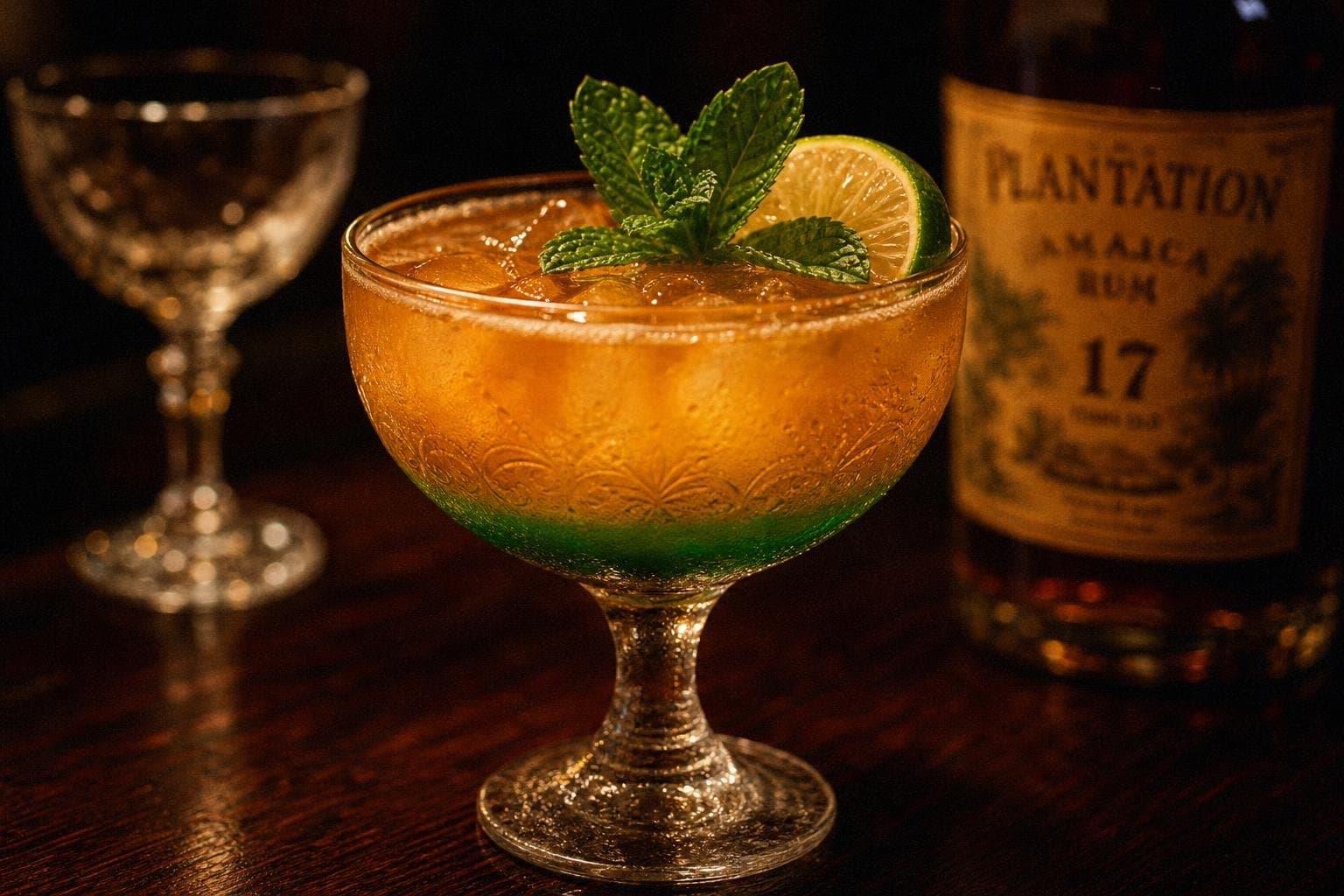

Two men spent decades telling the same story about themselves: I invented the most famous drink in tiki. Neither ever produced a document that settled it, and neither needed to. The argument itself became part of the product.
The Mai Tai is probably the best-known cocktail to come out of American tiki, and its origin is still disputed by the people who study this stuff for a living. That's not an accident of lost paperwork. It's a pattern. Tiki as a category was built on romanticized, half-invented backstories from the start, and the drink that became its flagship inherited the same instinct for myth before fact.
Two Bar Owners, One Drink, No Receipts
The standard version of the story credits Victor Bergeron, the Oakland bar owner behind Trader Vic's, with creating the Mai Tai in 1944 — though even that claim comes with a built-in asterisk, since accounts describe him as having "created (or at least claimed to create, depending on whom you ask)" the drink, per Spork Island Trading Company. His rival was Ernest Gantt, who rebranded himself Donn Beach and opened Don's Beachcomber in Hollywood in the early 1930s, building his reputation on rum drinks mixed from house syrups he guarded so closely his own bartenders worked off coded, numbered bottles rather than real recipes, according to the same source. That level of operational secrecy wasn't paranoia for its own sake — it was the business model. If nobody could replicate your drink, nobody could prove who invented it either.
Other accounts of the period frame it even more bluntly: there's "still a debate because there were two people who claimed to have invented the drink," with dates for the Mai Tai's first appearance floated as either 1933 or 1944, according to Gusto Meadow. That decade-plus spread between the two proposed origin dates is itself revealing. A drink invented in 1933 and a drink invented in 1944 aren't the same claim with a rounding error — they're two different timelines pointing at two different bars, which is exactly the shape of the dispute. Nobody's arguing over whether Bergeron tweaked an existing recipe. The argument is over which decade and which bar the thing came from at all.
Why Nobody Can Just Check
Cocktail history runs into this problem constantly, and it's worth being honest about why. Bars in this era didn't file patents. Recipes were proprietary trade secrets, protected by exactly the kind of obfuscation Donn Beach practiced with his numbered bottles. When your entire competitive advantage is a syrup blend nobody else can reverse-engineer, you don't write it down somewhere a rival could find it. You also don't correct the record decades later if the ambiguity is working in your favor — a famous invented drink is a marketing asset whether or not you actually invented it.
This isn't unique to tiki. Bénédictine's own origin story follows an identical shape: a liqueur supposedly distilled by monks in 1510, "lost" after the French Revolution, then "rediscovered" a century later by a wine merchant, Alexandre Le Grand, who marketed his version as a faithful recreation of the ancient recipe, as Punch lays out. Whether or not Le Grand actually found an old book in a monastery archive, that story sold liqueur. The Mai Tai feud works the same way. A disputed, debated origin generates more attention than a settled one, and both Bergeron and Beach understood that a mystery is better advertising than a receipt.
So when you read a confident paragraph insisting one man definitively invented the Mai Tai, you're reading marketing copy dressed as history, not a verified fact. The honest version of the story is the dispute itself.
What Tiki Was Actually Selling
It helps to remember what both men were building wasn't really Polynesian in any documented sense — it was a Hollywood-filtered fantasy of the South Pacific assembled from bamboo, carved masks, and imagined exoticism, a "romantic, Hollywood-tinted daydream" rather than an import of any single Pacific culture, as Spork Island puts it. Tiki blended Polynesian, Melanesian, and Micronesian motifs into one invented aesthetic, a tension between escapism and appropriation that still shapes how the genre gets discussed, per Ribbon Rock Maui. Against that backdrop, an origin feud between two California bar owners over a drink named for a Tahitian word isn't a footnote — it's the whole enterprise in miniature. The entire category was built on confident assertion standing in for verified cultural fact, and the Mai Tai dispute is just the version of that habit that happened to involve two men instead of an entire industry.
The postwar boom that followed only deepened the fantasy. Returning servicemen brought back stories from the Pacific theater, Thor Heyerdahl's 1947 raft voyage turned into a bestselling adventure narrative, and Hawaii's 1959 statehood put the islands within easy reach of mainland travelers, according to Spork Island — all of it compounding tiki's commercial momentum right as the Bergeron/Beach rivalry was hardening into legend. A drink with a disputed birth year fit a genre that was already comfortable blurring the line between where something came from and where it was convenient to say it came from.
The Drink Survived the Argument Better Than the Argument Deserved
Here's the part that actually matters to anyone mixing one tonight: the fight over authorship has outlived any agreement on what the drink should taste like. Descriptions of the Mai Tai today range from rum-forward and tart to fruit-juice-heavy and sweet, and the ingredient list has ballooned well past the original pairing of rum, lime, and orgeat to include grapefruit, pineapple, grenadine, and falernum in various modern versions, per Gusto Meadow. That's not a minor stylistic drift. A drink built around two or three components holds its balance; a drink with eight competing elements usually just tastes like punch. The authorship feud gets all the attention because it's a story with characters and grudges. The quieter failure — that most bars serving "Mai Tai" today are pouring something closer to a fruit-juice sour than whatever either Bergeron or Beach actually put behind their own bar — gets almost none.
That's the real cost of a myth with no settled version: not just confusion over who gets the credit, but confusion over what the thing is supposed to be in the first place. If nobody can agree on the drink's birth certificate, it's not surprising nobody agrees on the recipe either.
What to Actually Argue About Instead
The authorship question isn't solvable with the sources that exist, and I'd rather be honest about that than pretend a confident verdict is available. What's worth paying attention to going forward isn't who gets canonized as the inventor — it's whether bars pouring a "Mai Tai" are building it around rum, lime, and orgeat in close balance, or burying it under juice and grenadine because that's what sells on a menu photo. The feud between two long-dead bar owners is permanently unresolved. Whether your glass tastes like the drink they were actually fighting over is something you can check tonight.


