


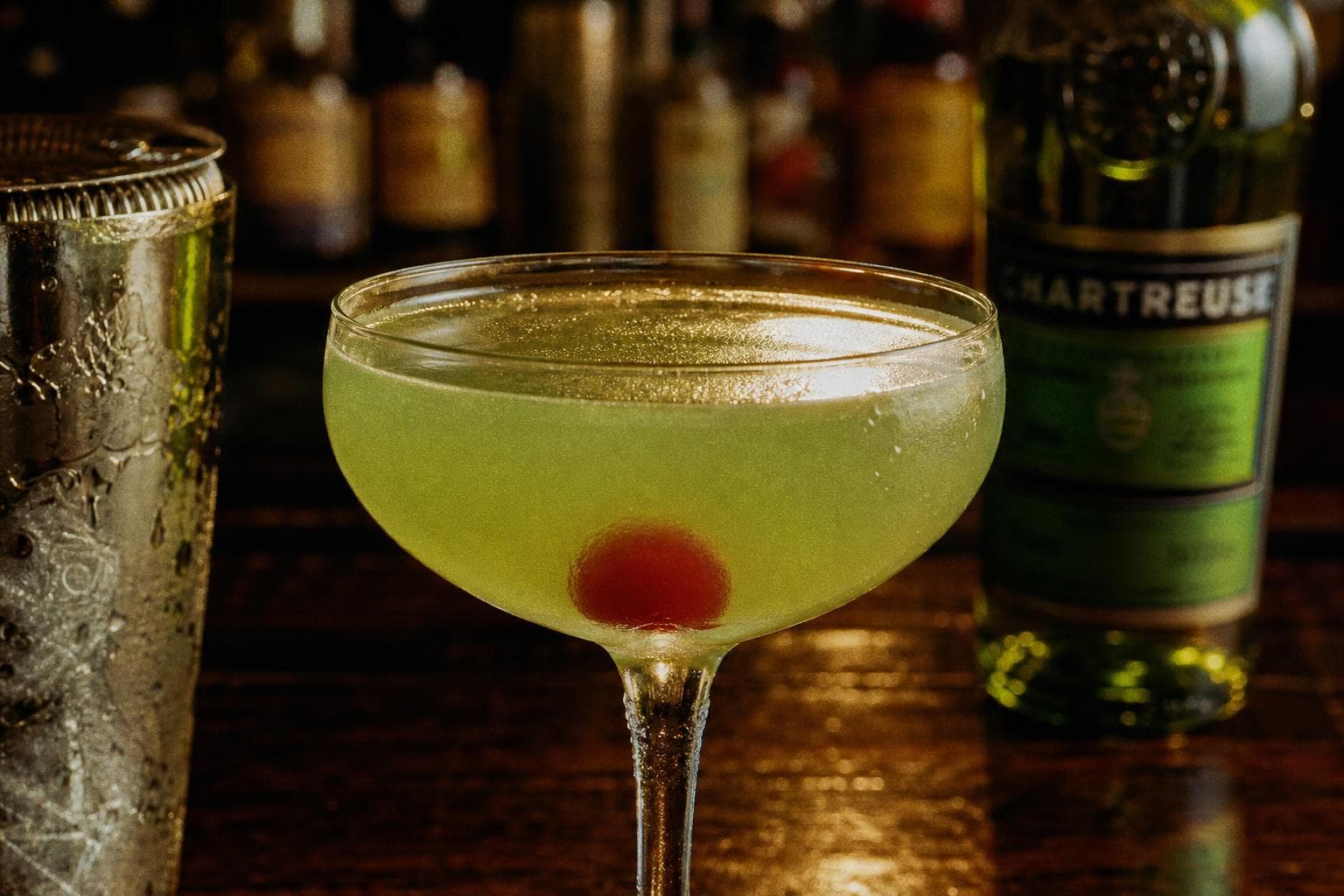

There's a version of cocktail history where the Last Word never returns. Where it stays buried in Ted Saucier's 1951 book Bottoms Up! — a curiosity attributed to a vaudeville performer, surrounded by other drinks nobody makes anymore. Where the equal-parts formula gets dismissed as a relic, the Chartreuse gets written off as too weird, and the whole thing gathers dust alongside the Clover Club and the Corpse Reviver No. 1.
That's not what happened. But it almost was.
Four Equal Parts, No Hierarchy
The Last Word is an exercise in structural democracy. Gin, green Chartreuse, maraschino liqueur, fresh lime juice — each at ¾ oz, each pulling exactly its weight. No base spirit dominating, no modifier playing support. The formula is so balanced it borders on mathematical.
What makes it work is that each ingredient is doing something the others can't. The gin provides botanical backbone and proof. The Chartreuse — made by Carthusian monks from a recipe involving 130 ingredients, known to no more than three people at any given time — brings herbal complexity that no other liqueur on the market replicates. The maraschino adds cherry-almond sweetness without the cloying thickness of a syrup. The lime cuts through all of it with enough acid to keep the drink from collapsing into sweetness.
The result is simultaneously herbal, citrusy, and boozy — strong without being harsh, complex without requiring a glossary. It falls technically into the sour family, but calling it a sour is like calling a cathedral a building. Accurate, but missing the point.
Detroit, 1916, and a Vaudeville Performer Nobody Remembers
The drink's documented origin traces to the Detroit Athletic Club, as early as 1916 according to Difford's Guide — which would make it pre-Prohibition, not a product of it, though it survived and apparently thrived through the dry years. Its first appearance in print came in Saucier's Bottoms Up!, where it was attributed to Frank Fogarty, a vaudeville performer billed as "The Dublin Minstrel."
Fogarty is not a household name. Neither is the Detroit Athletic Club in cocktail history. This is part of why the Last Word's origin story has never been fully pinned down — the sourcing runs through a 1951 book citing a performer from a club, which is about three degrees of separation from anything verifiable. The standard caveat applies: treat this as the most credible account available, not as settled fact.
What's not disputed is the disappearance. After Bottoms Up!, the Last Word largely vanished from bar culture for the better part of fifty years. The ingredients were still around. The recipe was in print. Nobody was making it.
Murray Stenson and the Zig Zag Café
The revival has a specific address: the Zig Zag Café in Seattle, in the early 2000s. The bartender responsible was Murray Stenson, who found the drink in Saucier's book and put it on the menu. From there it spread through the craft cocktail community with the speed that only happens when a drink is genuinely, undeniably good. Within a few years it was on menus across the country and spawning riffs — the Final Ward (rye and lemon in place of gin and lime) being the most prominent.
This is how cocktail revivals actually work. Not through marketing campaigns or trend cycles, but through one practitioner finding something buried and deciding it deserves better. The Last Word didn't come back because a brand pushed it. It came back because a bartender in Seattle recognized a well-constructed drink and trusted that other people would too.
Build It Yourself
The recipe is unforgiving of shortcuts. Use fresh lime juice — bottled will flatten the whole drink. The Chartreuse must be green, not yellow; they are not interchangeable, and yellow Chartreuse will produce a noticeably sweeter, less complex result.
The Last Word
- ¾ oz London dry gin (Tanqueray or Plymouth work well; avoid anything too cucumber-forward)
- ¾ oz green Chartreuse (~$65–75, specialty shop or online)
- ¾ oz Luxardo maraschino liqueur (~$35, widely available)
- ¾ oz fresh lime juice
Combine in a shaker with ice. Shake hard — this drink benefits from proper dilution and chill. Double-strain into a chilled coupe. Garnish with a maraschino cherry if you have one; skip it if you don't.
On the Chartreuse: It's the expensive ingredient and the non-negotiable one. There's no real substitute. If you're building a home bar and can only justify one bottle of herbal liqueur, this is the one.
The Last Word is eighty-plus years old, survived Prohibition, disappeared for half a century, and came back without changing a single ingredient. That's not nostalgia. That's a drink that was right the first time.