
The most consequential piece of evidence against absinthe came from a murder case in Switzerland in 1905. Jean Lanfray shot his pregnant wife and two daughters, and the newspapers blamed absinthe. What the newspapers did not prominently report — and what Catherine Cavendish's account of the case makes plain — is that Lanfray had also consumed crème de menthe, cognac, seven glasses of wine at lunch, a liter of wine after dinner, and a couple of coffees laced with brandy. The absinthe was two glasses in a day that would have felled a draft horse by other means. It got the headline anyway.
That case, more than any chemistry, is the story of absinthe's century-long exile. And the story of its return is less about vindication than about how thoroughly the myth outlasted the ban — and how the ritual that grew up around the drink became its own kind of problem.
The Thujone Theory Was Wrong From the Start
The scientific case against absinthe was built in the 1860s and 1870s by the French psychiatrist Valentin Magnan, who dosed laboratory animals with concentrated wormwood oil and observed seizures. As LegalClarity's history of the ban explains, those early studies typically used concentrated wormwood oil rather than distilled absinthe — producing results that bore little resemblance to what anyone would actually drink. The findings were alarming enough, and the temperance movement was powerful enough, that outright prohibition followed. The U.S. banned absinthe in 1912 under the Pure Food and Drugs Act, classifying wormwood as a harmful ingredient.
The ban held for 95 years. It survived the repeal of Prohibition in 1933 — because it was rooted in food safety law, not the 18th Amendment — and it survived long enough to transform a drink into a legend.
Modern chemistry eventually caught up with 19th-century fear. In 2008, a team led by Dirk Lachenmeier at the Chemical and Veterinary Investigation Laboratory in Karlsruhe opened thirteen bottles of pre-ban absinthe — distilled before 1915 — and ran them through gas chromatography. The results were flat. Total thujone ranged from 0.5 to 48.3 mg/L, averaging 25.4 mg/L. That sits comfortably inside the 35 mg/kg ceiling the European Union permits in bitter spirits today. The paper's conclusion was unusually blunt for a chemistry journal: of everything tested, only the alcohol content stood out as capable of producing what 19th-century doctors labeled "absinthism."
The pre-ban bottles ran at roughly 70 percent alcohol by volume — close to double a modern whisky — and were drunk by the glass in cafés for hours at a stretch. The mystery of absinthe's effects was never a mystery at all.
The same research group tested whether thujone might have simply degraded over a century in the bottle. Their follow-up work exposed absinthe in traditional green glass to ultraviolet light for up to 200 hours. Composition held. Clear glass lost about 18 percent of its beta-thujone and visibly faded, but the vintage bottles had kept their color, suggesting they had seen little light. The thujone was never there to begin with.
Thirteen bottles is a small sample. It represents a handful of distilleries and vintages from a period spanning decades and a continent's worth of production. But the finding aligned with what modern pharmacological analysis had already established: thujone acts as a GABA-A receptor antagonist and can influence neuronal excitability, but at the concentrations present in actual absinthe — typically 5 to 10 mg/L — it does not produce hallucinations or the psychoactive effects the mythology required. The concentration needed to cause the effects Magnan observed in his animals was orders of magnitude higher than anything in a glass.
The U.S. lifted its ban in 2007. The first Certificate of Label Approval went to Lucid Absinthe Supérieure on March 5 of that year. The Alcohol and Tobacco Tax and Trade Bureau subsequently issued guidance permitting absinthe to be labeled and sold provided the finished product contains less than 10 parts per million of thujone — a threshold that, given what the chemistry actually shows, most traditional absinthes would have met anyway.
The Ritual Is Doing More Work Than the Drink
Here is where absinthe's return gets complicated. The chemistry was rehabilitated. The drink came back. And then the industry — and the bars that stocked it — leaned hard into the mythology that the chemistry had just disproved.
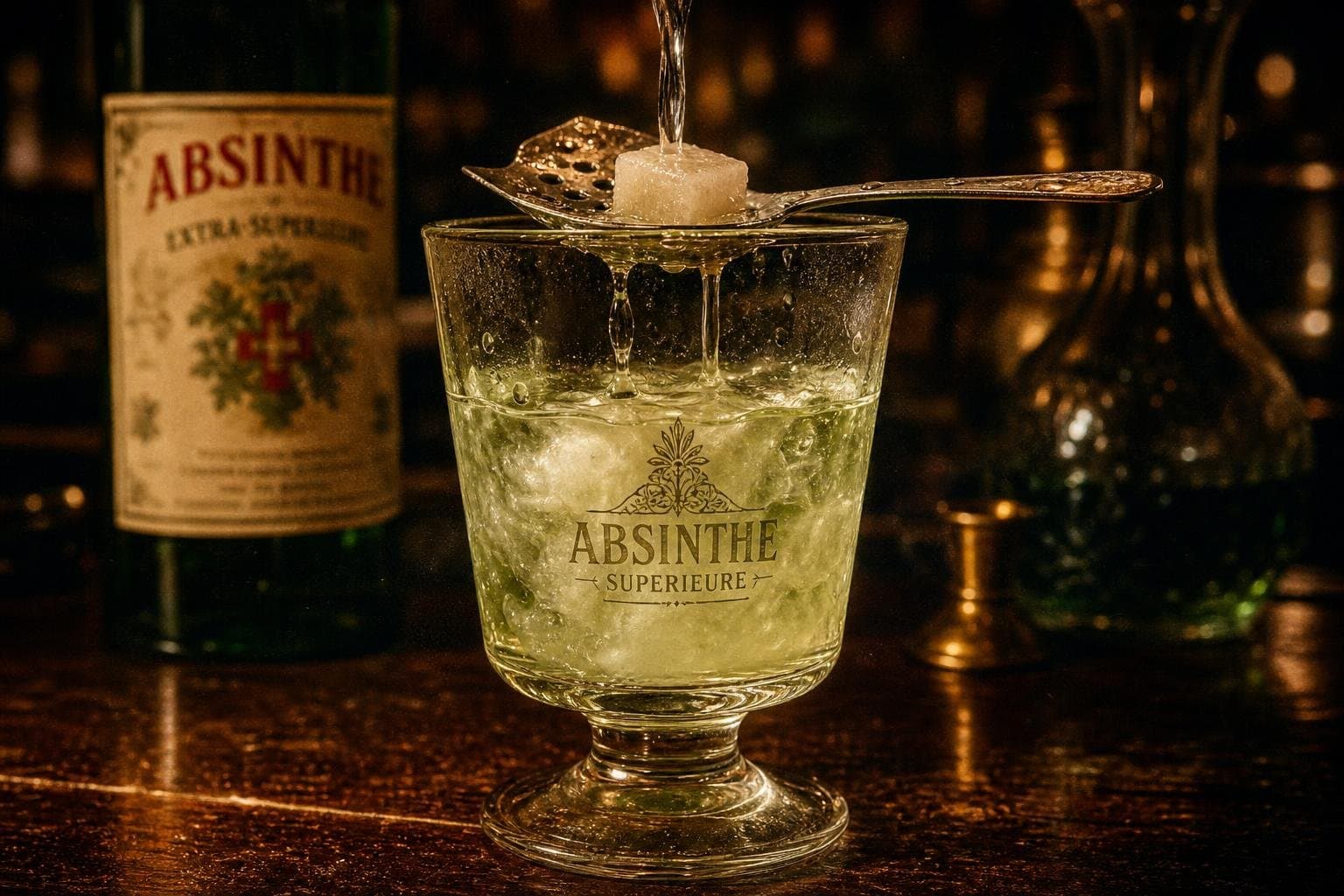
The louche. The slotted spoon. The sugar cube. The drip fountain. These are real elements of traditional French absinthe service, and there's nothing wrong with them. The louche — the clouding that occurs when cold water is added, caused by the precipitation of anise and fennel oils — is genuinely beautiful to watch and serves a real purpose: diluting a 68-percent spirit to a drinkable proof while releasing aromatic compounds. The ritual has legitimate roots.
But the ritual got marketed as mysticism. The green fairy. The hallucinations. The creative madness. Bars that opened absinthe menus in the late 2000s and early 2010s frequently sold the experience as much as the drink, and the experience being sold was the discredited one. You were drinking what Van Gogh drank. You were flirting with the forbidden. The science said the forbidden part was fiction, but the marketing needed the fiction to justify the theater.
This is the spirits industry's marketing-to-substance ratio problem at its most naked. Absinthe came back not as a complex, historically significant herbal spirit with genuine aromatic interest, but as a prop for a story that had already been debunked. The ritual became a delivery mechanism for mythology rather than for the drink.
Nimmi Malhotra's account of drinking absinthe in Prague captures the geographic dimension of this problem. Czech "absinth" — intentionally spelled differently — emerged during the revival years as a category that sometimes omitted wormwood and anise entirely, the botanicals that define the spirit's character and produce the louche. Without anise, there's no louche. Without wormwood, there's no absinthe in any meaningful sense. What remained was a high-proof green liquid that could be set on fire, which became its own ritual: the burning sugar cube, the flaming spoon, the caramelized sweetness dripped into the glass. This is not traditional absinthe service. It's a pyrotechnic invented for tourists and adopted by bars that wanted spectacle over substance.
The Czech variation is a useful case study because it shows what happens when the ritual fully detaches from the drink. You end up with theater that has no relationship to the spirit's actual history, flavor, or character — and customers who think they've had absinthe when they've had something else entirely.
What Absinthe Actually Tastes Like, and Why That Matters
Strip away the mythology and the ritual and you have a high-proof herbal spirit built on a botanical framework of grand wormwood, green anise, fennel, and typically a second maceration with lemon balm, hyssop, and petite wormwood. The classic form produces a high-proof, herbaceous, anise-forward liquid that turns white and cloudy when water touches it. That's the drink.
Properly diluted — the traditional ratio is roughly one part absinthe to three to five parts cold water — it's a genuinely complex spirit. The anise and fennel provide the dominant aromatic register, but they're not the whole story. Wormwood contributes a characteristic bitterness that keeps the anise from going cloying. The secondary botanicals add herbal depth. A well-made absinthe at proper dilution has more in common with a fine amaro than with the anise-bomb reputation it carries.
The problem is that most people who encounter absinthe in bars encounter it wrong. Either it's served as a rinse — a thin coating on a glass before another spirit takes over, which is a legitimate technique but teaches you nothing about absinthe itself — or it's served in a shot, undiluted, which is like evaluating a Negroni by drinking the Campari straight. The ritual, when performed correctly, exists precisely to prevent this. The slow water drip isn't theater for its own sake; it's the mechanism by which the drink becomes the drink.
This is where absinthe's role in cocktail history becomes interesting. The Arsenic and Old Lace, a 1940s Martini variation first published in Broadway producer Crosby Gaige's 1944 Cocktail Guide and Ladies' Companion, uses absinthe as a rinse — a quarter-ounce or less — to add an herbal, anise-tinged undercurrent to a gin and crème de violette base. Brandyn Shank at Nocturne in Denver, as Punch reported, uses just a rinse of absinthe in the glass, letting it function as a botanical accent rather than a featured spirit. That's absinthe doing what it does best in a cocktail context: providing aromatic complexity without dominating.
The Sazerac uses it the same way. So does the Corpse Reviver No. 2. In each case, absinthe is a precision tool — a small amount that changes the character of everything around it. That's a different argument for the spirit than the mythology makes. The mythology says absinthe is special because it's dangerous. The drink says absinthe is special because a quarter-ounce of it can transform a cocktail.
The Revival's Real Problem Is What It Left Unexamined
Absinthe's return to U.S. shelves was a genuine correction — a century-long prohibition built on bad science and temperance politics finally ended. That's worth acknowledging. But the revival that followed didn't interrogate the mythology; it monetized it.
The green fairy branding, the theatrical service rituals, the Czech fire-spoon spectacle, the Van Gogh associations — all of it persisted because it sold bottles and experiences. The science said the hallucinations were never real. The marketing said: but what if they were, a little? The hedged implication was more useful than the truth.
What got lost in that transaction was the drink itself.


