


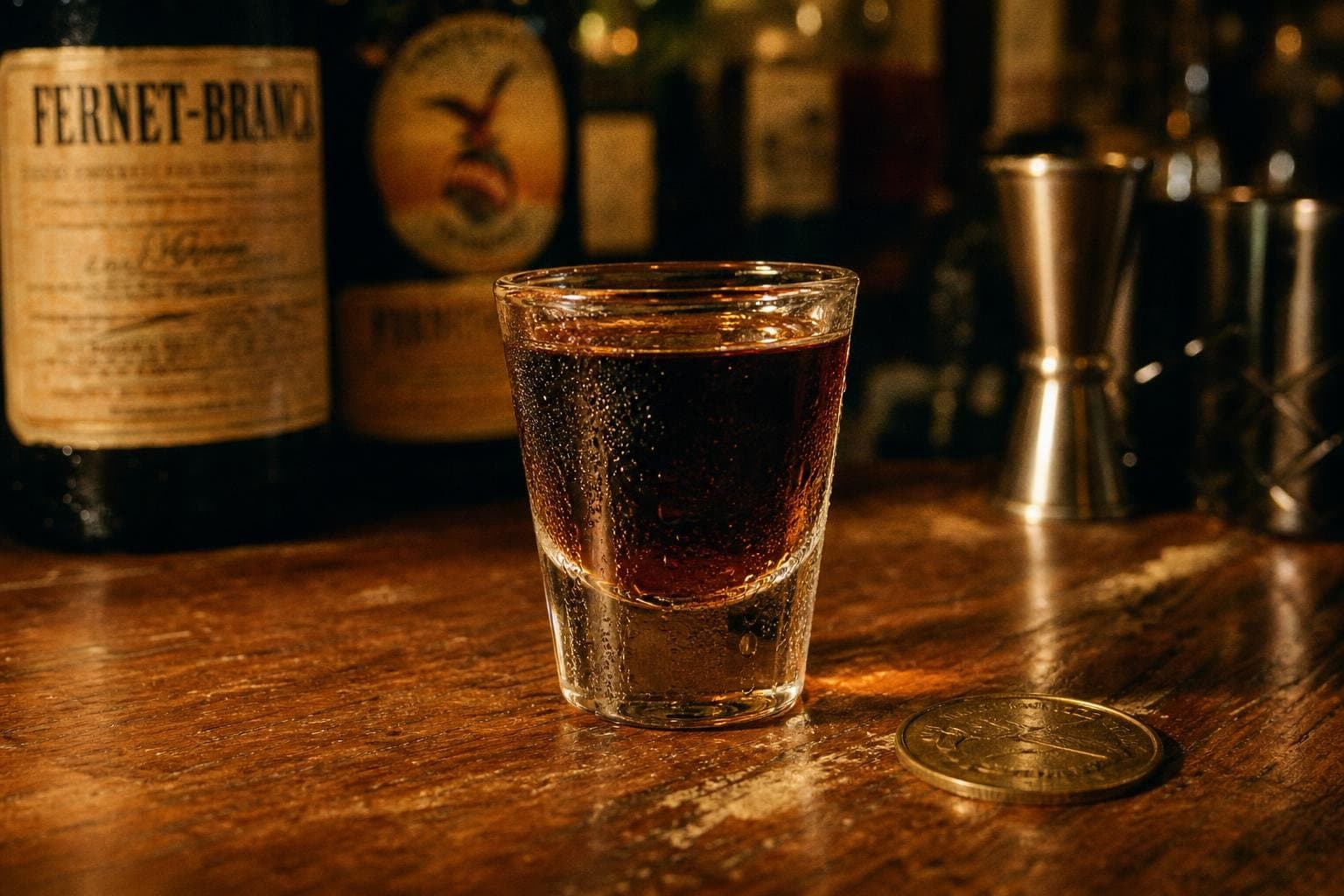

There's a ritual happening right now in bars across the UK. Bartenders are gathering — invitation only — to design the next official Fernet-Branca Coin. According to The Spirits Business, the tour hit London, Manchester, and Edinburgh this month, with each city's winning design submitted to Fratelli Branca's global team for final selection. The coin tradition itself began in San Francisco in 2013, inspired by the custom of bartenders taking a shot of Fernet-Branca at shift change — a ritual that became known as the bartender's handshake.
It's a good story. It's also, at this point, a marketing program.
That's not a cynical observation — it's a useful one. Because the gap between the Fernet-Branca that bartenders actually drink and the Fernet-Branca that gets sold to civilians has never been wider, and the coin tradition sits right at the center of that gap. The coin says: this drink is yours, bartender, a symbol of belonging. The brand says: now let's get everyone else to order it too. Those two projects are in tension, and the tension is worth examining.
The Bartender's Handshake Was Never About the Handshake
Fernet-Branca's hold on the professional bar community didn't come from branding. It came from the liquid. The drink is intensely bitter, menthol-forward, and medicinal — a combination that reads as punishment to the uninitiated and as reset to anyone who's spent eight hours behind a stick. After a long service, your palate is wrecked. You've tasted forty drinks, eaten nothing, and your mouth tastes like citrus pith and simple syrup. A shot of Fernet cuts through all of it. It's not pleasant in the conventional sense. That's the point.
The shift-change shot became a ritual because it worked. Not because someone handed out coins.
What made Fernet the bartender's drink was also what kept it off civilian menus for decades: it's genuinely hard to like on first encounter. The bitterness is aggressive. The menthol is medicinal. The finish lingers in ways that sweet-palate drinkers find alarming. Asterley Bros. notes that Argentina — where Fernet arrived with Italian immigrants in the late 19th and early 20th centuries — solved this by mixing it with Coca-Cola in a roughly 1:3 ratio, a drink called Fernet con Coca that now accounts for the majority of global consumption. Argentina didn't make Fernet approachable by explaining its complexity. It made it approachable by diluting it with something sweet and familiar.
The American craft bar world took a different approach: it made the difficulty the selling point.
The Jäger Comparison Is the Wrong Comparison
The assigned framing — bartenders drink Fernet neat while customers order Jäger — is true in the broadest sense, but it flattens something more interesting. Jägermeister is also a bitter herbal liqueur. It also has a cult following. It also gets ordered as shots. The difference isn't really about sophistication; it's about context and temperature.
Jäger built its American identity around cold shots and nightlife. The brand leaned into it. Fernet-Branca built its American identity around the back bar and the shift change — a context that was, by definition, not available to customers. The mystique came from exclusion, not from the drink's inherent superiority. Both are bitter. Both are herbal. One got positioned as a party drink; the other got positioned as a trade secret.
The problem is that "trade secret" positioning has a shelf life. Once the secret is out — once Fernet-Branca is on every cocktail menu and the coin tradition is a branded tour — the exclusivity that made it feel special starts to erode. Fratelli Branca's global export head says the coin "belongs to the bartender community." But the brand is also the one running the competition, selecting the design, and hosting the launch party. That's not community ownership. That's community-flavored marketing, and the bar world is usually sharp enough to notice the difference.
What the Drink Actually Earns
None of this means Fernet-Branca is undeserving of its reputation. It isn't. The liquid is genuinely complex — 27 botanicals, including gentian, saffron, myrrh, rhubarb, and peppermint, macerated and aged in a process the brand has kept largely opaque. It works in cocktails — the Toronto is a serious drink, and the Hanky Panky holds up — and it works neat in the way that very few liqueurs do. The shift-change shot isn't mythology. It's a real use case for a real product.
But the coin tradition, now in its second UK run, is worth watching with clear eyes. When a brand institutionalizes a grassroots ritual, it usually does so because the ritual is doing marketing work the brand can't do itself. The bartender's handshake was powerful because it was organic. The question now is whether formalizing it — designing it, branding it, touring it — preserves the thing that made it matter, or just preserves the aesthetic of it.
The drink in the glass doesn't change. What changes is what it means to order it.