


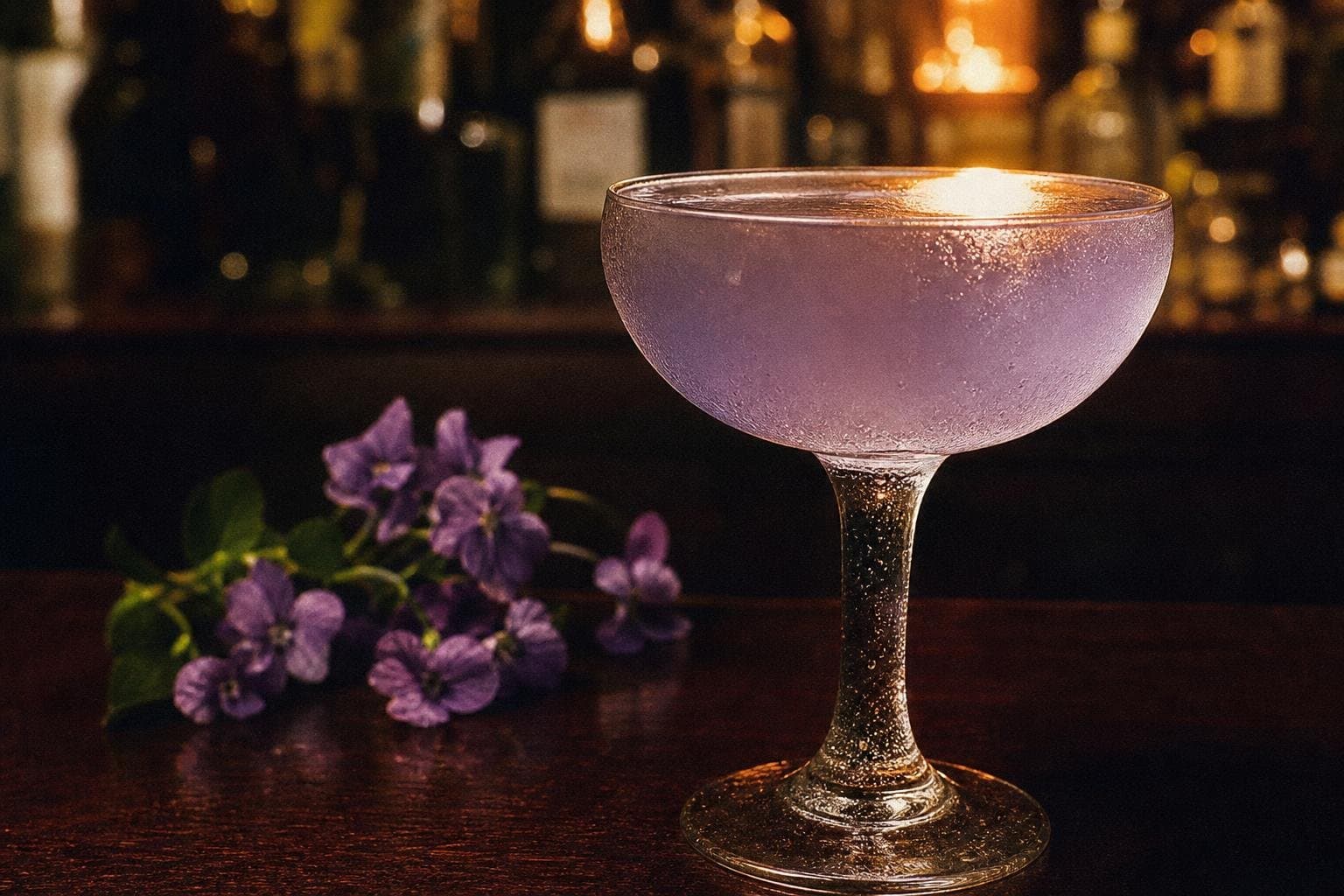

Here's what the crème de violette revival actually tells you about how bars work.
For about fifty years, the Aviation was a lie. Not a malicious one — just the quiet kind that happens when an ingredient disappears and nobody wants to admit the drink changed. Bars kept making Aviations. They kept calling them Aviations. They just left out the thing that made the drink violet, and eventually a generation of bartenders learned the recipe without it and passed that version down as gospel.
I've covered the violette disappearance twice before — the crème de violette gap and the Crème Yvette distinction that most bars still fumble. What I haven't pulled apart is the more interesting question underneath: why did bars actually bring it back? The answer isn't "bartenders love history." It's more complicated and more instructive.
The Ingredient Came Back Before the Demand Did
This is the part the revival narrative usually gets backwards. The standard story frames crème de violette's return as demand-driven — serious bartenders wanted to make proper Aviations, so they went looking for the liqueur and eventually someone supplied it. That's a tidy arc. It's also mostly marketing.
The more accurate version: the craft spirits movement created distribution infrastructure for obscure liqueurs that previously had no American pathway to market. When that infrastructure existed, producers and importers started filling it with things that had historical cocktail credibility. Crème de violette had a famous drink attached to its name. That made it an easier sell to specialty retailers than, say, a regional French digestif with no cocktail hook.
The Aviation was the marketing story. The distribution shift was the actual mechanism.
This matters because it changes what the revival means. It wasn't bars saying "we need this ingredient to make drinks correctly." It was importers saying "here's an ingredient with a built-in narrative, and here's the drink that proves it belongs on your shelf." Bartenders responded to availability. Availability was created by commercial logic.
What the Drink Reveals When You Actually Make It
Set aside the history for a moment and look at what crème de violette does in the glass, because this is where the ingredient earns its place or doesn't.
The Aviation is gin, fresh lemon juice, maraschino liqueur, and crème de violette — and the violette is doing two things simultaneously. The obvious one is color: that pale lavender that photographs well and signals "this is not a standard sour." The less obvious one is aromatic bridging. Violet is a floral note that sits between the botanical complexity of gin and the almond-cherry sweetness of maraschino. Without it, you have a gin sour with a cherry liqueur accent. Perfectly fine. With it, you have something that actually coheres — the floral thread ties the other elements together in a way that's hard to articulate until you taste both versions back to back.
The problem is that crème de violette is easy to overdo. Too much and the drink smells like a grandmother's powder room. The balance is narrow. This is probably why the ingredient got dropped in the first place — it's finicky, it was scarce, and a lot of bartenders decided the Aviation worked fine without it. They weren't wrong that the drink was drinkable. They were wrong that it was the same drink.
The Lesson the Revival Keeps Not Teaching
Punch's coverage of the best new bartenders of 2026 shows something worth noting: the most interesting current work isn't chasing historical restoration, it's using classic structures as starting points for something new. A Bijou riff with wormwood extract and blueberry cordial. A Piña Colada that drinks like an Old-Fashioned. These bartenders know the canon well enough to depart from it deliberately.
That's actually what the violette revival should have taught the industry, and mostly didn't. The lesson isn't "put the missing ingredient back and call it authentic." The lesson is that understanding why an ingredient was in a drink — what structural or flavor problem it solved — makes you a better bartender whether you use that ingredient or not. Crème de violette teaches you about aromatic bridging. Knowing that, you can find other solutions to the same problem. Or you can use the original. Either way, you're making a decision rather than following a recipe.
Most bars that put crème de violette back on the shelf did it to make a correct Aviation. Fewer asked what the violette was actually doing. Those are different levels of engagement with the same history.
If you want to stock it: Rothman & Winter Orchard Violet is the most widely available option in the U.S. — specialty shop tier, roughly $25–35 depending on market. It's not hard to find if you're near a serious bottle shop or willing to order online. It is, emphatically, not out of production. It just took fifty years to get back to American bars, and the reason it finally did has more to do with import economics than anyone's love of the Aviation.
The drink is better with it. That part, at least, isn't complicated.