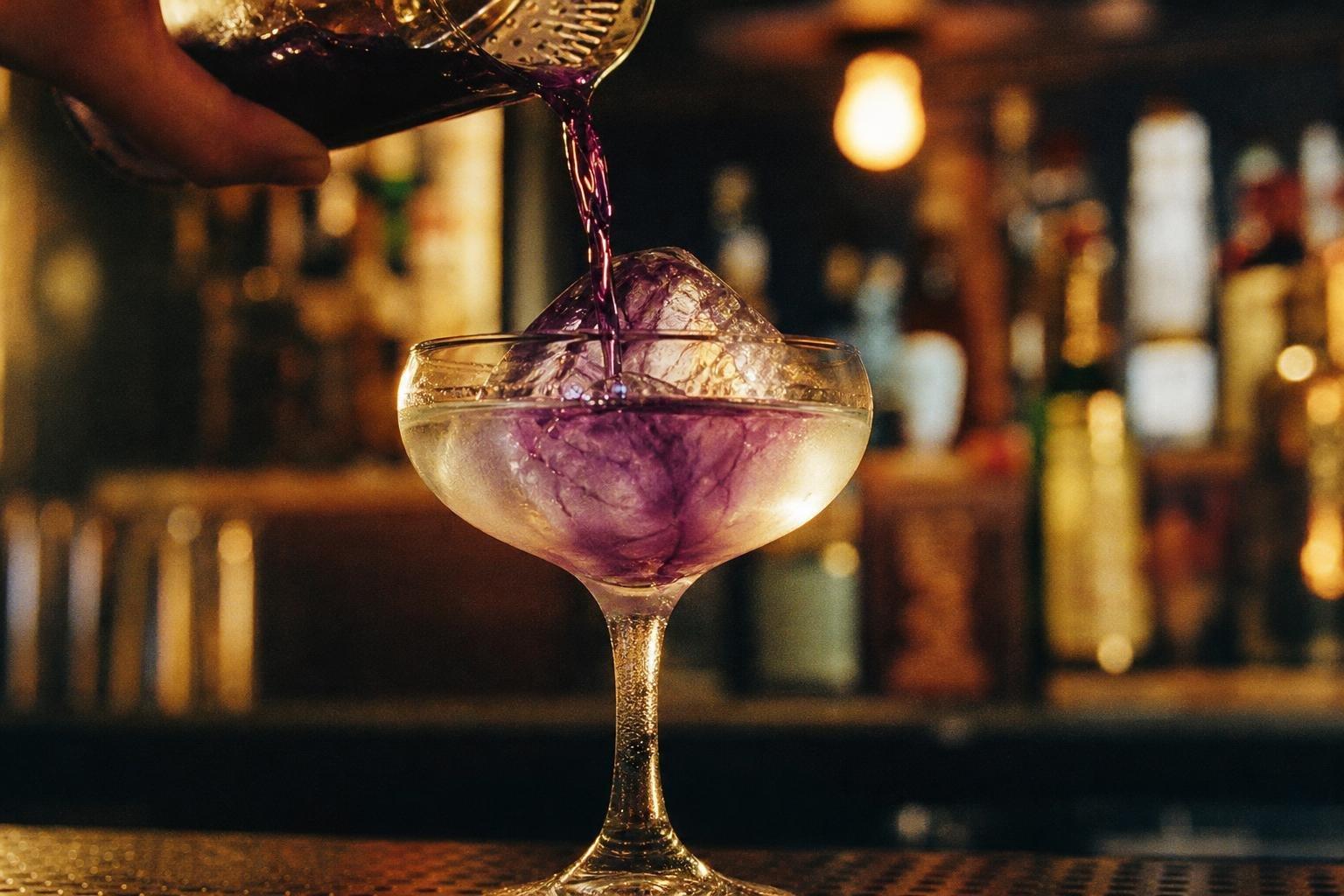

I've covered crème de violette's comeback before — the supply chain reasons it vanished, the half-true revival story bars like to tell. What I hadn't done is sit with the Aviation itself long enough to notice that the drink has never actually settled on what it's supposed to be. There's no canonical Aviation. There's a drink that's been rewritten at least three times, and most bars pour whichever version they inherited without knowing the others exist. It still shows up on general-interest "classics everyone should know" lists as the "vibrant violet" entry, filed next to the Paper Plane like it's a contemporary invention instead of a hundred-year-old argument (Taste of Home).
The Recipe Has Always Been an Argument
Hugo Ensslin, head bartender at New York's Hotel Wallick, printed the Aviation in his 1916 book Recipes for Mixed Drinks — though even that date carries an asterisk, since some editions get cited as 1917 (drinkmx). His version ran two parts gin to one part lemon, with two dashes each of maraschino and crème de violette. Fourteen years later, Harry Craddock's Savoy Cocktail Book printed the same drink minus the violette, and that's the version most of the 20th century actually drank: a pale gold, cherry-kissed gin sour that had nothing to do with the sky it was named for (drinkmx).
That's not a case of one bartender getting it right and another getting it wrong. It's two specs from two eras, and modern bars still split along that fault line — some chasing the 1916 proportions, some running an IBA-style listing, most just making whatever their training manual handed them. There's no single official recipe to defer to. Treat any spec you're handed as a starting point, not scripture — the same spirit that drove early revivalists to comb through old guides "like the Rosetta Stone" for forgotten proportions and glassware (Imbibe).
What the Violette Actually Does — and Doesn't
Here's where tasting language earns its keep instead of decorating a review. Maraschino isn't a sweetener standing in for simple syrup — it brings a dry, nutty, cherry-stone edge that syrup can't touch, which is why a three-ingredient drink tastes like it has more going on than it does (drinkmx). Crème de violette isn't pulling weight in the sour-sweet-strong structure at all. It's doing something more fragile: a little bit lifts the gin's botanicals, a lot turns the whole glass into a candle shop. The balance point is narrow, and it's easy to oversell the violet past where the drink is still a cocktail and not a perfume sample.
This is also where the "hard to find for decades" framing matters more than the "lost spirit" framing that gets repeated around this drink. Crème de violette wasn't discontinued across the mid-20th century — it was simply absent from American shelves long enough that bartenders stopped building recipes around it, and the Savoy's violette-free spec became the default by attrition rather than preference. Distribution problems get remembered as extinction stories because extinction makes a better anecdote. It wasn't gone. It was just somewhere else — not unlike the way other once-dismissed ingredients, vodka included, got written out of serious cocktail culture for reasons that had more to do with fashion than quality (Imbibe).
The Renaissance Rewarded Precision, Then Got Bored of It
The Aviation's revival tracks a pattern the broader cocktail renaissance went through more generally. Early-revival bartenders hunted down smaller glassware, forgotten specs, exact dash counts, because the movement needed to prove its seriousness (Imbibe). That same instinct resurrected crème de violette alongside the coupe and the Nick & Nora. Once the point was made, though, bars relaxed, and the same looseness that let Jell-O shots made with allocated bourbon become a punchline also let plenty of menus start pouring the Aviation on vibes rather than ratio (Imbibe). Seasonal roundups keep finding new classics to rediscover and repackage every winter (PUNCH), but rediscovery without measurement is just a different kind of carelessness.
The drink doesn't need a return to museum-piece precision. It needs bartenders who understand that the violette is a volume knob, not a garnish, and that dialing it wrong in either direction breaks the thing they're trying to honor. Industry gatherings will keep marking anniversaries and reciting the canon back to itself — Tales of the Cocktail already has its 25th edition on the calendar for next July (Tales of the Cocktail Foundation) — but that kind of celebration rarely trickles down to the well where the violette bottle sits half-used behind the bar. Next time you order one, ask what's actually in the dash. Most bars won't know, and that's the tell. The history isn't buried. Nobody's reading the label.