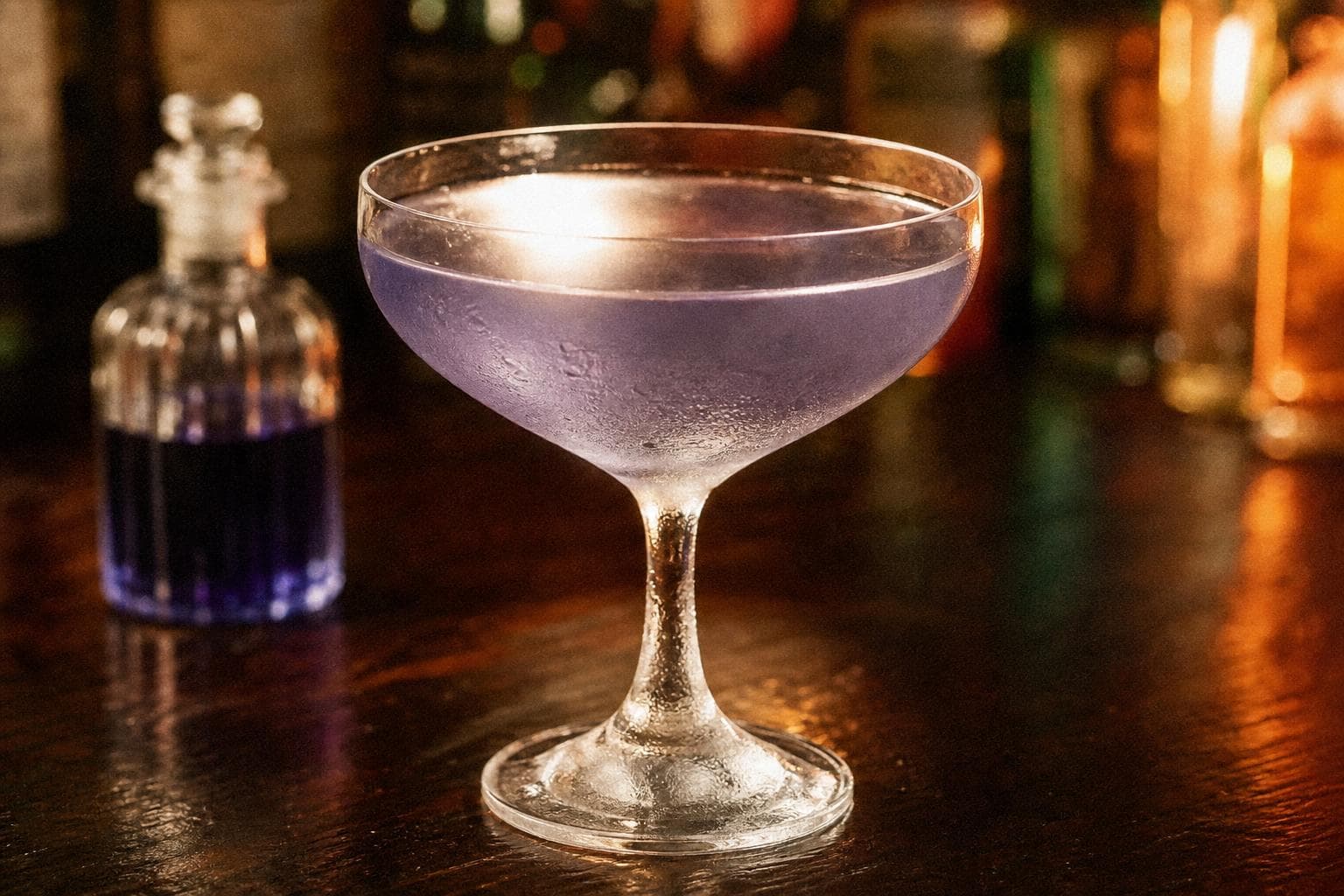

There's a version of the Aviation that tastes like a well-made sour — gin, lemon, maraschino, balanced and clean. Bartenders made it that way for decades. They weren't wrong, exactly. They were just working with what they had, which was no crème de violette, because crème de violette had essentially vanished from the American market.
The drink in Hugo Ensslin's Recipes for Mixed Drinks (1916) — the earliest known printed source for the Aviation, as noted in the Vince Keenan cocktail archive — included the violet liqueur. That's where the name comes from: the pale purple color is supposed to evoke sky. Without it, you have a gin sour with maraschino. A good gin sour with maraschino, but not an Aviation. Not really.
The Absence Rewrote the Recipe
Crème de violette's disappearance from American bars wasn't dramatic. No scandal, no prohibition, no fire at the distillery. The liqueur simply became unavailable — a combination of shifting tastes, consolidation in the European liqueur industry, and the general collapse of pre-Prohibition cocktail culture that took out dozens of ingredients alongside it. By the time the cocktail revival of the 1990s and early 2000s got underway, bartenders working from Harry Craddock's Savoy Cocktail Book (which omits the violet liqueur from its Aviation recipe) had a ready-made template that didn't require a product nobody could source anyway.
The Savoy version became the default. And because the Savoy version was the one bartenders could actually make, it became the one that got taught, reprinted, and eventually treated as authoritative. This is how cocktail history rewrites itself: not through deliberate revision but through the slow accumulation of practical constraints. You can't stock what you can't buy. You can't teach what you've never tasted. Within a generation, the violet Aviation wasn't suppressed — it was simply forgotten.
The craft cocktail revival, for all its historical fetishism, initially perpetuated this. Bars in the early 2000s were doing serious archival work — pulling out pre-Prohibition recipes, sourcing obscure bitters, importing European spirits that had never crossed the Atlantic in meaningful quantities. But crème de violette remained a gap. The ingredient existed in Europe; it just wasn't imported to the U.S. in any commercially viable form.
Rothman & Winter Changed the Equation
The inflection point was the U.S. introduction of Rothman & Winter Crème de Violette, an Austrian product that finally gave American bartenders access to a violet liqueur built for the purpose. This is where I have to be careful: the spirits industry's marketing apparatus loves a clean resurrection narrative, and I'm not going to launder a brand origin story as cocktail history. What I can say is that the availability of a quality crème de violette in the American market — whatever the precise timeline — created conditions for the Aviation to be made as Ensslin wrote it.
The result was not a minor tweak. The violet liqueur changes the drink's color, obviously, but more importantly it changes its flavor architecture. Maraschino is nutty, slightly bitter, with a cherry-pit quality that can dominate a drink if you're not careful. Crème de violette is floral and sweet in a different register — softer, more perfumed, with a quality that either reads as elegant or medicinal depending on your tolerance for flower-forward spirits. In the Aviation, it bridges the gin's botanicals and the maraschino's nuttiness in a way that makes the drink feel complete rather than merely balanced.
The difference between an Aviation with and without crème de violette is not subtle. It's the difference between a sketch and a finished painting. Bartenders who tasted the complete version for the first time often described it as a revelation — not because the violet version is dramatically more complex, but because it explains why the drink was worth preserving in the first place.
What "Essential" Actually Means at the Bar
Here's where the resurrection story gets interesting, and a little uncomfortable. Crème de violette went from unavailable to "essential to craft cocktails" — a phrase that deserves scrutiny. Essential to what, exactly?
The Aviation is a great drink. It's not a template. You can't riff on crème de violette the way you can riff on Campari or Chartreuse or even Cynar. The flavor profile is specific and narrow — floral, sweet, violet — and it doesn't play well with most spirits outside of gin. The number of classic recipes that call for it is small. The number of modern recipes built around it is smaller. What crème de violette is essential to is the Aviation and a handful of related drinks (the Blue Moon, the Moonlight Cocktail, a few others). That's not nothing. But "essential to craft cocktails" as a category claim overstates the case.
What actually happened is that crème de violette became a signal. Stocking it meant you were serious — that you'd done the archival work, that you cared about historical accuracy, that you weren't just running a Greatest Hits bar. In the mid-2000s craft cocktail scene, where seriousness was currency, having crème de violette on the back bar was a credential. The drink it enabled was almost secondary to what the bottle communicated.
This is a pattern worth recognizing. The craft cocktail revival was genuinely important — it recovered real knowledge, restored real drinks, and raised the floor of what American bars could do. But it also developed its own status markers, its own gatekeeping, its own version of the ego and credentialism that bartenders are still pushing back against. Crème de violette became one of those markers. The Aviation became a test. Order it at a bar and see if they make it right — with the violet, in the correct proportions — and you'd know whether the bartender had done their homework.
That's a legitimate use for a classic drink. It's also a slightly exhausting one.
The Drink That Earned Its Complexity
None of this is an argument against crème de violette. The Aviation with violet liqueur is genuinely better than the Aviation without it, and the ingredient deserves its place on a well-stocked bar. The point is that "essential" is doing a lot of work in the resurrection narrative, and it's worth being precise about what was actually recovered.
What was recovered was a complete recipe — one ingredient that had been missing for half a century, restored to its original context. That's meaningful. What wasn't recovered was a whole new category of violet-forward cocktails waiting to be made. Crème de violette is a specialist, not a generalist. It does one thing exceptionally well and a handful of other things adequately. Treating it as a cornerstone of craft cocktail culture inflates its role; dismissing it as a novelty undersells what it actually contributes to the drinks that need it.
The Aviation, made correctly, is worth the effort. Here's how to build one that earns the violet's inclusion rather than just gesturing at it:
The Aviation (Ensslin-adjacent)
- 2 oz London dry gin (Tanqueray or Plymouth — something with botanical backbone, not a soft contemporary style)
- ¾ oz fresh lemon juice
- ½ oz maraschino liqueur (Luxardo)
- ¼ oz crème de violette (Rothman & Winter — widely available at specialty shops, roughly $25–$30; online-only in some states)
Shake hard with ice. Double-strain into a chilled coupe. No garnish, or a brandied cherry if you must. The drink should be pale purple — not deep violet, not pink. If it's coming out too dark, you're over-pouring the violet.
The proportions matter more than they look like they should. A quarter ounce of crème de violette is enough to color the drink and add its floral note without turning the whole thing into a perfume counter. Go to a half ounce and the maraschino gets buried. Go to an eighth and you're back to the Savoy version with a slight purple tint and a vague sense of having wasted a specialty ingredient.
A note on sourcing: Rothman & Winter is the most widely available option in the U.S. and performs well in the Aviation. Giffard Crème de Violette is another solid choice if you can find it — slightly more floral, slightly less sweet, which some palates prefer. Crème Yvette (the older American product, now revived by Cooper Spirits) is a different animal — berry-forward with violet as one note among several — and makes a different drink. Worth having both if you're serious about this corner of the bar, but they're not interchangeable.
The Aviation's resurrection is a good story. It's also a story about how cocktail culture assigns meaning — how a single missing ingredient can become a symbol of seriousness, how recovery gets mistaken for discovery, and how "essential" is a word that should be earned rather than awarded. The drink deserved to be completed. Whether it deserved to become a credential is a different question, and the honest answer is probably no.
Make the drink. Skip the gatekeeping. The violet was always supposed to be there.


