


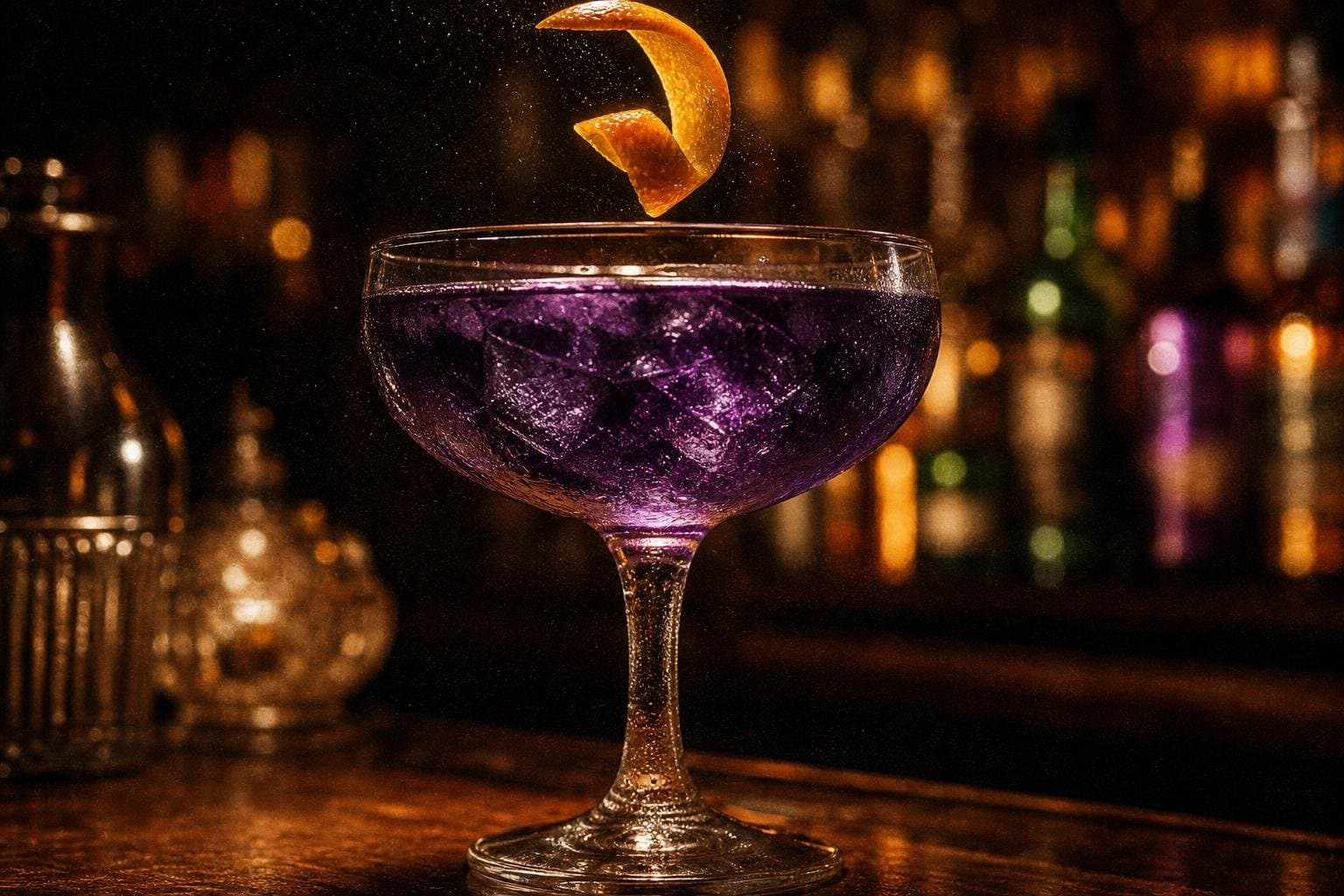

There's a 1944 Martini variation sitting in the back of cocktail history books that checks every box the current moment should love: gin-forward, violet-tinted, absinthe-rinsed, built on a recipe old enough to have genuine provenance. And yet nobody orders it, because nobody knows it exists, and the ones who do clock the name and assume it's a novelty drink.
The Arsenic and Old Lace — first published in Broadway producer Crosby Gaige's Cocktail Guide and Ladies' Companion — is a gin Martini with crème de violette, dry vermouth, and an absinthe rinse. Punch reports that Brandyn Shank at Nocturne in Denver has been quietly reviving it, working from a spec that modernizes the original's proportions: two ounces gin, three-quarters ounce vermouth, a quarter-ounce violet liqueur, absinthe rinse, orange bitters. The original 1944 recipe ran three parts gin to one part absinthe with just dashes of vermouth and crème de violette — a much more aggressive build, and probably the reason the drink didn't survive the century intact.
Shank's version is essentially a classic Martini with violet and anise accents. The absinthe is a rinse, not a pour. The crème de violette is a quarter-ounce — enough to tint the glass and add florality without turning the drink into a dessert. The structure is sound. The problem, as Punch notes, is that when guests see the purple, they assume sweetness. They're wrong, but the assumption is hard to argue against from a menu.
The Name Is the Obstacle, and Also the Point
Here's the tension: the Arsenic and Old Lace gets its title from Joseph Kesselring's 1939 play and Frank Capra's 1944 film — the one where sweet old ladies poison bachelors with elderberry wine. The drink's purple color and poison-adjacent ingredients were clearly intentional. The cocktail is a joke with a recipe. That's a feature, not a bug, but it requires a bartender willing to explain it, and most menus don't have that kind of real estate.
What the drink actually is: a floral, dry, elegantly structured Martini variation that earns its place in the same conversation as the Tuxedo No. 2 or the Turf Cocktail — drinks that have gotten their revivals while the Arsenic and Old Lace sat on the shelf. The violet doesn't make it sweet. The absinthe doesn't make it aggressive. The balance is there.
The drinks that stay forgotten