


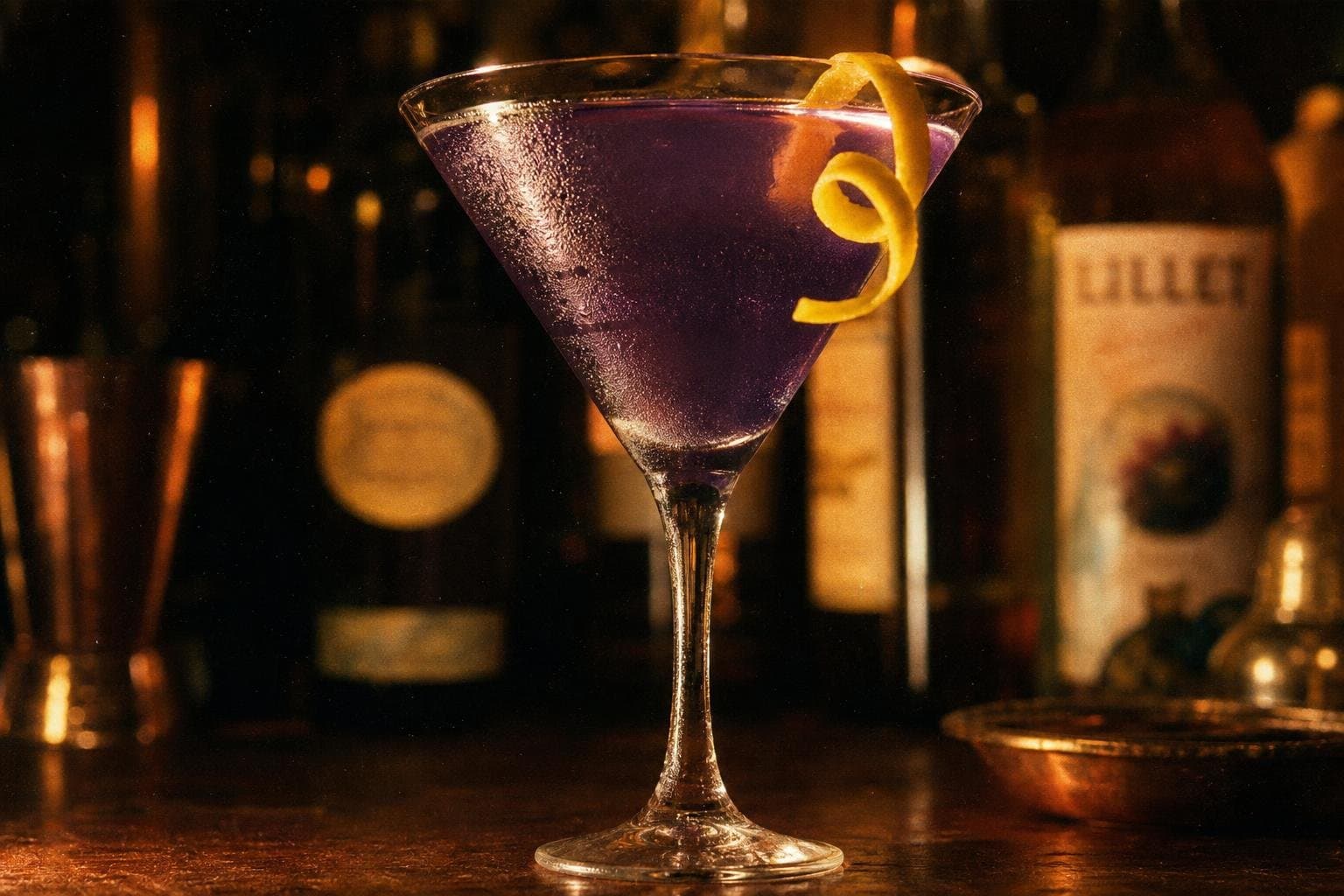

I covered the Arsenic and Old Lace briefly in July — the name problem, the purple prejudice, the fact that it's been sitting in Crosby Gaige's 1944 Cocktail Guide and Ladies' Companion waiting for someone to order it. What I didn't do is give it the full spec treatment. That's the gap. Here's the actual working information.
What It Is
A gin Martini variation with crème de violette, dry vermouth, and absinthe. Purple. Floral. Drier than it looks. Named after Joseph Kesselring's 1939 play and Frank Capra's 1944 film — the one where two sweet old ladies poison their houseguests with elderberry wine. The drink earns the name: it looks innocent and has teeth.
Punch's profile of Brandyn Shank at Nocturne in Denver describes it as "floral, bright, elegant, decadent and very, very drinkable." That's accurate. It's also the most useful three-word rebuttal to anyone who sees the color and assumes dessert.
Two Specs, Side by Side
The 1944 Original (from Gaige's Cocktail Guide and Ladies' Companion, via Punch):
- 3 parts dry gin
- 1 part absinthe
- 3 dashes dry vermouth
- 3 dashes crème de violette
This is a strong, anise-forward drink. The absinthe is a full pour, not an accent. The vermouth and violet are barely there. It's closer to an absinthe-gin split than a Martini.
The Nocturne Build (Brandyn Shank, Denver, via Punch):
- 2 oz dry gin
- ¾ oz dry vermouth
- ¼ oz crème de violette
- Absinthe rinse only
- Orange bitters
- Lemon twist
This is a Martini that happens to be violet. The absinthe drops to a rinse — present on the nose, gone by the second sip. The vermouth is a real ingredient, not a gesture. The violet liqueur adds color and a floral note without sweetening the drink.
The Nocturne version is the more drinkable spec. The original is the more historically honest one. Know which you're making.
The Ingredient Decisions That Actually Matter
1. Gin selection Shank uses Citadelle Gin Original 88 for its floral nose and herbal palate — qualities that bridge the violet and absinthe without fighting either. A heavily juniper-forward London Dry will work but will push the drink in a drier, more austere direction. A contemporary gin with citrus-forward botanicals risks muddying the violet note.
2. Crème de violette quantity A quarter-ounce is the ceiling for the Nocturne build. More and you're sweetening the drink; less and you lose the color and the floral register that distinguishes this from a standard Martini. The original's three-dash measure is a different philosophy entirely — violet as a tint, not a flavor.
3. Absinthe as rinse vs. pour The 1944 spec uses absinthe as a co-base spirit. The modern spec uses it as a coating. These are not interchangeable. A rinse leaves aromatic presence; a full pour changes the drink's structure. If you're working from the original and find it too anise-dominant, you're not making it wrong — you're making the 1944 version, which was built for a different palate.
4. Vermouth The original treats vermouth as a dash ingredient. The Nocturne build treats it as a structural component. Either way: use something you'd drink on its own. A stale or low-quality dry vermouth will flatten the drink faster than any other variable.
What to Stock
- Crème de violette: Rothman & Winter is the most widely available option at specialty shops (~$25–30). Giffard Violette is an alternative worth seeking out if your shop carries it.
- Absinthe: Any quality Swiss or French absinthe works for a rinse. Vieux Pontarlier and Kübler are solid specialty-shop options (~$40–55).