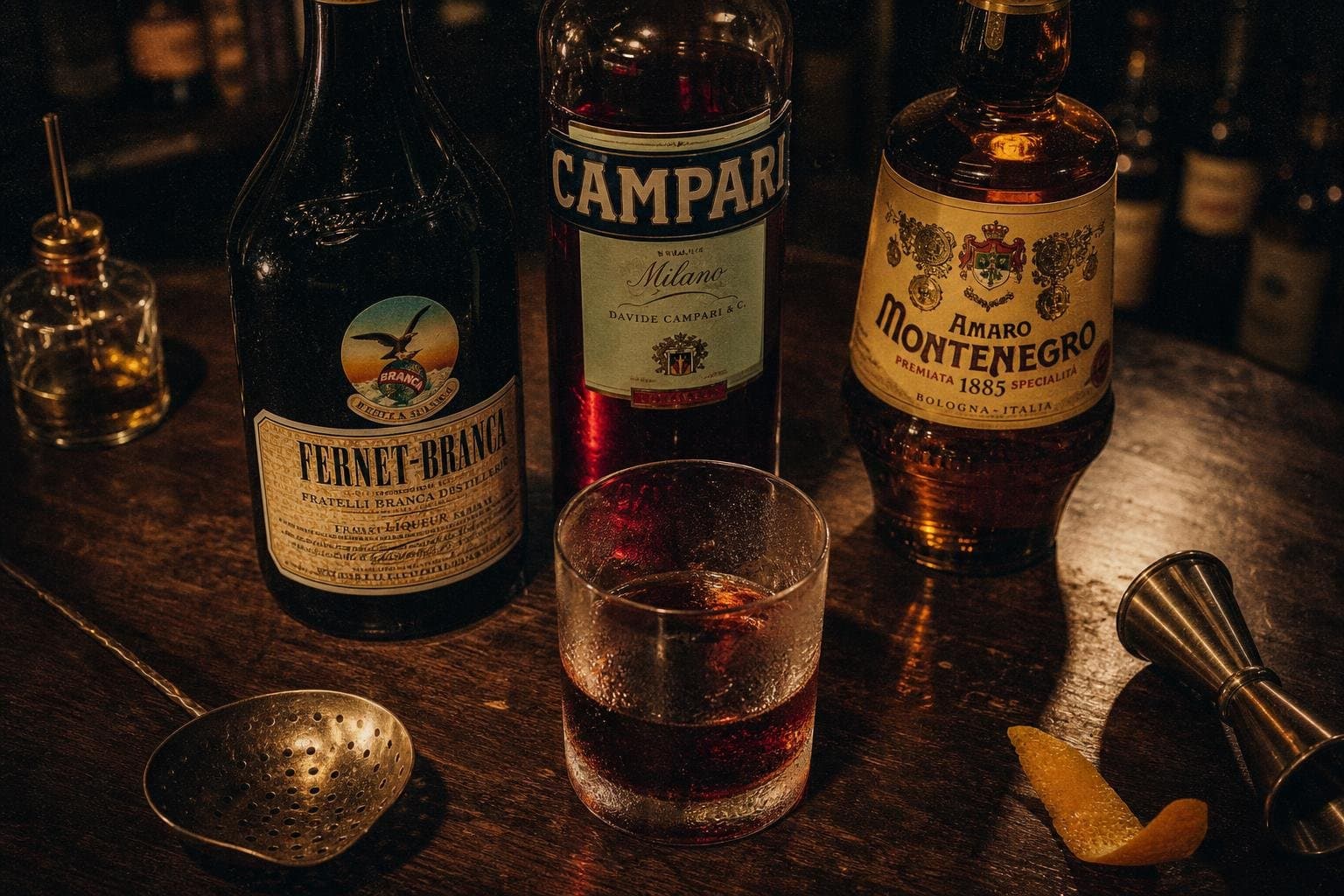

There's a specific kind of bar conversation that dates the amaro explosion better than any sales chart. It goes like this: someone orders a Negroni, the bartender nods approvingly, and then — unprompted — begins explaining what Campari is. As if the person who ordered a Negroni doesn't know what Campari is. As if knowing what Campari is has become a personality.
That conversation peaked somewhere around 2018 and has been slowly dying since. Which means we're at the interesting part: the aftermath. When a category gets evangelized hard enough to become a cliché, the serious drinkers move on, the casual converts keep buying what they learned to buy, and the actual depth of the category — the stuff that was always there, waiting — finally gets some room to breathe.
The amaro explosion was real. What we're missing is everything it didn't get around to.
How Campari Became the Gateway Drug and Fernet Became the Handshake
The story of amaro's American ascent has a few reliable origin points, none of them clean. Spirits & Distilling traces the arc through the craft cocktail movement's rediscovery of the Negroni — a drink that had been sitting in cocktail books for decades before bartenders decided it was the litmus test for a serious bar. Campari was the entry point. Once drinkers understood that the bitter red thing in their Negroni was its own category, with its own logic and its own history, the rabbit hole opened.
Fernet-Branca became the industry's internal currency. Asterley Bros. documents the San Francisco phenomenon precisely: by 2008, a single American city accounted for roughly 25% of all Fernet consumed in the United States. The "bartender's handshake" wasn't metaphor — it was a literal practice, a shot poured between colleagues as a signal of shared taste and shared suffering. Fernet's medicinal intensity, its menthol-forward bitterness built from botanicals including gentian, saffron, myrrh, and chamomile, made it a kind of hazing ritual dressed up as connoisseurship. If you could drink it without flinching, you belonged.
I wrote about this dynamic at length back in April and again in May. The short version: Fernet's cult status is real, but the reasons given for it — that it's uniquely complex, that it's an acquired taste worth acquiring — often paper over the fact that it became a symbol before most people had actually thought hard about what was in the glass. The handshake became more important than the drink.
The Paper Plane accelerated the cocktail side of the explosion. Tasting Table credits New York bartender Sam Ross with introducing it in the late 2000s, a drink built on equal parts bourbon, Aperol, Amaro Nonino, and fresh lemon juice. Its genius was structural: it demonstrated that amaro could be a primary cocktail ingredient rather than a modifier, that its bitterness could anchor a drink rather than complicate one. The Paper Plane earned its modern classic status because it actually works — the balance of sweet, sour, and bitter is genuinely elegant — but it also had the effect of making Amaro Nonino the "correct" amaro for a certain kind of cocktail bar, which is a different thing from understanding the category.
What the Explosion Missed: The Spectrum Nobody Talked About
Here's the problem with evangelism: it simplifies. The amaro moment gave American drinkers Campari, Fernet, Aperol, and Amaro Nonino. It gave them the Negroni and the Paper Plane. What it mostly didn't give them was any sense of how wide the category actually runs.
Spirits & Distilling lays out the basic logic: amaro is a liqueur, the word means bitter, and the bitterness and aromatics come from botanical macerations — but the level of bitterness ranges from nearly imperceptible and almost cloyingly sweet to full-on bitter bombs. That spectrum is enormous. Cynar, the artichoke-based amaro I've written about before, sits in a completely different register than Fernet. Averna — dark, syrupy, Sicilian, built on caramel and citrus peel and Mediterranean herbs — is barely recognizable as the same category as Campari. Asterley Bros. notes Averna's residual sugar takes the edge off the bitterness in a way that makes it almost approachable to people who claim they don't like bitter drinks.
Amaro Montenegro is the case study in how the explosion created a hierarchy that doesn't quite match the actual quality of what's in the bottles. A Couple Cooks describes it as more floral than most amari — orange-forward, rose petal finish, 23% ABV, built from 40 botanicals, running around $35 for a 750ml bottle at specialty shops. It's widely available. It's also genuinely interesting in a way that gets undervalued because it doesn't fit the bitter-bomb narrative that made Fernet famous. The rose petal note reads as approachable, which the amaro cognoscenti treated as a mark against it. That's backwards. A spirit that can do something Fernet can't — sit comfortably in a floral, citrus-forward cocktail — is a tool, not a compromise.
The Difford's Guide community recipe for the Amarillo makes the point practically: equal parts lemon juice, Amaro Montenegro, Yellow Chartreuse, and mezcal blanco. That's a drink built on the assumption that Montenegro's floral bitterness can hold its own against alpine herbaceousness and agave smoke. It can. But you'd never know that from the way the amaro moment was narrated, which was mostly: Campari is the gateway, Fernet is the destination, everything else is a detour.
The Aperol Problem: When Marketing Becomes the Product
The amaro explosion had a shadow twin, and its name is Aperol Spritz. A detailed account of Aperol's rise traces the engineering behind it: two brothers, Luigi and Silvio Barbieri, mixed the original formula in Padua in 1919, and it sat in regional obscurity for roughly 80 years. Campari acquired it in 2003 for €150 million — a wild multiple for a sleepy regional liqueur — and then built the Aperol Spritz as a standardized ritual: three parts prosecco, two parts Aperol, one part soda. Simple enough to scale globally. Consistent enough to be recognizable from Milan to Miami.
The numbers are not subtle. US shipments went from roughly 9,000 cases in 2010 to around 390,000 cases in 2022. Today Aperol drives close to a quarter of Campari Group's roughly €3 billion in annual sales.
None of that is the problem. The problem is what it did to the category's reputation. Aperol Spritz became the thing that people who don't drink amaro drink, which meant that amaro's serious drinkers had to perform distance from it. The result was a bifurcation: Aperol on one side (mass market, Instagram, vacation), Fernet on the other (industry, serious, acquired). Everything in between — the genuinely interesting middle of the category — got squeezed out of the conversation.
The TNT Magazine piece on French herbal liqueurs captures the hangover accurately: "For about a decade, ordering an Aperol was embarrassing and ordering Amaro made you look like you knew your way around a well stocked drinks cabinet. Negronis led to Campari neat, then to obscure Sardinian digestifs that tasted like cough medicine and cost £14 a shot. The amaro moment was real, then it peaked, and now the bartenders who were evangelising Fernet are quietly reaching for something else."
That something else, the piece argues, is French — génépi, Suze, Bénédictine, the alpine herbal tradition that Italy's moment partially obscured. Which is fine. But it's worth noting what's being left behind in the pivot: a category that still has enormous depth that the explosion never properly excavated.
What the Aftermath Actually Looks Like at a Good Bar
The most useful thing the amaro moment produced wasn't the Negroni renaissance or the Paper Plane. It was the normalization of bitter as a flavor category in cocktails. Before Campari became ubiquitous, bitterness was something American drinkers were trained to avoid. The explosion changed that, and the change is durable even as the trend itself fades.
The practical result, at bars that are paying attention, is amaro used as a modifier rather than a star — the way it functions in the Somssi "little beverages" program described by Punch, where head bartender Christian Gray uses alpine amaro to punch up a Campus Queen built on pilsner and grapefruit oleo saccharum. That's amaro doing what it does best: adding herbal complexity and bitterness to a drink that would otherwise be one-dimensional, without announcing itself. The amaro is the thread, not the headline.
The Negroni taught drinkers that bitter could be beautiful. The Paper Plane taught bartenders that amaro could anchor a cocktail. What the next phase requires is something less dramatic: the understanding that different amari do genuinely different things, and that matching the right one to the right application is a craft decision, not a status signal.
Amaro Montenegro's floral bitterness belongs in different drinks than Cynar's vegetal depth. Averna's caramel sweetness serves different purposes than Fernet's menthol intensity. These aren't interchangeable bottles on a shelf — they're a toolkit, and the explosion mostly taught people to reach for the same two or three tools regardless of what they were building.
The amaro moment gave American drinkers a category they didn't know they needed. That's not nothing. But the evangelism had a cost: it created a canon that was too narrow, a hierarchy that rewarded bitterness as performance, and a bifurcation between the mass-market spritz and the industry handshake that left the genuinely interesting middle of the category underexplored.
The bottles worth reaching for now are the ones that didn't make the highlight reel. The ones that are still made, just poorly distributed. The ones that do something specific and strange that the famous bottles don't. That's always been the deep bench. The explosion just made it easier to find — if you're willing to look past what the explosion told you to look for.


