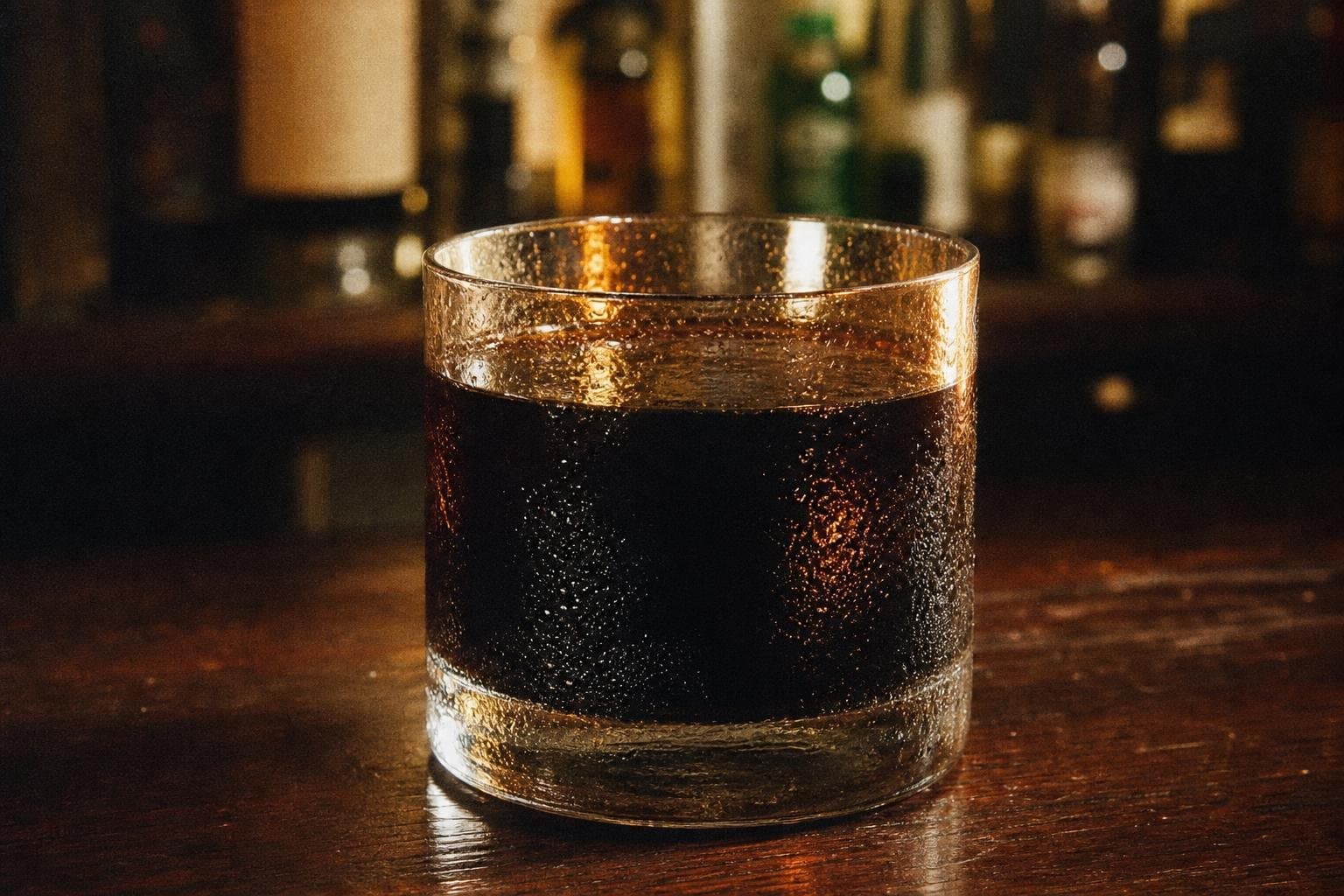

There's a version of the amaro story that's been told so many times it's become a kind of mythology: bartenders discovered bitter Italian liqueurs, put them in everything, and cocktail culture was transformed. The story isn't wrong, exactly. It's just incomplete — and the incompleteness is doing real work, obscuring what actually happened and what comes next.
I wrote about amaro's cultural ascent back in May, arguing that the category's rise was driven by bartenders rather than marketing departments, which made it unusual and worth taking seriously. That argument still holds. But something has shifted since then, and TNT Magazine put it plainly in July: "The amaro moment was real, then it peaked, and now the bartenders who were evangelising Fernet are quietly reaching for something else." The question worth asking isn't whether that's true — it clearly is — but what the amaro explosion actually accomplished while it lasted, and whether the category leaves anything durable behind when the trend-chasers move on.
The Explosion Was Real, But It Wasn't Uniform
Start with what "the amaro explosion" actually means, because the phrase flattens a category that resists flattening.
Spirits & Distilling puts the range plainly: amaro runs from nearly imperceptible bitterness to "full-on bitter bombs designed to make your tongue recoil." The category spans Campari at one end — sweet, accessible, the engine of a billion Negronis — and Fernet-Branca at the other, which Asterley Bros describes as "sharp, medicinal, and menthol-forward," with an ingredient list that includes gentian, saffron, myrrh, rhubarb, and chamomile. These are not variations on a theme. They are fundamentally different drinking experiences that happen to share a category label.
What the explosion actually did was collapse that range into a single cultural signal. Ordering amaro meant you were serious. It didn't much matter which amaro, or why, or whether you actually liked it — the gesture was the point. This is how trends work, and it's also how they die: once the gesture becomes legible to everyone, it stops signaling anything. The bartenders who genuinely loved Fernet were eventually joined by people who ordered it because ordering it was the right move. Then the right move changed.
The more interesting question is what happened to the drinks themselves during this period — because the cocktail applications that emerged from the amaro moment are not going anywhere, regardless of what's fashionable to order neat.
What Amaro Actually Did to the Cocktail Canon
The most durable contribution of the amaro explosion wasn't cultural cachet. It was the demonstration, repeated across thousands of bar programs, that bitter herbal liqueurs could function as primary cocktail ingredients rather than accent notes.
This seems obvious now. It wasn't, twenty years ago. The Negroni existed, of course — equal parts gin, sweet vermouth, and Campari — but for most of the twentieth century it was a European curiosity rather than a canonical American cocktail. The craft cocktail revival changed that, and the Negroni's rehabilitation opened the door for everything else.
Tasting Table's survey of amaro cocktails points to the Paper Plane as the clearest example of what the amaro moment made possible. The drink — equal parts bourbon, Aperol, Amaro Nonino, and fresh lemon juice — was introduced by New York bartender Sam Ross in the late 2000s and earned modern classic status quickly. What makes it instructive is the architecture: two Italian aperitifs sharing equal billing with the base spirit, neither one subordinated to the other. That's a structural argument about what amaro can do in a glass, and it's an argument that won.
Amaro Montenegro illustrates a different application. A Couple Cooks describes it as more approachable than most amari — lighter, more floral, with orange and rose petal notes — which makes it useful in contexts where Campari or Fernet would overwhelm. At around $35 for a 750ml bottle and widely available, it's the kind of bottle that earns its place on a home bar by being genuinely versatile rather than just impressive-looking. The "Montenegroni" — Montenegro standing in for Campari in a Negroni template — is a legitimate variation, not a gimmick, because the substitution actually changes the drink in a coherent direction: softer, more floral, less aggressive.
This is what the amaro explosion accomplished at its best: it gave bartenders and serious home drinkers a working vocabulary for bitter and herbal flavors, and a set of structural templates for using them. The Negroni template alone — spirit, bitter, sweet vermouth — has generated more interesting variations than almost any other cocktail architecture. That's a real contribution to the canon.
Fernet's Particular Problem
Fernet-Branca deserves its own accounting, because its trajectory during the amaro moment was stranger than the rest of the category's.
I've written about Fernet twice before — its bartender-handshake mythology and the gap between its cult status and the reasons usually given for it. The short version: Fernet's reputation was built on genuine bartender affection, then colonized by people performing that affection, then became a kind of shorthand that meant less and less the more widely it circulated.
Asterley Bros notes that by 2008, San Francisco alone accounted for roughly 25% of all Fernet consumed in the United States — a figure that illustrates how concentrated the early enthusiasm was, and how much of the subsequent "explosion" was really diffusion of an existing subculture rather than genuine new discovery. The drink didn't change. The audience did.
The cocktail applications for Fernet are real but narrow. The Toronto — rye whiskey, Fernet, simple syrup, Angostura — is a legitimate classic that uses Fernet's intensity as a feature rather than a problem. The Hanky Panky, a gin-and-sweet-vermouth Martini variation with a small float of Fernet, does something similar. But these are precision instruments. Fernet works in cocktails when the recipe is built around its specific character; it fails when it's added because the bartender wanted to signal something.
The honest assessment: Fernet-Branca is a great digestif and a useful cocktail ingredient in the right hands. It is not, and was never, a universal solvent. The amaro moment oversold it as the latter, which is why the correction was inevitable.
What the Bartenders Are Reaching For Now
TNT Magazine's July piece on French herbal liqueurs is worth reading as a document of where the serious-bar conversation is moving, even if you discount the trend-piece framing. The shift it describes — from Italian amari toward French herbal liqueurs like génépi, Suze, and Bénédictine — makes sense as a bartender's progression. Once you've internalized the bitter-herbal vocabulary that amaro teaches, you start looking for more variation within that vocabulary. French herbal liqueurs offer it: drier, more medicinal, more alpine in character, sitting differently in the stomach after a meal.
Génépi is the specific recommendation worth noting. Dolin makes a widely available version (TNT puts a 50cl bottle at roughly £30-40 in the UK). The Carthusian monks who make Chartreuse also produce a separate génépi — drier and more serious, distilled from Alpine wormwood — though availability varies. These are not amaro replacements. They're adjacent tools that do different things.
The Difford's Guide community recipe for the Amarillo — equal parts lemon juice, Amaro Montenegro, Yellow Chartreuse (or génépi), and mezcal — is a useful illustration of where this cross-pollination leads. It's a recipe that would have been illegible to most bar programs fifteen years ago and is now the kind of thing a serious home bartender can execute on a Tuesday. That's the amaro explosion's real legacy: not the trend itself, but the expanded ingredient literacy it left behind.
There's also a useful corrective in the Somssi "little beverages" piece from Punch, which describes head bartender Christian Gray using "alpine amaro" as a supporting element in a small-format drink built around grapefruit oleo saccharum. The amaro isn't the point of the drink; it's one voice in a more complex arrangement. That's a more sophisticated use than "add Fernet, signal expertise" — and it suggests that the category has genuinely been absorbed into the working vocabulary of serious bar programs, which is a different and better outcome than trend status.
What We're Still Missing
The amaro explosion had a blind spot, and it's worth naming: it was almost entirely focused on a handful of widely distributed bottles. Campari, Fernet-Branca, Aperol, Amaro Nonino, Cynar, Montenegro — these are the names that circulated, and they circulated because they were available. The actual range of Italian amari is vastly larger, and most of it remains poorly distributed outside Italy, which means "hard to find" rather than out of production.
Regional Italian amari — the Sardinian digestifs, the obscure alpine styles, the bitter liqueurs tied to specific towns or monasteries — were largely absent from the amaro moment because they couldn't be reliably sourced. The trend moved faster than distribution infrastructure could follow. This is a genuine loss, because the most interesting amari are often the most local ones, the ones that taste like a specific place and a specific tradition rather than a category.
The bartenders who are now reaching for French herbal liqueurs are, in some ways, doing the same thing the amaro evangelists did a decade ago: finding a category that rewards curiosity and hasn't yet been flattened by trend adoption. The cycle will repeat. What matters is what gets left behind when it does — and if the amaro moment is any guide, what gets left behind is a set of techniques, templates, and flavor relationships that outlast the enthusiasm that produced them.
The Negroni isn't going anywhere. The Paper Plane earned its place. The bitter-herbal vocabulary that the amaro explosion built into serious bar culture is genuinely useful and genuinely durable. That's more than most trends leave behind.
The question for the next few years is whether the French herbal liqueur moment — if it becomes one — produces the same kind of structural contribution, or whether it stays at the level of bartender fashion. Génépi in a Margarita template is interesting. Génépi as a signal that you've moved on from amaro is not.


