


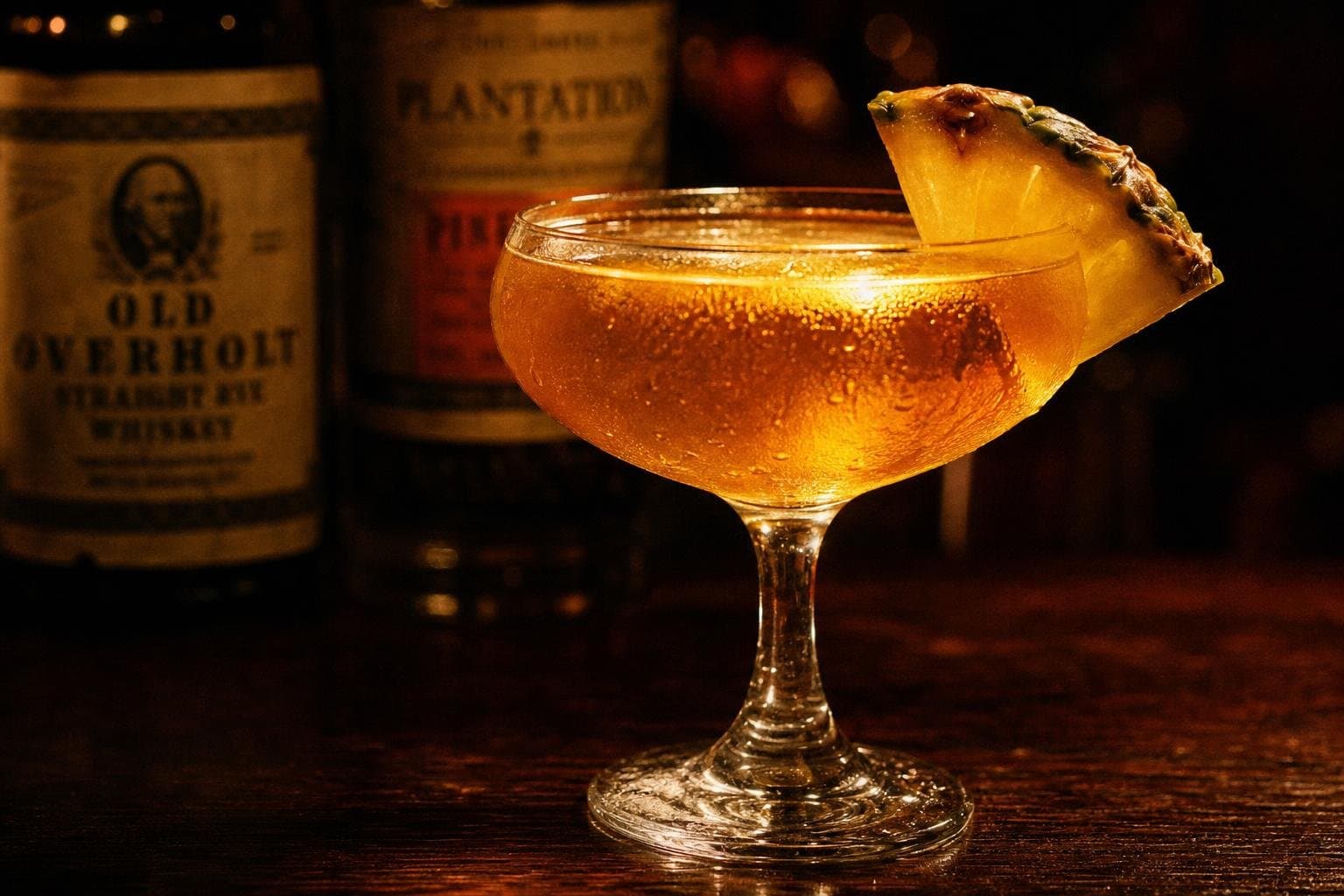

I've written about the Algonquin twice now — once when it failed to get its revival, once when it finally did. Both times, the drink's core tension was the same: rye, French vermouth, and pineapple juice in equal parts sounds like a dare, and it mostly drinks like one. The question I didn't fully answer was why it keeps attracting serious bartenders despite consistently resisting them.
Dillon Raaz at Atoma in Seattle might have cracked it, and his answer is instructive. After a decade of failed attempts — first at Mercantile, where he and a colleague "played around with it and couldn't find a version that we liked" — Raaz stopped trying to fix the Algonquin and started using it as a directional guide instead. The result is the Weird Al 'Gonq'ovich: rye, pineapple gum syrup, tepache, Tokay wine, chocolate nocino, finished with a spritz of cacao nib-infused peated Scotch.
That's not a revival. That's a séance.
The Vermouth Was Always the Weak Link
The original recipe's problem is the French vermouth. Dry vermouth and pineapple juice don't want to be in the same glass — the vermouth's herbal astringency and the juice's tropical sweetness pull in opposite directions without anything to mediate. Raaz and his assistant bar manager made a telling observation: dry French vermouth in the 1920s "probably was fermented anyway 'cause of lack of good refrigeration." So they replaced most of it with tepache — traditional Mexican fermented pineapple — which gives the drink fermented dryness while doubling down on the pineapple rather than fighting it. Raaz says the result "drinks like a Martini."
That reframe matters. The Algonquin was always trying to be a stirred drink trapped in a sour's body. The vermouth was the tell. Tepache solves the problem by being both things at once: fruity and dry, sweet and fermented. The pineapple gum syrup handles the texture. The Tokay and nocino give the rye's chocolate and vanilla notes somewhere to go.
What Raaz built is a useful model for any drink that's historically interesting but practically broken: don't substitute around the problem ingredient, understand what job it was supposed to do and find something that actually does it. The Algonquin needed fermentation, not vermouth. It took ninety years and a bar in Seattle to figure that out.
The original recipe — two parts rye, one part French vermouth, one part pineapple juice, first appearing in print in the 1930s — is still worth making once