


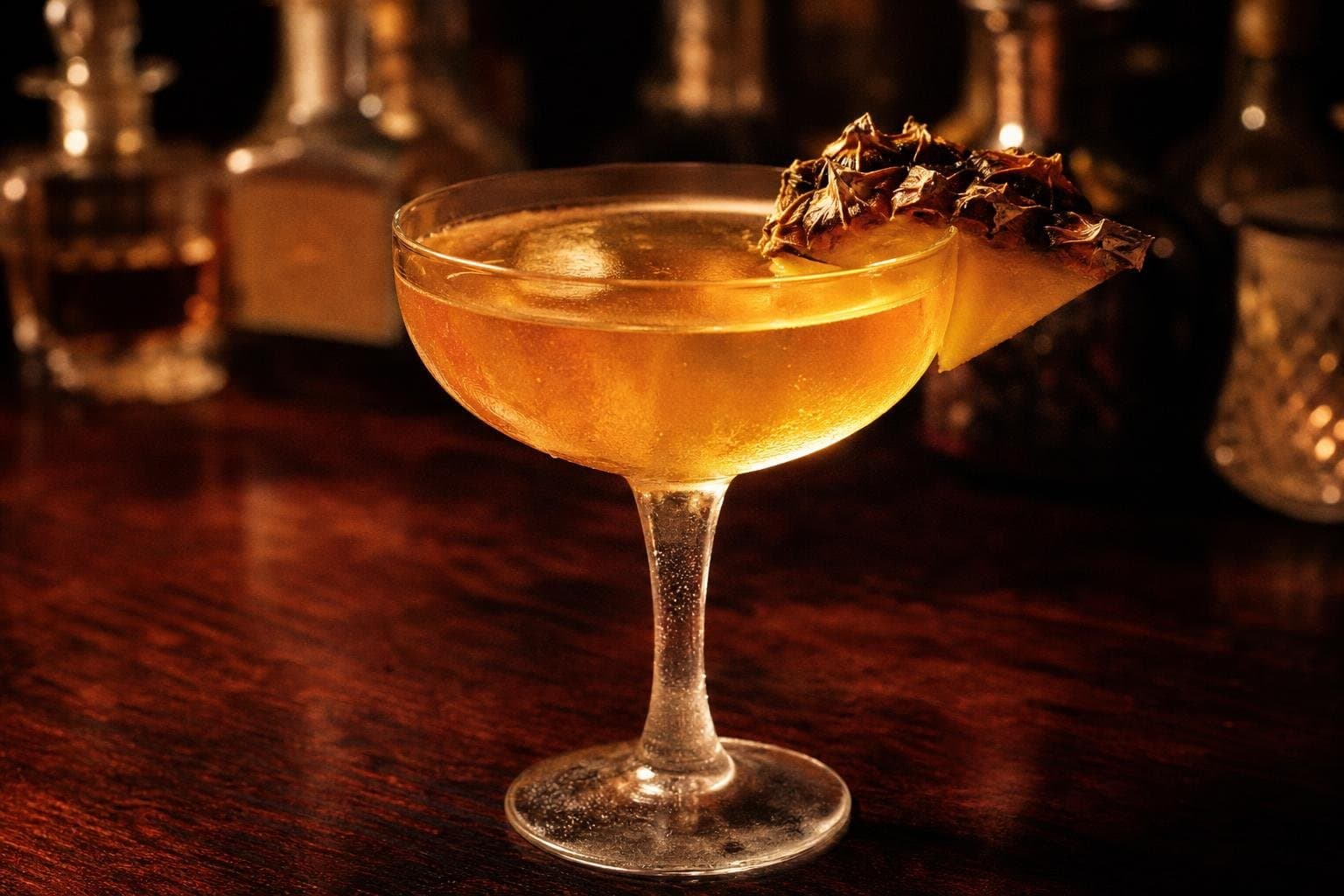

Most forgotten cocktails fail for one reason: they taste bad. The Algonquin fails for a stranger one: it tastes almost right, which is harder to fix.
The original recipe — two parts rye, one part dry French vermouth, one part pineapple juice — has been sitting in the record since the 1930s, appearing first in Along the Wine Trail and then in a 1937 issue of Esquire. It made it into Jim Meehan's PDT Cocktail Book and Ted Haigh's Vintage Spirits and Forgotten Cocktails. It has the pedigree. It has the name recognition — the Algonquin Hotel, the Round Table, Dorothy Parker presumably nearby. And yet the drink never found its footing in the revival era. The same craft bar culture that excavates drinks built from an idea backward, tested until concept and flavor converge, somehow kept passing this one by.
The problem is structural. Rye and pineapple want to fight each other, and dry vermouth doesn't have the body to referee. The drink sits in an awkward middle register — not tropical, not spirit-forward, not quite sour. It's a genre-straddler with no genre to land in. The same instinct that sends bartenders back to the Old Fashioned's two-century lineage in search of something solid keeps them away from the Algonquin: when the bones are shaky, the revival stalls.
Tepache Fixes What Vermouth Couldn't
Dillon Raaz, bar director at Atoma in Seattle, spent a decade on and off trying to solve it. His solution, the Weird Al 'Gonq'ovich, is instructive: he replaced most of the vermouth and part of the pineapple juice with tepache, the traditional Mexican fermented pineapple drink. The logic is sound — something fermented does the structural work that vermouth was supposed to do, drying the palate while keeping the fruit. He rounds it out with Tokay wine, chocolate nocino, and a spritz of cacao nib-infused peaty Scotch. The result, he says, drinks like a Martini.
That's a long way from the original. But it's the right move. The Algonquin's problem was never the concept — rye and pineapple is a legitimate pairing — it was that the original recipe asked dry vermouth to do something it can't. Fermentation gives you the acidity and the dryness without the thinness. It's the same logic behind the agave Zombie riff at Compass Rose, where swapping base spirits fixes a structural problem the original recipe never fully solved.
The drink sat in the books for ninety years waiting for someone to figure out what was wrong with it. Turns out the vermouth was the problem all along.