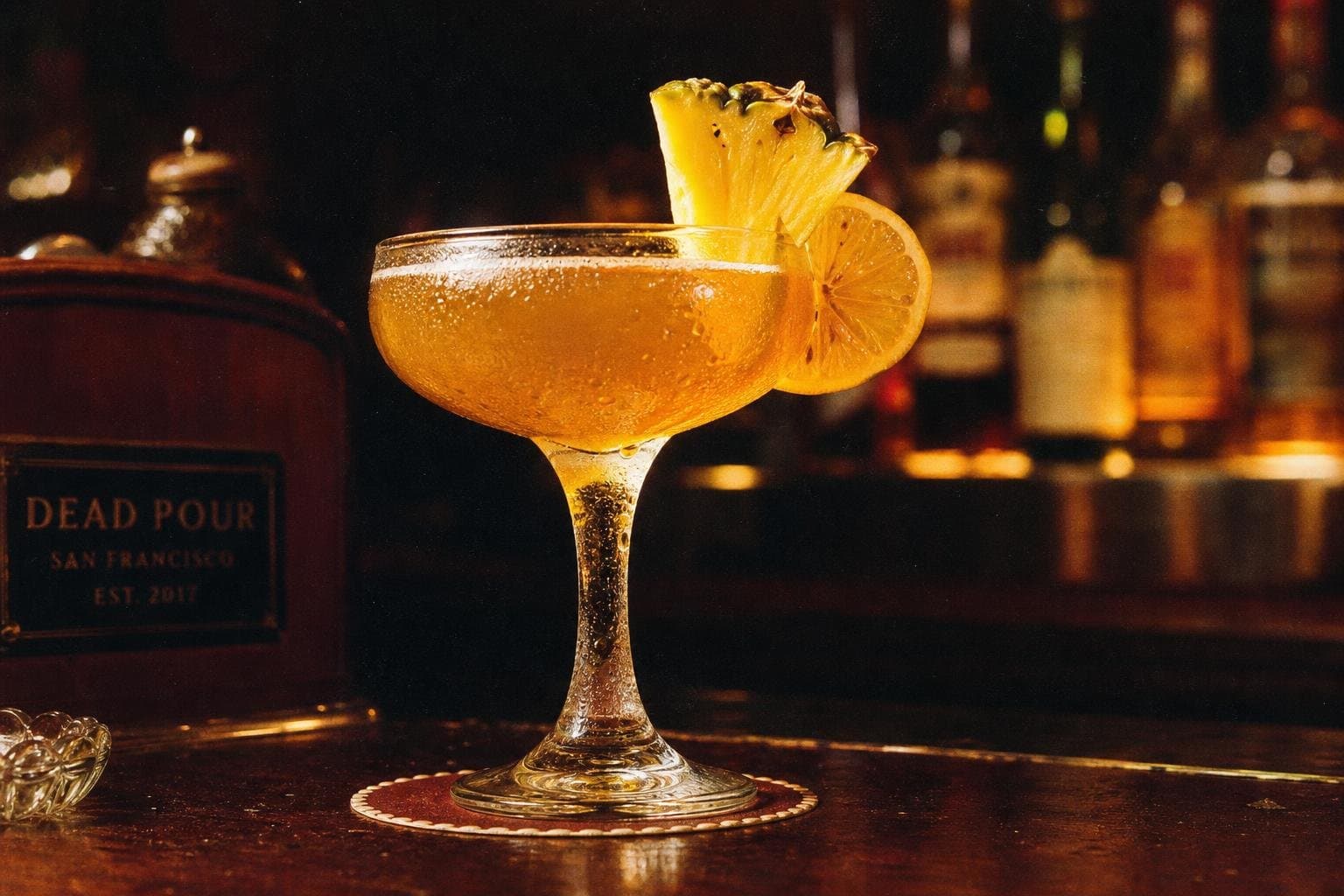

There is a cocktail that was, by multiple accounts, the most famous drink in the American West for the better part of half a century. Bartenders traveled from across the country to taste it. The recipe was kept secret. When the bar that made it famous finally closed, the drink didn't just fade — it vanished so completely that most American drinkers today couldn't tell you what pisco is, let alone that it once anchored one of the country's great cocktail institutions.
That's not a story about a drink falling out of fashion. That's a story about erasure — and it's worth understanding how it happened, because the erasure wasn't accidental.
The Bank Exchange and the Drink That Defined a City
The pisco punch was the house specialty of the Bank Exchange Saloon in San Francisco, which operated through the Gold Rush era and well into the early twentieth century. A recent cookbook celebrating American cocktail history identifies the Bank Exchange as the place that made pisco punch famous — and identifies it as one of San Francisco's most famous signature cocktails, full stop. Not a regional curiosity. Not a historical footnote. The signature drink of a major American city.
The drink's core is Peruvian pisco — a grape brandy distilled under strict rules that, as the diplomatic record makes clear, require single distillation with no water added afterward. The spirit comes off the still at drinking strength. You get one pass. That constraint produces something with a different character than cognac or Chilean pisco — a rawer, more aromatic grape presence that reads as both delicate and assertive depending on the variety.
Pisco punch combined that spirit with pineapple, citrus, and a syrup whose exact formula was famously guarded. The Bank Exchange's version was reportedly so good that visitors to San Francisco made it a required stop. This was not a drink that needed marketing. It had genuine word-of-mouth across an entire continent.
And then Prohibition arrived, the Bank Exchange closed, and the recipe went with it.
What Prohibition Erased — and What It Didn't
The standard narrative of Prohibition's damage to American cocktail culture focuses on the obvious losses: bartenders emigrating to Europe, domestic spirits production collapsing, the institutional knowledge of hotel bars and saloons dissolving. All of that is true. But Prohibition's damage wasn't evenly distributed, and pisco took a particular kind of hit.
Domestic whiskey and gin had infrastructure — distilleries that could pivot to "medicinal" production, bootleggers who kept demand alive, and an entire cultural apparatus ready to resume when repeal came. Pisco had none of that. It was an imported spirit with a single American stronghold. When the Bank Exchange closed, there was no secondary ecosystem to keep the drink alive. No bootleg pisco punch. No underground tradition waiting to resurface.
When repeal came in 1933, the cocktail revival that followed was built around what was available and what bartenders remembered. Pisco wasn't available in meaningful quantities, and the bartenders who'd made it famous were gone. The drink that had defined San Francisco's drinking culture for decades simply wasn't there to be rediscovered.
This is the mechanism of erasure: not active suppression, but the compounding effect of infrastructure loss. A spirit with no domestic production, no surviving institutional champions, and no critical mass of drinkers who'd grown up with it had no path back into the canon.
The Geopolitics of Obscurity
There's a second layer to pisco's American absence that has nothing to do with Prohibition, and it's still operating today.
Peru and Chile both produce pisco. Both claim it. The dispute is not informal — it involves protected designations of origin, government-funded promotional campaigns, international legal filings, and, in one particularly pointed move, Chile's renaming of a town to Pisco Elqui in 1936, which the Peruvian side regards as a deliberate act of territorial claim-staking in the branding war.
The practical consequence for American consumers is confusion. When pisco does appear on a back bar, there's rarely any indication of which country's version it is, what the production differences mean, or why it matters. Chilean pisco is produced in larger volume and has historically been easier to source in American markets. Peruvian pisco — with its stricter single-distillation rules and no-water-addition requirement — is the version with the longer American history, the one that went into pisco punch, the one with the direct line back to the Bank Exchange. But that context is almost never provided.
Peru established an official Denomination of Origin for its pisco in 1991, a move that coincided with growing international interest in Peruvian food culture. The DOC framework was meant to protect provenance and signal quality — the same logic that governs Champagne or Cognac. Whether it's worked as an export strategy is a different question. As Amanda Barnes, MW, author of The South America Wine Guide, told Food & Wine: "The top piscos of Peru are still relatively untapped and certainly deserve more attention."
That's a generous framing for what is, in practice, a distribution and storytelling failure. The spirit has the history. It has the production rules that serious drinkers tend to respect. What it lacks is the American market infrastructure to put it in front of people who would care.
The Pisco Sour Problem
The pisco sour is now the drink most Americans associate with pisco, and that's both a blessing and a complication.
The blessing: the pisco sour is genuinely excellent. Pisco, lime, simple syrup, egg white, Angostura bitters. The egg white isn't decorative — as the technique goes, it's a foaming agent and emulsifier; the proteins denature during the dry shake, trapping air and producing a dense, stable foam that changes the drink's texture and softens the acid. A pisco sour without egg white is sharper, thinner, and arrives faster. The egg white version is rounder and more complete. The technique matters.
The complication: the pisco sour, as the drink most likely to appear on American menus, tends to flatten pisco into a single application. It becomes "the pisco drink" the way the Aperol Spritz became "the Aperol drink" — a gateway that also functions as a ceiling. Drinkers who enjoy the pisco sour rarely get pushed toward the broader category, because bars rarely stock more than one bottle and bartenders rarely have the context to explain why the category is interesting.
The pisco punch — the drink with the actual American history — barely registers. When it does appear, it's usually treated as a novelty, a Gold Rush-era curiosity rather than a serious cocktail with a documented lineage. A recent cookbook treating pisco punch as California's representative classic cocktail for the country's 250th anniversary is a meaningful signal, but it's also a reminder of how much work remains: the drink needs a cookbook to vouch for it in its home city.
What a Real Pisco Punch Requires
The original Bank Exchange recipe is lost. What survives are accounts of its ingredients and effect, and the reconstructions that serious bartenders have built from those accounts. The core elements are consistent across most versions: Peruvian pisco as the base, fresh pineapple (often as a syrup or juice), citrus, and something sweet to bind it.
The Pisco Solstice riff from Spirits of '76 — pisco, pineapple-pomegranate shrub, yuzu or lemon juice, orange bitters, club soda — is a modern interpretation that adds complexity through the shrub's vinegar backbone and the yuzu's aromatic citrus. It's a reasonable evolution. Whether it captures what made the original famous is unknowable, but it demonstrates that the template is still alive and still interesting.
For a more direct reconstruction, the working spec is: two ounces Peruvian pisco (a quebranta-based bottle for the most traditional profile), three-quarters ounce fresh pineapple juice or a light pineapple syrup, three-quarters ounce fresh lemon juice, half ounce simple syrup, shaken hard with ice and strained. Some versions add a small float of pineapple gomme. The drink should be bright, aromatic, and lighter than it looks — pisco's grape character reads as floral rather than heavy, which is what made the original so disarming.
On bottles: Peruvian pisco is available in the United States, though distribution is uneven. Expect specialty shop or online sourcing in most markets; a handful of major urban markets carry it at better-stocked retailers. Price range for quality Peruvian pisco runs roughly $25–$45 at retail, though availability varies significantly by region. Chilean pisco is more widely distributed and generally less expensive, but the production differences are real — for a drink with this much history attached to the Peruvian version, the sourcing effort is worth it.
The Excavation Problem
Here's what the pisco punch story illustrates about cocktail history more broadly: the canon we've inherited isn't a neutral record of what was good. It's a record of what survived the specific disruptions of the twentieth century — Prohibition, two world wars, the mid-century turn toward simplicity and volume production — filtered through the revival movements that came after.
The craft cocktail renaissance of the 2000s did extraordinary work recovering forgotten drinks. The Last Word came back. The Corpse Reviver #2 came back. Genever started appearing on serious back bars. But the recovery was uneven, and it tended to favor drinks with European spirits at their core — the spirits that had maintained production continuity and distribution infrastructure through the dark years.
Pisco had neither. Its American story was interrupted at exactly the wrong moment, and the revival movements that followed didn't have the institutional memory to reconstruct it. The Bank Exchange is gone. The bartenders who made pisco punch famous are long dead. What remains is a spirit with genuine quality, a documented American history, and almost no presence in the bars where that history should be celebrated.
Peru's pisco producers are increasingly focused on international markets, and the quality argument for Peruvian pisco — the strict production rules, the grape variety diversity, the terroir specificity — is the same argument that has worked for other spirits categories when someone bothered to make it clearly. The drink that built San Francisco's cocktail reputation is still waiting for its bartender.


