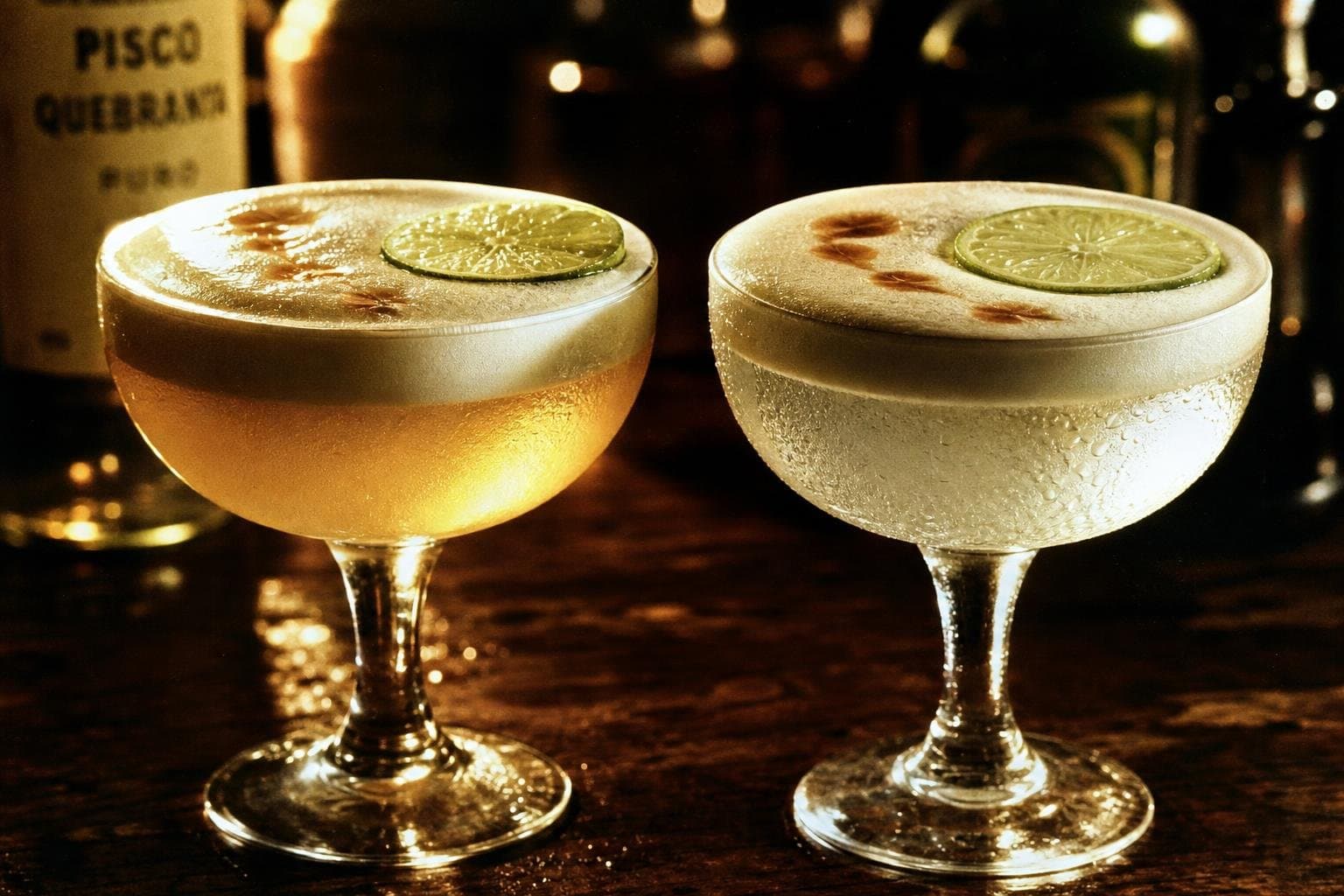

Order a Pisco Sour in Lima and one in Santiago and you are not drinking variations on a theme. You are drinking two different regulatory philosophies that happen to share a label. Most American bar menus don't bother making that distinction, and most drinkers never ask. That's the actual confusion — not whether Peru or Chile "invented" pisco, but that bartenders keep treating the word as if it describes a single thing.
The Border Came After the Barrel
Before there was a Peru or a Chile, there was a viceroyalty, a coastline, and a lot of surplus wine. Spanish colonists planted vines across the Viceroyalty of Peru in the sixteenth century, and by the early 1600s distillers along the Ica coast were turning that wine into aguardiente de uva — grape brandy — shipped out through the port town of Pisco, south of Lima (Barlist). At the same time, vineyards in what is now northern Chile were doing the same thing with their own grapes in the Elqui and Limarí valleys (Barlist). Nobody involved was thinking about national pride. There were no passports for alembics, and the colonial trade routes moved grapes, stills, and know-how across territorial lines that hadn't been drawn yet (María de la Peña).
The fight over who "owns" pisco is a nineteenth- and twentieth-century invention, grafted onto a seventeenth-century agricultural practice after independence turned shared colonial geography into competing nation-states. That's worth sitting with before picking a side, because cocktail history is full of this move — a drink or a spirit gets claimed by a single inventor or a single country long after the actual practice was already diffuse and regional. Pisco's provenance dispute isn't settled, and it shouldn't be treated as settled by either country's boosters.
Two Rulebooks, Two Spirits
What actually separates Peruvian and Chilean pisco isn't patriotism. It's regulation, and the regulations produce genuinely different liquids.
Peru's Denomination of Origin was declared in December 1990 and ratified the following January, restricting the name to spirits made along the coast of Lima, Ica, Arequipa, and Moquegua, plus specific valleys in Tacna, with a technical standard fixing bottling strength between 38 and 48 percent ABV (Blog Voyageur). Within that zone, the rules get strict: distillation happens once, in copper pot stills, the spirit rests a minimum of three months in neutral vessels — glass or stainless, never wood — and nothing gets added afterward, no water to proof it down, no sugar to round it out (Black Flannel). What comes out of the still has to already be the finished product. There's no barrel to fix a flawed cut later.
Chile got there first on paper, legally defining pisco as a national spirit back in 1931, decades before Peru formalized its own designation, in the Atacama and Coquimbo regions (Barlist). But Chilean regulation leaves considerably more room on method — producers aren't bound to the same single-distillation, pot-still, no-dilution framework that defines the Peruvian category (Barlist). The practical result is two spirits with the same name, built on different assumptions about what "pisco" is even supposed to guarantee: Peru treats it like a protected expression of terroir and craft, closer in spirit to how Cognac treats its own rules; Chile treats it more like a national category with looser tolerances.
If you've never compared them side by side, the difference shows up fastest on the nose and the finish — not fruitier versus drier in some simple way, but a difference in texture, in how much the spirit tastes like it was shaped by equipment rather than just grapes and time.
The Label Isn't Lying, It's Just Not Telling You Everything
Even within Peruvian pisco, the words on the bottle are doing more work than most menus let on, and this is where I think the "confusion" the industry blames on Chile-versus-Peru politics is actually a labeling literacy problem.
Puro and acholado describe grapes, not quality tiers: puro means a single variety, acholado means a blend, and neither one outranks the other — they're production choices, not a hierarchy (Vinetur). Mosto verde describes something else entirely — not the grapes, but the timing of distillation, pulling the spirit off before fermentation has fully finished. It doesn't mean green in color, it doesn't require unripe fruit, and it isn't a guarantee of sweetness or softness, despite how often it gets marketed that way (Vinetur). A bottle can be both mosto verde and puro at once — the terms describe different layers of the same process, and conflating them is how a perfectly good label turns into a riddle nobody bothers to solve behind the bar.
This matters for the same reason vermouth labeling matters, or genever style labeling matters: when an industry doesn't bother to teach its own staff what the words mean, the words stop functioning as information and start functioning as decoration. A bartender who can't tell a guest the difference between quebranta and torontel grapes, or explain why one pisco smells like stone fruit and another smells almost savory, isn't selling a spirit. They're selling a sound effect.
What Gets Lost When Bars Treat Pisco as One Ingredient
The practical cost of all this shows up in the Pisco Sour, which remains the spirit's one unkillable cocktail and the place where substitution happens most casually. A Peruvian pisco — distilled once, unaged, unadjusted — brings a different weight and aromatic intensity to that drink than a Chilean pisco built under looser production rules. Swap one for the other and you haven't made the same cocktail with a cheaper or more convenient bottle. You've made a related but distinct drink, in the same way a Daiquiri made with aged rum isn't a Daiquiri with a twist — it's a different drink wearing the same name.
Most American bars don't draw that line, partly because stocking both styles takes shelf space and partly because very few guests ask the follow-up question. Tacama's Quebranta bottling gets cited repeatedly as a benchmark example of the non-aromatic, single-variety Peruvian style — one of the clearer entry points if you want to taste what the Peruvian DO's strict rules are actually protecting (Barlist). Pisco tourism in Ica, where bodegas like Vista Alegre and Hacienda Tacama run regular tastings, exists largely to let visitors compare styles like puro and acholado side by side precisely because the difference doesn't come through on a spec sheet (Machu Travel Peru) — which tells you something about how much nuance gets lost once a bottle crosses a border and lands on a back bar that treats it as one SKU among many.
The Fix Isn't Picking a Side
The instinct when writing about pisco is to adjudicate the Peru-Chile dispute, declare a winner, and move on. I'd rather not, because the dispute itself is the less interesting story. Both countries have legitimate, documented claims running back to the same colonial wine economy, and both have built real regulatory frameworks around the spirit since — Chile's arriving first, Peru's arriving stricter (Blog Voyageur; Barlist). Neither claim cancels the other out, and any writer who tells you it's obviously settled is selling you a flag, not a fact.
What bars owe their guests isn't a verdict on provenance. It's honesty about what's actually in the bottle, and a willingness to stock more than one answer. The next time a menu lists "pisco" as if it were a single ingredient the way vodka or gin can get away with being, ask which country's rules made it and what those rules actually require. If the bartender can't answer, that's not a border dispute. That's a training gap.


