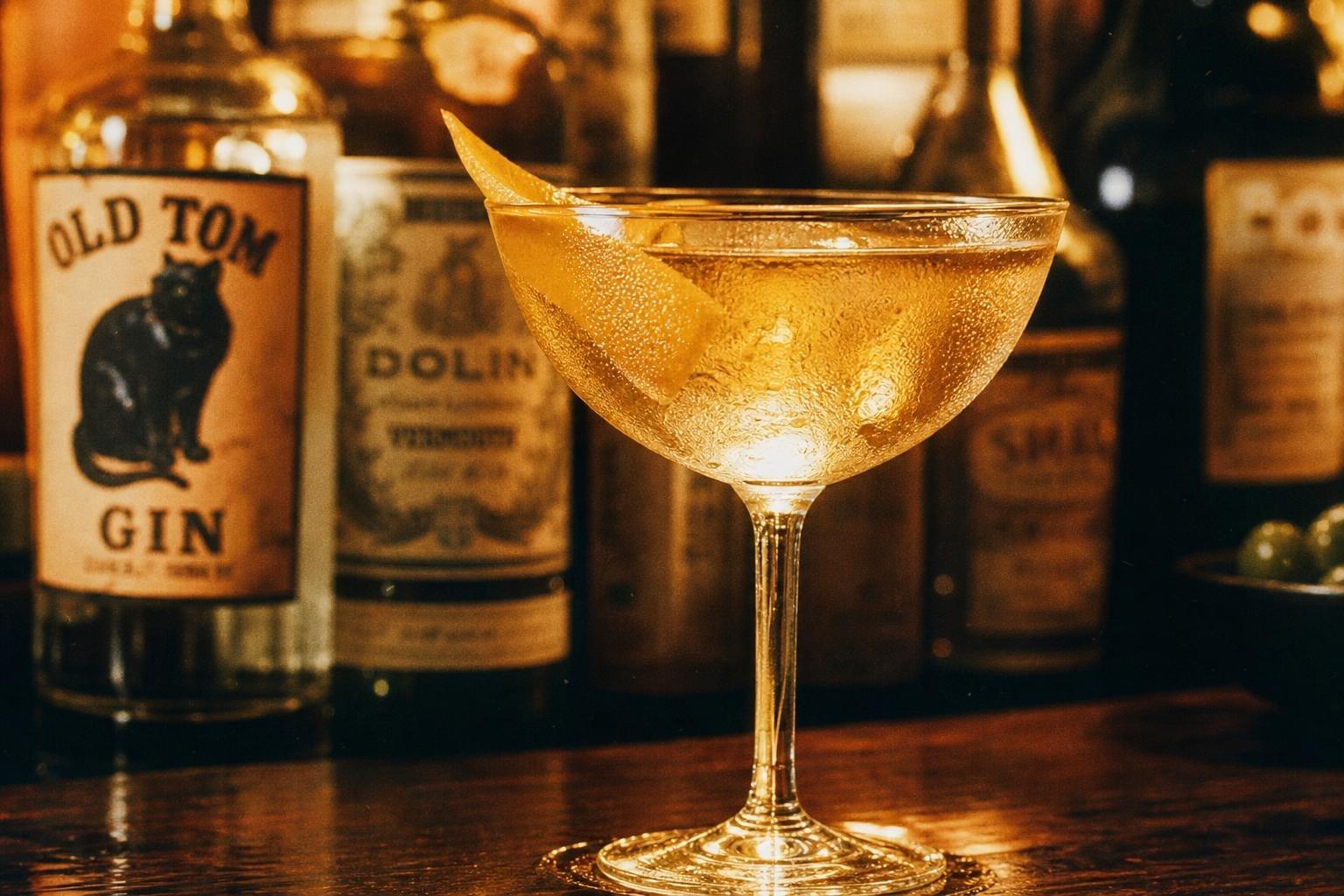

There's a tidy story people like to tell about Old Tom gin: it's the missing middle step, the evolutionary link between heavy, malty genever and the crisp, juniper-forward London Dry that eventually won. Tidy stories are usually wrong, or at least incomplete, and this one is no exception. Old Tom wasn't a deliberate bridge between two traditions. It was a cover-up for bad distillation that outlived the problem it was built to solve.
The Sweetness Was a Fix, Not a Philosophy
Eighteenth- and early nineteenth-century copper pot stills couldn't fully purify the base spirit, so early gin came out pungent and rough. Distillers masked that roughness first with lemon or aniseed, then with liquorice, and eventually — once beet sugar collapsed in price in the mid-to-late 1800s — with straight sugar, which is how the few English brands that survived into the twentieth century ended up holding roughly 2 to 6 percent sugar, made mostly for export to markets like Finland and Japan before that demand dried up TIPXY. That's the whole story of Old Tom's defining trait: it's sweetened gin, and the sweetening existed because the base spirit needed hiding. Genever's malt-wine backbone and London Dry's all-flavor-from-the-still purity both represent coherent production choices. Old Tom's sugar was triage.
This matters because it undercuts the genealogy people assume. Genever didn't evolve into Old Tom, and Old Tom didn't evolve into London Dry in some neat relay race. The legal record backs this up by its absence: London Dry is a defined grade requiring that all flavor come through the still with nothing added afterward but water and spirit, genever is a separately protected category covering juniper-flavored spirits that aren't gin at all, and Old Tom has no legal standing whatsoever — it's simply sold as gin or distilled gin, and it can't be labeled "dry" Jerry Can Spirits. Old Tom sits in a gap in the law because it was never a style anyone standardized. It was a habit that stuck around long enough to get a name.
The Cat Story Is the Least Interesting Part
Ask a bartender where "Old Tom" comes from and you'll usually get the cat-in-a-vat legend, or the one about Captain Dudley Bradstreet hawking gin through a cat-shaped sign to dodge the 1738 Gin Act — a story Bradstreet himself wrote up in his own 1755 memoir, with no actual evidence tying him to the name beyond that. The better-documented origin is duller and more corporate: in an 1903 court case, Boord & Son testified they'd introduced the term in 1849, naming it after a distiller called Thomas Chamberlain at Hodges' distillery TIPXY. Both make good bar trivia. Neither holds up as a clean founding myth. No single inventor gets to own this one — competing claims persist because nobody kept good records on purpose, and a trademark dispute seven decades later is the closest thing to a paper trail that survives.
It's Thin on Shelves, Not Gone From the World
Here's where the "out of production" framing gets sloppy. Old Tom isn't extinct. It still exists as a recognized way to sell gin, with no fixed sugar threshold attached, which leaves plenty of room for a modern distiller to make a lightly sweetened, sometimes wood-rested version without breaking any rule Jerry Can Spirits. What collapsed was distribution and demand, not the category itself. That's a supply-chain failure, not an extinction event, and the broader point holds across spirit categories generally: a juniper-forward spirit can meet very different legal frameworks on either side of the Atlantic while still answering to the same core requirement, that the dominant character come from juniper itself tfetimes.com. Bars that treat Old Tom as a relic are making a stocking decision, not reporting a fact about what's being distilled.
The Recipes Still Know the Difference
The clearest evidence that Old Tom isn't interchangeable with London Dry sits in the drinks written specifically for it: the Martinez, the Casino, the Tuxedo, the Turf Club, the Ford Cocktail Jerry Can Spirits. Even the Tom Collins, the drink that carries the name into daily rotation, is traditionally built on Old Tom rather than a bone-dry London gin, with the sweetness in the gin itself meant to work alongside the lemon and syrup rather than fight them The Double Strainer. Build any of these on a drier spirit and the proportions go sharp and thin, because the recipe's sugar math assumed a spirit that was already carrying some sweetness.
It's a pattern worth sitting with at a moment when the cocktail world has gotten more relaxed about categories it once treated as sacred, vodka included Imbibe. Relaxing about snobbery is good. Forgetting what a category was actually built to do is not the same thing, and a bar that will fuss endlessly over a garnish often won't spare the same attention for the gin underneath it PUNCH.
The honest version of Old Tom's story isn't a tidy lineage chart. It's a style born from a mechanical limitation, named by committee and lawsuit rather than invention, left undefined by regulators who never bothered to pin it down, and mostly absent from back bars because nobody built the supply chain to keep it stocked. That's a less romantic story than "missing link." It's also the true one.


