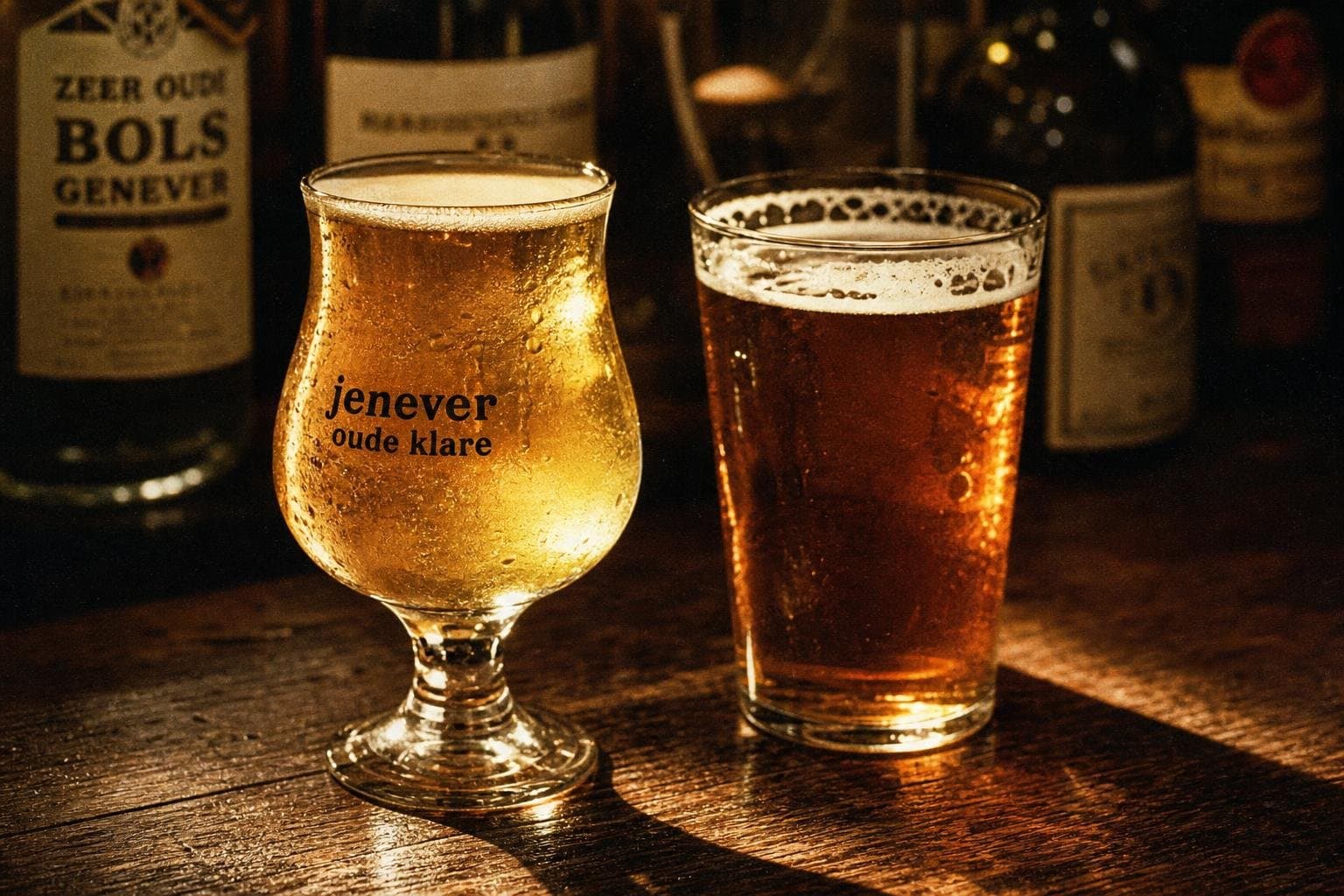

There's a Dutch word — kopstootje — that translates, with wonderful imprecision, as "little head butt." It describes the traditional pairing of genever with a beer back: a small tulip glass filled to the brim, drunk in one smooth tilt without touching the rim. The ritual survives in Dutch bars, where a single establishment might stock a hundred different genevers. Outside the Netherlands, most bartenders couldn't name three.
That gap — between what genever is in its home country and what it is everywhere else — is the identity crisis in miniature. And it didn't happen by accident.
The Original Spirit That Got Filed Under the Wrong Category
Genever predates gin by at least a century. The name comes from jeneverbes, the Dutch word for juniper berry, and the earliest documented references to juniper-infused spirits in the Low Countries date to the late 1400s and early 1500s. Early distillers weren't building a cocktail ingredient — they were making medicine, using juniper's supposed healing properties in a grain-based distillate that retained the character of its malt base.
That grain character is the key distinction. Genever is built on moutwijn — malt wine — redistilled with botanicals including juniper berries, giving it a richer, rounder profile that sits somewhere between whisky and the lighter gins we recognize today. The blend of maltwine distillates — corn for sweetness, rye for spice — is what makes individual genevers distinct from each other, not the botanical infusions. A Bols representative once put it bluntly: "Botanicals are nothing."
Gin came later — built on neutral spirit rather than malt wine, with botanicals doing all the heavy lifting because there was no grain character underneath to carry anything. According to one account, it was the result of an attempt to copy genever that went sideways. That's not a criticism of gin. It's a description of a different philosophy. Gin is a canvas. Genever is a painting.
The problem is that the canvas won.
How London Dry Ate the Category
London Dry is a legally defined production standard — all flavor from botanicals distilled with the spirit, nothing added after except water and a trace of sweetening, no colouring. That precision made it legible. Bartenders knew what they were getting. Consumers knew what to expect. The style became the default, and the default became the category. A Dry Martini, a Negroni, a classic gin and tonic — all built around this kind of spirit, and all of them reinforced the same narrow definition of what gin was supposed to be.
Genever never had that clarity in export markets. To be named genever, a spirit must be produced in the Netherlands or Belgium, and the two main styles — oude (old) and jonge (young) — describe production methods, not flavor profiles in any way that translates easily to a back bar conversation. Oude genever must contain at least 15% malt wine; jonge, which emerged around the 1900s as distilling techniques improved, uses mostly neutral spirit and can contain no more than 15% malt wine. Jonge genever sits closer to a lighter British-style gin; oude carries heavier malty characters, sometimes aged in casks for up to three years, closer to a soft herbal whisky than anything on the gin shelf.
Neither description fits neatly into the gin section. Neither fits neatly into the whisky section. So genever ended up on neither, or worse, got shelved with gin and introduced as "kind of like Dutch gin" — which is the equivalent of introducing Calvados as "sort of like French vodka." There are more types of gin than ever, and the labels can be confusing — but genever's problem isn't label confusion within the gin category. It's that it doesn't belong in the gin category at all, and nobody in the export trade has ever found a compelling way to say so.
The result is a spirit that's genuinely hard to explain in the thirty seconds a bartender has before a customer's eyes glaze over. London Dry doesn't have that problem. It is what it says it is.
What Gets Lost When the Category Collapses
Here's what the identity crisis actually costs: the pre-Prohibition cocktail canon was built partly on genever, not gin. The early Manhattan-adjacent drinks, the Holland Gin Sling, the recipes in Jerry Thomas's era — many of those called for a malt-forward spirit that modern gin simply doesn't replicate. When bartenders reach for gin in those recipes, they're making a substitution and calling it a restoration.
The good news is that genever is not out of production. It's poorly distributed in most markets, which is a different problem with a different solution. Bols Genever is the most widely available entry point — specialty shops in most major cities, online-only in others, roughly $25–35 depending on market. Straight, it has a smooth, herbal quality with the base spirit actually perceptible beneath the botanicals — soft, slightly sweet, no burn. In a cocktail, it adds a dimension that neutral-spirit gin can't provide.
The identity crisis is real, but it's not terminal. The spirit exists. The history exists. Amsterdam in the late 1500s was already one of the most active trading hubs in Europe, and genever traveled those trade routes across the continent. It can find its way back onto the bar — but not by being explained as a gin variant.
Drop the gin comparison entirely. Call it what it is: the original grain-forward juniper spirit, older than gin, richer than gin, and considerably more interesting in the glass than most of what's currently taking up shelf space under the gin label.


