


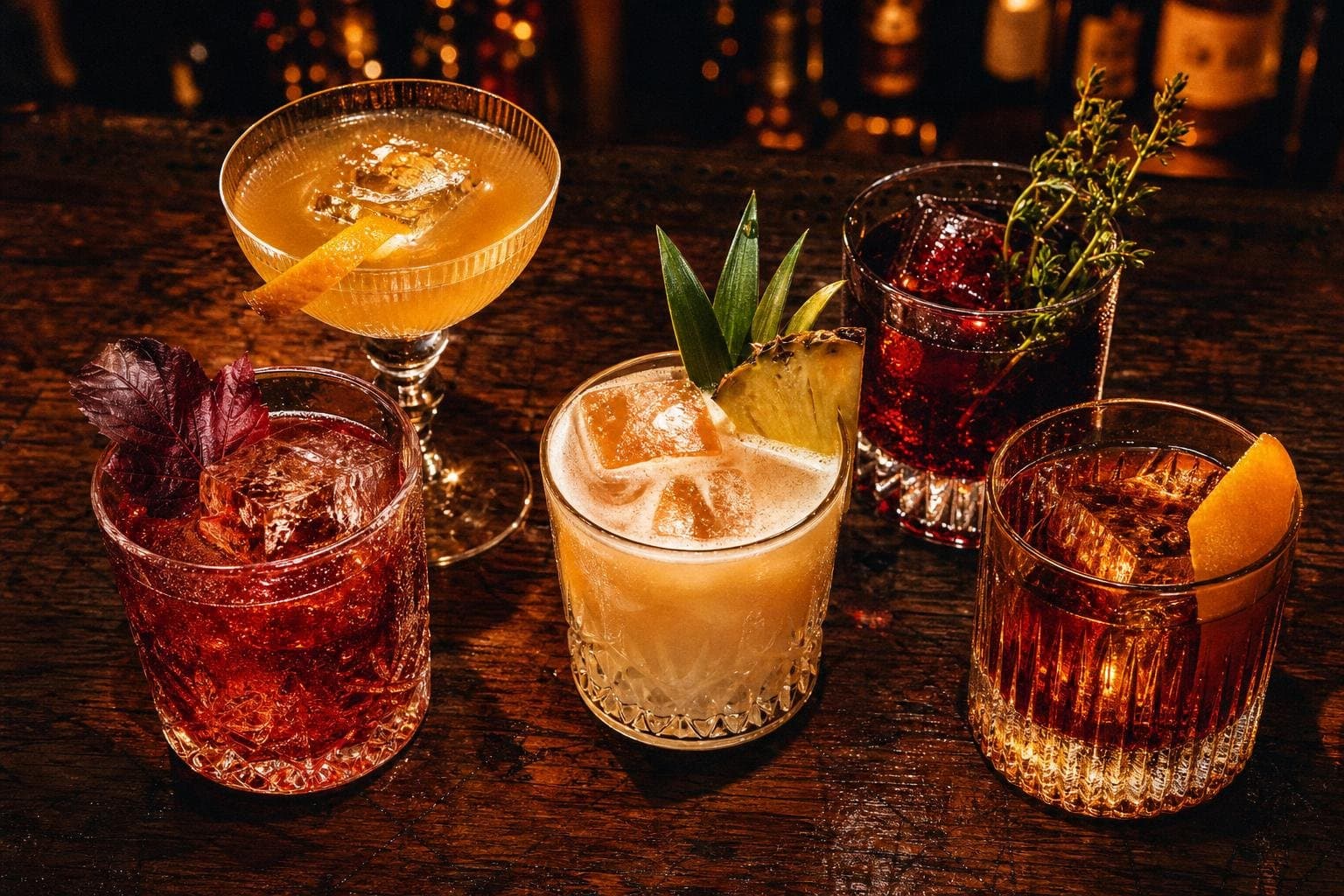

Negroni Week comes around every year, and bars respond by putting the same four riffs on their menus. The Sbagliato. The White Negroni. Something with mezcal. Something with a fancy vermouth. The Negroni is the most riffed-upon drink in the modern canon — Imbibe's recent roundup of industry favorites confirms the category is essentially infinite — and yet most bars fish from the same shallow end of the pool.
Here are five variations worth knowing, ranked loosely from most accessible to most obscure.
1. The Quill
The one that should be on every serious menu and almost never is. Nearly identical to the Negroni — gin, Campari, sweet vermouth — with a splash of absinthe. That's the whole trick, and it's enough.
William Elliott, executive bar director at Maison Premiere in Brooklyn, explains it well: the absinthe "adds layers of cooling, herbal bitterness that deepen the gentian-forward profile" and contributes "a subtle textural creaminess and slight louche." The drink rounds out rather than sharpens. It's a Negroni that lingers.
Provenance is disputed, as it always is. Drinks historians often credit the recipe to Frank C. Payne, a theatrical press agent, circa 1930 — but the cocktail didn't appear in Harry MacElhone's Harry's ABC of Mixing Cocktails until the expanded 1996 edition, not the 1920s original. Make of that what you will.
Spec: 1 oz gin / 1 oz Campari / 1 oz sweet vermouth / ¼ oz absinthe. Stir, strain, rocks or up.
2. The Alpine Negroni (Génépy Variation)
Swap the sweet vermouth for génépy and you get something colder, more botanical, and considerably less sweet. Génépy — made from artemisia steeped in neutral alcohol — has moved from après-ski obscurity to backbar staple, and it earns its place here by doing what vermouth does without the wine weight. Dante's version pairs it with gin, Cocchi Americano, and Suze — the Suze pulling the gentian bitterness forward while the génépy cools everything down.
This is a drier, more austere drink than the classic. Good for people who find the standard Negroni too sweet. Bad for people who don't like being challenged.
Availability note: Dolin Génépy des Alpes is the most widely distributed expression in the U.S. — specialty shops, $25–35. Chartreuse-adjacent in price, not in scarcity.
3. The Negroni Colada
Sounds like a joke. Isn't. Meaghan Dorman, bar director at Raines Law Room and Dear Irving in New York, called out the Negroni Colada at Clemente Bar as one of her recent favorites — "bitter, botanical edge you'd expect, but with a silkier texture and rich coconut backbone." The drink shifts as you drink it, she notes, which is the right thing to want from a variation.
The structural logic is sound: coconut cream does what sweet vermouth does (fat, sweetness, body) while adding tropical register. The Campari cuts through it. This is the variation most likely to convert someone who thinks they don't like Negronis.
4. The Savory Negroni (Olive or Beef Extract)
Two separate bartenders, independently, arrived at adding umami to the Negroni. Ryan Chetiyawardana (Mr Lyan) recommends a dot of beef extract for "rich, kokumi profile" and "wonderful length and mineral finish." Anthony Schmidt at CH Projects in San Diego accidentally fell for a quarter-ounce of olive brine added to their house Negroni — his words: "stone-cold psychotic," but it works.
Both versions push the drink toward digestif territory. Neither is for everyone. Both are more interesting than a Negroni with fancy vermouth.
**5. The Whiskey Negroni (Scotch and