


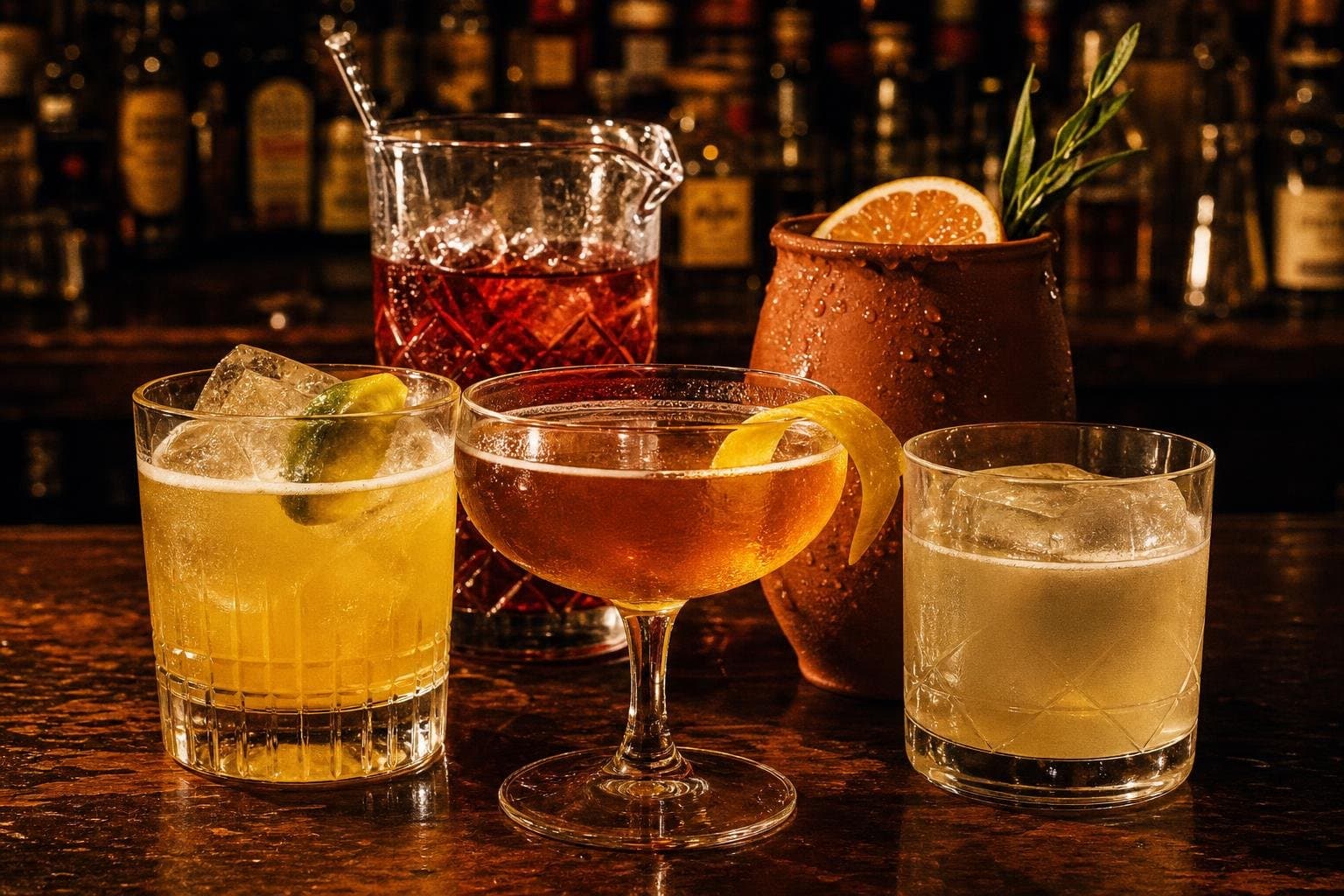

The bar world has a consolidation problem. Three drinks — the Margarita, the Negroni, the Spritz — now occupy so much mental real estate that everything else gets filed under "obscure" by default. Some of those overlooked drinks are obscure for good reason. Others are just poorly marketed, geographically stranded, or victims of a cocktail culture that mistakes familiarity for quality. Here are five worth pulling out of the drawer.
1. The Between the Sheets — A Cognac Sour That Earned Its Warning Label
First appeared in print in 1929, in Frank Shay's Drawn from the Wood, as a gin-and-Bacardi-and-Cointreau drink. By 1930 it had crossed the Atlantic, swapped gin for Cognac, picked up lemon juice, and landed in the Savoy Cocktail Book — which is how most bartenders eventually find it. Patrick Gavin Duffy, writing in his 1934 Official Mixer's Manual, warned readers about "sudden intoxication" and "sick headaches." He wasn't wrong about the mechanism; he was wrong to think that was a deterrent.
Punch's recent profile of Ryan Gannon at Lonnie's in Brooklyn is the best current case study in how to build this drink properly. His spec:
- Cognac: Frapin 1270 — sits between the richness of Pierre Ferrand and the lightness the drink requires
- Rum: Probitas — a blend of funky Jamaican pot-still and clean Barbadian Coffey-still; without some funk, "it's a Cognac drink that you just proofed up without really adding anything"
- Orange liqueur: critical choice; Cointreau from the original recipe is one option, but the orange component needs to bridge the two base spirits
The drink is essentially a Sidecar with rum sharing the load. That's not a diminishment — it's a description of why it works.
2. The Toreador — Australia Knows Something America Doesn't
Tequila, apricot liqueur, lime juice, simple syrup. Punch notes that the Toreador predates the Margarita and is a standard entry in the mental recipe book of most professional Australian bartenders. In the U.S., almost nobody orders it. Jeremy Blackmore, creative director for Sydney's Mucho Group, calls it "such a great, simple drink that gets overlooked."
The apricot liqueur is doing the work the triple sec does in a Margarita — sweetness, fruit, bridge — but with more texture and less acidity. Worth making once to recalibrate your sense of what tequila sours can do.
3. The Rosita — The Tequila Negroni That Isn't the Mezcal Negroni
The Mezcal Negroni has had its moment. The Rosita — reposado tequila, sweet vermouth, dry vermouth, Campari, bitters — has not, despite being the older and arguably more interesting variation. Punch credits Gary "Gaz" Regan with popularizing it. The split vermouth (sweet and dry together) is the structural move that separates it from a straight swap: it pulls the drink drier and more complex than a standard Negroni build.
Current bar interpretations range from smoked tequila versions (the Franklin in New Orleans) to blanco-based builds served up in a coupe (Roma Norte in San Diego). The drink is still alive; it's just not being talked about.
4. The Guadalajara Punch (Cazuela Voladora) — A Regional Classic That Hasn't Traveled
A large-format Jalisco drink: tequila, citrus, soda, salt, served in a clay vessel. Punch notes it's sometimes called the Cazuela Voladora — "flying casserole" — because its drinkability can "send you flying." Related to the Cantarito, another earthenware-served tequila classic.
This one hasn't crossed into American bar menus in any meaningful way. The format (large, communal, clay vessel) doesn't translate easily to a single-serve cocktail program. That's a logistics problem, not a quality problem.