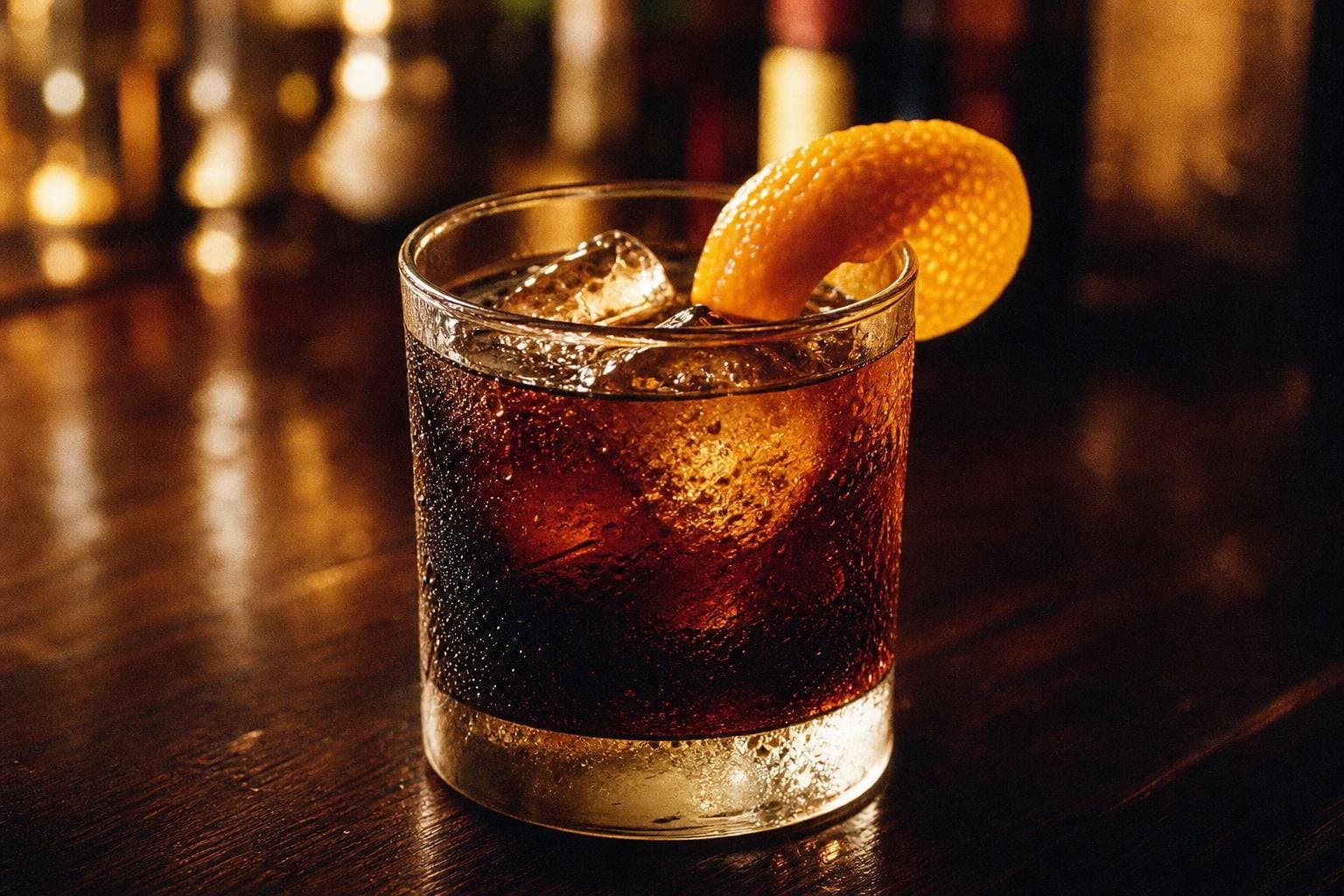

There's a number that stops people cold when they hear it. Argentina, despite having roughly 13% of the U.S. population, consumes approximately 75% of the world's Fernet supply. Not a meaningful share. Not a plurality. Three-quarters of everything produced, poured mostly into tall glasses with Coca-Cola at a 1:3 ratio. That single fact does more to explain Fernet-Branca than any amount of bartender mythology — and it also quietly demolishes the mythology.
Because the story American bar culture tells about Fernet is a story about difficulty. About a drink so challenging, so medicinal, so aggressively bitter that only the initiated can appreciate it. The bartender's handshake. The shot you earn. The thing civilians can't handle. And then you find out that Fratelli Branca opened its only production facility outside Italy in Buenos Aires specifically to meet Argentine demand — demand driven largely by people mixing it with Coke at asados and football matches. The drink that American bartenders treat as a badge of insider knowledge is, in its largest market, a casual mixer. Beloved, yes. Exclusive, no.
This doesn't make Fernet-Branca less interesting. It makes it more interesting. The gap between what the drink actually is and what the industry decided it means is worth examining.
The Liquid Itself Deserves Better Than Its Reputation
Strip away the cult and you have a genuinely complex amaro. Fernet-Branca uses 27 botanicals — gentian, saffron, myrrh, rhubarb, chamomile, cardamom, aloe among them — macerated individually before blending, a process that preserves the distinct character of each ingredient rather than muddying them together. The result sits at around 39% ABV and leads hard with menthol and herbal bitterness before the gentian and saffron come through on the back end. It's not subtle. It's not trying to be.
What it actually is: a digestif that does what digestifs are supposed to do. The bitter compounds — gentian especially — genuinely stimulate digestion. The original 1845 marketing as a medicinal tonic wasn't entirely fiction dressed up as history; the lines between medicine and alcohol were legitimately blurred in mid-19th century Milan, and Fernet occupied that space honestly. The recipe is a closely guarded secret passed through the Branca family, which is either romantic or a marketing strategy depending on your level of cynicism. Probably both.
In cocktails, it earns its keep in two classics worth knowing: the Toronto (rye whiskey, Fernet, simple syrup, Angostura — a Manhattan with a bitter backbone that actually improves on the original's sweetness) and the Hanky Panky, Ada Coleman's gin-and-sweet-vermouth construction with a barspoon of Fernet that transforms the whole thing. Both are listed as legitimate uses by people who actually work with the bottle. Neither requires you to take it as a shot while making eye contact with another bartender.
The San Francisco Problem
The cult origin story in the U.S. centers on San Francisco, where by 2008 the city reportedly accounted for 25% of all Fernet consumed in the United States. That's a striking concentration for a single city, and it's real. What happened there was genuine: a community of bartenders adopted Fernet as a shared language, a way of signaling membership in a craft that was, at the time, still fighting for legitimacy against a drinks industry that mostly didn't take bartending seriously.
That context matters. The handshake wasn't arbitrary. It was a response to a specific moment when bartenders needed a way to recognize each other across bars and cities, and Fernet — bitter, unfashionable, cheap enough to shoot — served that function perfectly. The problem is that the ritual outlasted the moment. The craft cocktail movement won. Bartending is legitimate now. The handshake became a hazing ritual, and the hazing ritual became a personality.
The amaro category has moved on. Imbibe recently covered Scarlet Radice Amaro from Iseya Distillery in Japan's Kanagawa prefecture, a 30-botanical bitter liqueur that's drawing serious attention from bars like Amor y Amargo in New York and Billy Sunday in Chicago — bars that know their amaro. The category has enough depth now that defaulting to Fernet as the one true bitter is like defaulting to Scotch as the one true whisky. It's a starting point, not a destination.
What the Drink Actually Deserves
Fernet-Branca is good. It's not transcendent, but it's genuinely well-made, historically interesting, and more versatile than its reputation as a punishment shot suggests. The Toronto alone justifies keeping a bottle on the shelf. The Argentine con coca tradition — dismissed by American bartenders as lowbrow — is actually a reasonable way to drink something this intense, and it's been working for generations of people with no interest in performing sophistication.
The cult status is a distortion. The drink underneath it is worth your time. Those are two separate things, and conflating them is how you end up either worshipping a bottle or dismissing it — when the honest move is just to make the Toronto, drink it slowly, and decide for yourself.


