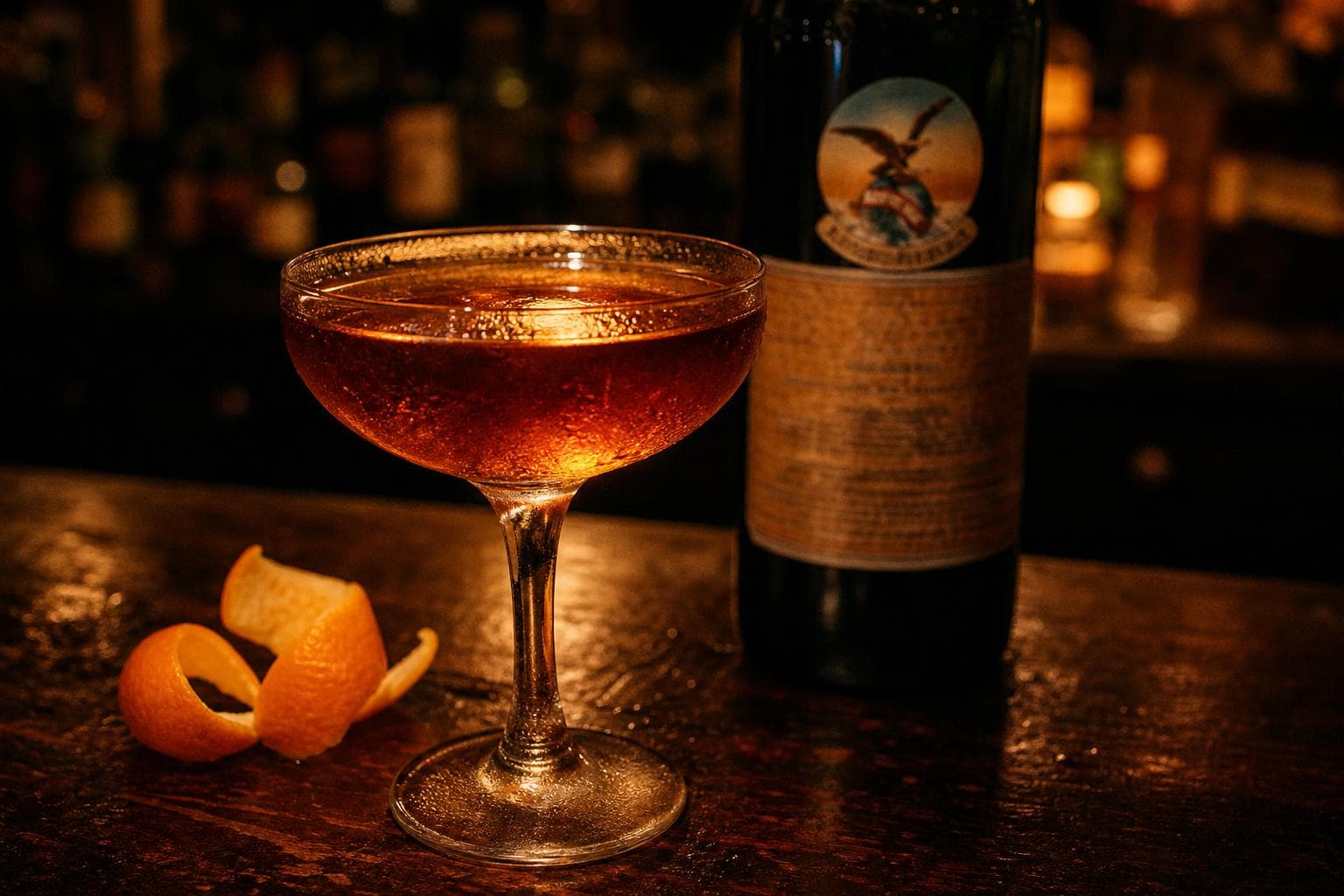

There's a specific moment that happens in bars across the country, and if you've worked in one, you know it. The last ticket fires, the well gets wiped down, and someone reaches for the Fernet-Branca without asking if anyone wants a pour. They just pour. Nobody debates it. Nobody asks what it tastes like. The shot appears, it disappears, and something unspoken gets communicated — you're one of us, you survived another night, welcome to the other side of the bar.
That ritual has a name. It's called the bartender's handshake, and it's been the unofficial credential of the American hospitality industry for at least two decades. But how a nineteenth-century Milanese medicinal tonic became the secret language of a modern professional class is a stranger story than the marketing would have you believe — and understanding it requires separating the myth from the mechanism.
The Bottle Predates the Ritual by About 150 Years
Fernet-Branca's origin story begins not in a cocktail bar but in a cholera epidemic. According to SevenFifty Daily, the herbalist Bernardino Branca developed the formula in Milan in the mid-1800s as a medicinal cure-all tonic during a wave of cholera that hit the city. The recipe — cardamom, chamomile, rhubarb, aloe, and a proprietary blend of herbs — was designed to heal, not to please. The Oxford Companion to Spirits & Cocktails reportedly calls fernet "an ill-defined style of Italian bitter digestive," which is either a criticism or a compliment depending on your relationship with ambiguity.
The brand arrived in the United States with Italian immigrants in the late 1800s, per the same source, citing Edoardo Branca, a sixth-generation member of the founding family. It survived Prohibition — as many bitters did, under the convenient fiction of medicinal use — and spent most of the twentieth century as a niche digestif, the kind of thing your Italian grandmother kept in a cabinet and your grandfather drank after Sunday dinner without explaining why.
What it was not, for most of that century, was a bartender's drink. The handshake ritual is a product of the craft cocktail revival, not of the Gilded Age. That distinction matters.
The Craft Revival Needed a Shibboleth
The early 2000s craft cocktail movement created a professional class of bartenders who thought of themselves differently than their predecessors — not as service workers but as practitioners, historians, technicians. With that identity came the need for markers. Shared references. Ways to recognize each other across a crowded room.
Fernet-Branca was, in retrospect, almost perfectly engineered for this role. It tastes terrible to the uninitiated — aggressively medicinal, menthol-forward, bitter in a way that reads as punishment rather than pleasure on first encounter. That inaccessibility is a feature, not a bug. A drink that filters out civilians is exactly what a professional subculture needs as a handshake. You don't order Fernet-Branca because you want to impress a date. You order it because you want to signal something to the person behind the stick.
SevenFifty Daily quotes Nick Kosevich, CEO of Earl Giles Drinks Emporium in Minneapolis, with a line that captures the ritual's logic precisely: "You don't order fernet to relax; you order it to close the loop on a night." And: "You don't debate it, you just pour it, and move on together." That's not a tasting note. That's a description of communion.
The drink's functional reputation reinforced the mythology. Bartenders have long credited Fernet-Branca with settling the stomach after a shift spent eating nothing but bar snacks and adrenaline. Whether the herbal formula actually delivers on that claim is a question for gastroenterologists, not cocktail writers. What matters is that the belief became part of the ritual, and the ritual became part of the identity.
What the Handshake Actually Costs the Drink
The honest answer is both, and the ratio depends on who's pouring.
The handshake ritual has made Fernet-Branca ubiquitous in American craft bars in a way that no amount of marketing could have manufactured. Harpers Wine & Spirit notes that the brand's UK distributor change to Mangrove Global was framed explicitly around "the shift to bitter flavour profiles amongst UK consumers" — the cultural momentum that started in American craft bars has gone transatlantic. That's real market penetration driven by subcultural cachet.
But the handshake also freezes the drink in a single use case. Fernet-Branca gets poured as a shot, end of shift, no questions asked. What it rarely gets is serious consideration as a cocktail ingredient — which is a shame, because it's genuinely interesting in small doses. The Hanky Panky, the early twentieth-century Ada Coleman creation, uses Fernet-Branca as a modifier in a gin-and-sweet-vermouth framework, and the result is one of the more elegant uses of a bitter amaro in the classic canon. Harpers mentions it specifically as a key component of that cocktail. Most bars that stock Fernet-Branca have never made one.
The handshake, in other words, has made the bottle indispensable while making the liquid underused.
A Recipe Worth Actually Making
The Hanky Panky deserves more attention than it gets, and it's a better argument for Fernet-Branca's range than any shot ritual.
Hanky Panky
- 1.5 oz London dry gin (Beefeater or Tanqueray — you want something with backbone, not a floral contemporary style)
- 1.5 oz sweet vermouth (Carpano Antica Formula; this is not a place to economize)
- 2 barspoons Fernet-Branca
Stir over ice until properly cold — forty seconds minimum, not the fifteen-second stir that produces a lukewarm Manhattan. Strain into a chilled coupe. Express an orange peel over the surface and discard.
The Fernet-Branca here is a modifier, not a feature. Two barspoons is enough to shift the drink's center of gravity — the sweet vermouth's vanilla and dried fruit get a menthol edge, the gin's botanicals get amplified rather than buried. It reads as a sophisticated Martini variation rather than a medicinal shot. Ada Coleman reportedly created it at the Savoy's American Bar in the early 1900s, though cocktail history being what it is, that attribution carries the usual caveats about disputed provenance and incomplete records.
Use Carpano Antica Formula for the vermouth. The recipe was built around a rich, complex sweet vermouth, and substituting a lighter style produces a thinner drink. If Antica isn't available, Cocchi Torino is a reasonable alternative. Both are specialty shop finds in most markets, roughly $20–$30 for a 375ml bottle.
On the Fernet itself: Fernet-Branca is widely available at most spirits retailers, typically $25–$35 for a 750ml. There are other fernets worth exploring — Fernet del Frate, Fernet Vallet — but for this recipe, the original formula's specific menthol-and-herb profile is what the drink was built around. Don't substitute a generic amaro and expect the same result.
The Handshake Has a Shelf Life
The bartender's handshake ritual is now old enough to have become, in certain circles, a cliché. A younger generation of hospitality workers has grown up with Fernet-Branca as received wisdom rather than discovery — it's the industry drink because it's always been the industry drink, which is a different relationship than the one that created the ritual in the first place.
Drinks International's 2026 Cocktail Report tracks the bestselling classics at award-winning bars worldwide, and the list reflects a moment when the craft cocktail canon is consolidating rather than expanding — the Naked & Famous, the Penicillin, the Vieux Carré all appear alongside century-old standards. Fernet-Branca doesn't appear as a cocktail component in that list, which tells you something about where it sits in the current hierarchy: essential to the bar back, largely absent from the menu.
That gap is the opportunity. The handshake ritual gave Fernet-Branca its cultural position, but it also capped its ceiling. The next interesting chapter for this bottle isn't another shift shot — it's bartenders treating it the way Ada Coleman did, as a precision tool rather than a blunt instrument. Two barspoons in the right framework, and it's one of the most useful modifiers in the amaro category. The medicinal reputation is real, the complexity is real, and the history is long enough to reward excavation.
The handshake got it in the door. Now someone needs to actually use it.


