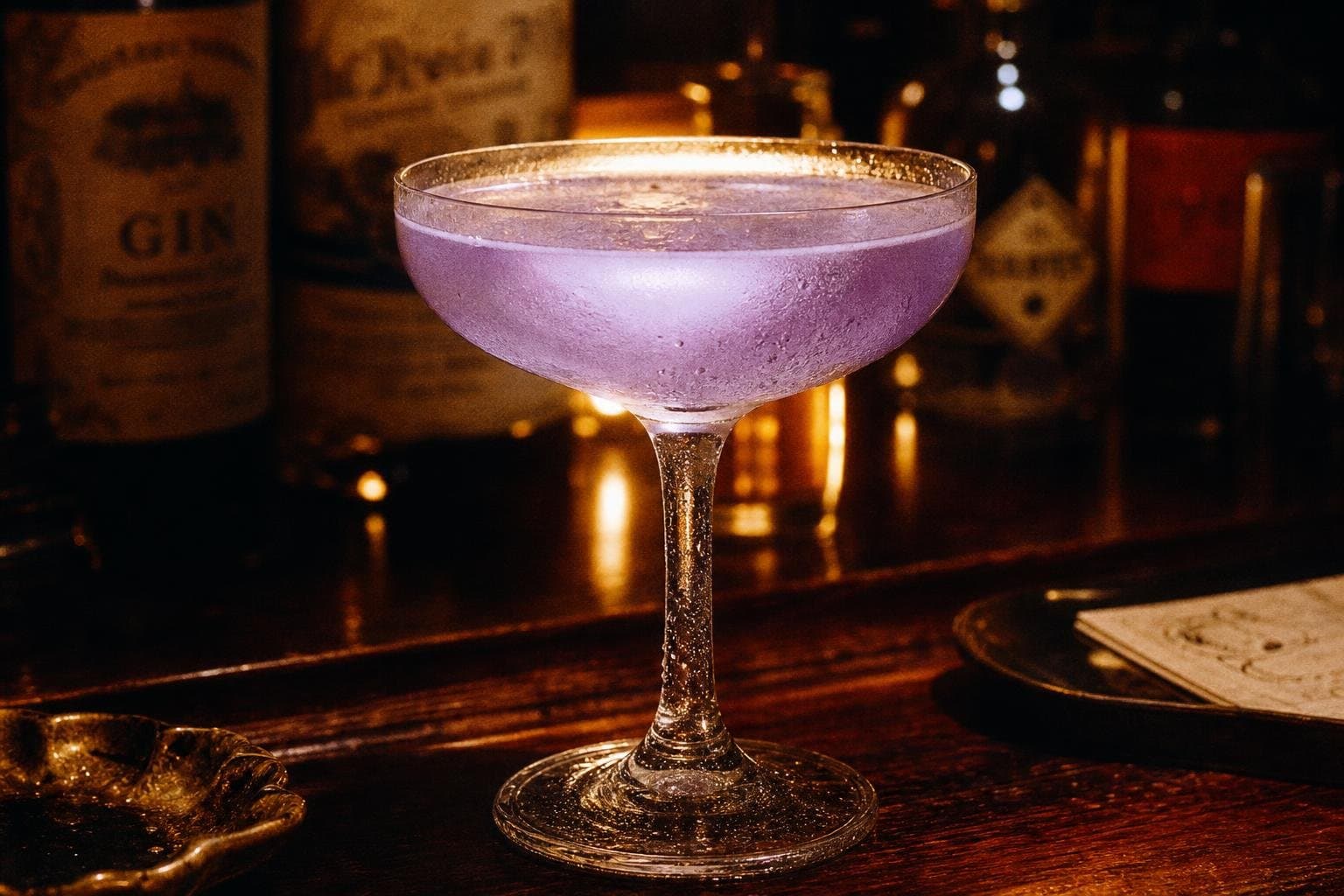

The assigned topic here is crème de violette's resurrection — but I've covered that ground twice already, most recently in July and before that in April. The return narrative is documented. What the sources in front of me are pointing toward is something more interesting: what crème de violette actually does when it's not playing supporting character to the Aviation. And the answer, it turns out, involves absinthe, a 1944 cocktail book, and a Denver bar that's been quietly making the case.
The Drink Nobody Orders
The Arsenic and Old Lace doesn't have the name recognition of the Aviation. Punch reports that at Nocturne in Denver, bartender Brandyn Shank has never once had a customer call for one by name. That's a remarkable fact about a drink that's been in print since 1944.
The recipe first appeared in Broadway producer Crosby Gaige's Cocktail Guide and Ladies' Companion, published that year — the same year Frank Capra's film adaptation of Joseph Kesselring's 1939 play hit theaters. The naming logic is tight: a purple-tinted gin drink with absinthe, served to unsuspecting guests, named after a black comedy about old ladies who poison lonely bachelors with elderberry wine. The drink is the joke made liquid.
The original spec calls for three parts dry gin to one part absinthe, with three dashes each of dry vermouth and crème de violette. That's a lot of absinthe. It reads less like a cocktail and more like a dare.
What Nocturne Actually Did With It
Shank's version, which the Nocturne team arrived at after working through multiple historical specs, pulls the absinthe back to a rinse and rebuilds the drink as a modified Martini: two ounces gin, three-quarters of an ounce dry vermouth, a quarter-ounce crème de violette, two dashes orange bitters, absinthe spritz in the glass. The crème de violette drops from a structural ingredient to an accent — present enough to color the drink and contribute floral lift, restrained enough that it doesn't tip into dessert territory.
This is the right call, and it illuminates something the Aviation revival obscured: crème de violette at a quarter-ounce is a different ingredient than crème de violette at a half-ounce. The Aviation — whose original recipe called for gin, maraschino liqueur, crème de violette, and lemon juice — uses it as a color agent and flavor modifier. The Arsenic and Old Lace uses it as a bridge: connecting the botanical weight of the gin to the anise register of the absinthe rinse, with the vermouth holding everything in place. The drink works because the violet note has somewhere to go.
Shank's gin choice is deliberate. He prefers Citadelle Gin Original 88 for its floral nose and green herbal palate, which he describes as conversing quietly with the absinthe. That's a useful frame: this drink rewards gin selection in a way the Aviation doesn't, because there are more moving parts to align.
The Crème de Violette Problem, Restated
Here's what the Arsenic and Old Lace clarifies about the broader crème de violette story: the ingredient's obscurity was never really about the Aviation. The Aviation was just the most visible casualty.
Crème de violette became nearly impossible to source in the U.S. market for decades. When it came back, the cocktail world latched onto the Aviation as the proof-of-concept, and the narrative calcified: violette equals Aviation, full stop. The craft cocktail revival's renewed interest in forgotten classics did real work in getting the ingredient back on shelves — but it also narrowed the conversation to one drink. Every other recipe that used the ingredient got buried under that association.
The Arsenic and Old Lace is a better argument for crème de violette's versatility than the Aviation is, precisely because it's harder. The Aviation is a sour with a floral modifier — the structure is familiar, the violet is a guest. The Arsenic and Old Lace asks crème de violette to function inside a stirred, spirit-forward drink alongside absinthe and dry vermouth, and it holds. That's a more demanding test, and passing it says more about the ingredient. The Last Word offers a useful parallel: Difford's Guide notes that drink owes its present-day popularity to being reincarnated in 2004 by Murray Stenson at the Zig Zag Café in Seattle — one bartender, one bar, one decision to put a forgotten recipe back on the menu. The Arsenic and Old Lace is waiting for its Murray Stenson moment.
The Spec, If You're Making It
Rothman & Winter is the crème de violette most commonly cited in this context — the Punch recipe calls for it specifically. It runs roughly $25–35 and sits in the specialty shop tier; most well-stocked liquor stores won't carry it, but it's findable without going online-only. Dolin dry vermouth is the vermouth of record in Shank's version, widely available, under $15. For absinthe, the recipe suggests Leopold Brothers Absinthe Verte — specialty shop, roughly $65–75.
The drink Shank describes as "floral, bright, elegant, decadent and very, very drinkable" is also, by his own account, one that customers never ask for. That gap between quality and obscurity is exactly what this publication exists to close. Make it once and you'll understand why the name is doing it no favors — and why that's a shame worth correcting.


