


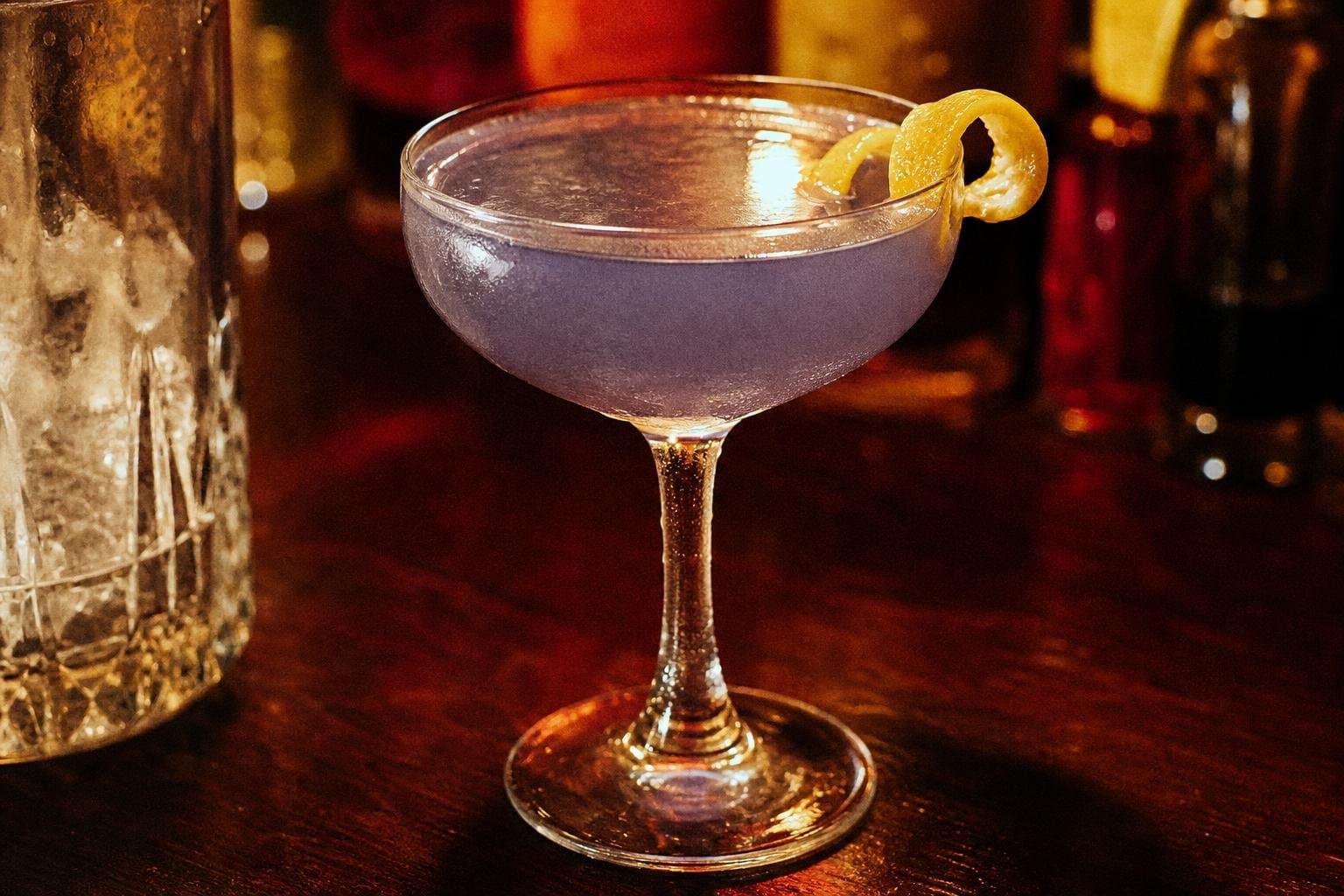

The Aviation spent roughly fifty years as a gray drink. Not metaphorically — literally gray. Without crème de violette, the violet color that gives the cocktail its name and its reason for existing simply wasn't there. Bars that kept the Aviation on their menus through the mid-twentieth century substituted it out, adjusted ratios, or just ignored the problem. The drink survived, technically. It didn't survive intact.
I've written about this before — the violette disappearance and the Crème Yvette distinction — so I won't retread that ground. What I want to look at now is the resurrection itself: what it actually was, what it wasn't, and why the story the industry tells about it is tidier than the reality.
The Return Was a Market Decision, Not a Rescue Mission
Here's what the standard narrative gets wrong: it frames crème de violette's comeback as bartenders demanding an ingredient back into existence through sheer historical passion. The craft cocktail revival did create demand. But demand doesn't conjure supply — someone had to decide it was worth making and importing again.
Loungerati noted in 2010 that Crème Yvette's return came through Cooper Spirits International — the same company behind St. Germain elderflower liqueur — which happened to have inherited the original recipe through its parent company, Charles Jacquin et Cie of Philadelphia. That's not a bartender rescue story. That's a business with an asset deciding the moment was right to monetize it.
Crème de Violette from Rothman & Winter — the Austrian producer whose product became the more widely available violette option — followed a similar logic. The ingredient returned because the craft cocktail movement created a viable commercial case for it, not because the industry collectively decided historical accuracy mattered. Both are true simultaneously, and collapsing them into a single heroic narrative flattens what actually happened.
Worth being precise here: Rothman & Winter's crème de violette is still in production and available through specialty retailers in most U.S. markets, typically in the $25–35 range. It's not rare. It's not a unicorn. It's a moderately distributed European liqueur that most well-stocked bottle shops can order if they don't carry it. "Hard to find" and "out of production" are different problems, and this one is the former — and barely that.
What the Ingredient Actually Does (and Doesn't Do)
The violette question is partly about color and partly about flavor, and the two are often conflated. As Loungerati observed, crème de violette can push cocktails toward gray rather than the expected purple — a function of how the pigment interacts with citrus. The color payoff depends heavily on ratio and the acidity of whatever it's paired with. Expect less than the bottle's hue suggests.
Flavor-wise, it's delicate to the point of fragility. In an Aviation — gin, maraschino, lemon, violette — it contributes a floral note that reads more as texture than as a distinct flavor. Increase the pour to make it more present and you risk the drink tipping sweet and perfumed. Keep it restrained and some drinkers won't taste it at all. This is not a criticism; it's a calibration problem. The ingredient requires precision, and most bars that put the Aviation back on their menus after violette's return didn't necessarily figure out that precision immediately.
The Imbibe retrospective on the craft cocktail era frames this period as one where bartenders "sought and found inspiration in cocktail history" and applied quality ingredients to old recipes. That's accurate as far as it goes. But applying a quality ingredient and understanding how to use it are different skills, and the Aviation's revival produced a lot of technically correct but culinarily inert versions of the drink.
The Resurrection Proved Something, Just Not What Everyone Claims
The crème de violette story is usually told as proof that historical accuracy matters — that getting the ingredient right restores the drink. And there's truth in that. An Aviation made with violette is a different drink than one without it, and the difference is meaningful.
But the more interesting thing the resurrection proved is how much work an ingredient's absence had done. The Aviation survived fifty years without violette because the underlying structure — gin, citrus, maraschino — is sound. The drink didn't collapse without its defining modifier. It just became something else. When violette came back, it didn't rescue a broken cocktail. It restored a specific version of a cocktail that had been quietly replaced by a functional substitute.
That's a subtler story than the one usually told. The craft cocktail movement's instinct toward historical recovery is genuinely valuable — Drinks International's 2026 cocktail report shows that the classics driving volume at the world's best bars are still the ones with the deepest structural logic. But recovery and restoration aren't the same thing, and knowing the difference is what separates excavation from nostalgia cosplay.
The violette is back. The Aviation is better for it. The story of how that happened is more commercial and more complicated than the industry prefers to admit — which makes it more interesting, not less.