


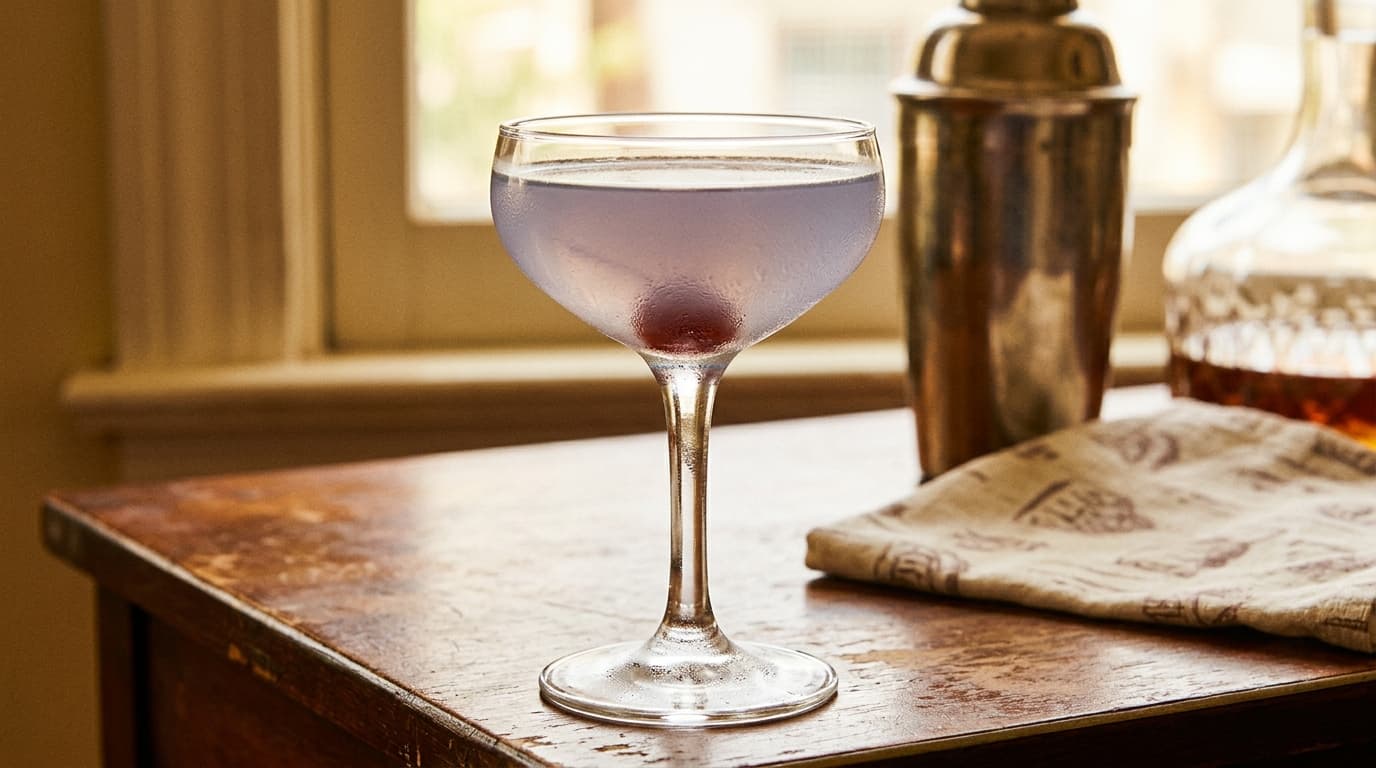

There's a reason the Aviation tastes like a gin sour with delusions of grandeur at most bars. The ingredient that made it worth ordering — the one that gave it color, name, and reason for existing — was absent from American back bars for roughly fifty years. When it came back, half the industry had already forgotten it was supposed to be there.
The Original Recipe Had Four Ingredients. Craddock Killed One of Them.
Hugo Ensslin published the first Aviation recipe in his 1916 Recipes for Mixed Drinks. Four components: gin, lemon juice, maraschino, crème de violette. The violet liqueur wasn't decorative — it gave the drink a bluish tinge meant to evoke the sky, which is the entire point of naming a cocktail after aviation. Without it, you've got a gin sour with a splash of maraschino. Perfectly drinkable. Completely anonymous.
Harry Craddock's Savoy Cocktail Book (1930) dropped the crème de violette entirely, calling for gin, lemon juice, and two dashes of maraschino. No explanation. No substitution. Just gone. Given the Savoy's influence on every bartender who came after, that editorial decision echoed for decades. By the time crème de violette became virtually unavailable in the United States — a process that appears to have been well underway by the late 1960s — most bartenders working from Craddock's template didn't notice anything missing.
The Substitute That Wasn't Quite a Substitute
Crème Yvette occupied adjacent territory. A French liqueur built from violet petals, berries, vanilla, and spices, it appeared in vintage cocktail books as an Aviation modifier and was considered close enough to crème de violette to stand in. It went out of circulation in 1969. So by the early 1970s, both violet liqueurs had effectively vanished from American bars simultaneously. The Aviation soldiered on in its stripped-down Craddock form — or didn't soldier on at all.
The pattern here is worth naming: this isn't a case of a drink being forgotten because it was bad. It's a case of a drink being simplified by one influential book, then stranded when its defining ingredient disappeared, then reconstructed from the simplified version by bartenders who never knew what they were missing. The Aviation that most people drank for fifty years wasn't the Aviation. It was a cover version of a cover version.
The Return: 2007, and Still Incomplete
Haus Alpenz brought crème de violette back to the U.S. market in 2007. Crème Yvette returned around the same time, revived by the team behind St. Germain elderflower liqueur. The cocktail revival had created demand; the importers responded. The Aviation got its fourth ingredient back.
The reception was not unanimous. At the 2012 Manhattan Cocktail Classic, Dale DeGroff — who had included the Aviation in his own books — nominated it for a panel called "Do Not Resuscitate," arguing it tasted like hand soap with or without the violet. That's a minority position, but it's not a stupid one. Crème de violette is polarizing. The floral note reads as perfumed to some palates and elegant to others. The drink asks you to commit.
Many bars still don't stock crème de violette, which means the three-ingredient version persists. If a bar can't make the real thing, they're serving you the Craddock edit and calling it an Aviation. Worth asking before you order.
Build It Right
The Aviation (Ensslin, restored)
- 45 ml gin — something botanical but not aggressively juniper-forward; Beefeater works, Plymouth is traditional
- 15 ml Luxardo Maraschino
- 15 ml fresh lemon juice
- 1 barspoon Rothman & Winter Crème de Violette (widely available, specialty shops; ~$25)
Shake hard with ice, strain into a chilled coupe. Maraschino cherry garnish. The color should be pale lavender-grey — not purple, not blue, not Instagram. If it looks like a Cadbury egg, someone got heavy-handed with the violette.
Sidebar — Sourcing the Violet: Rothman & Winter is the most accessible option in the U.S. Giffard also produces a crème de violette with good distribution. Crème Yvette (Cooper Spirits) is spicier and darker — it'll shift the flavor profile noticeably, but it's the historically appropriate substitute if you want to go that direction.
Verdict
The Aviation is a good drink that spent fifty years being made wrong, then came back to a debate about whether it should have come back at all. Make it with all four ingredients before forming an opinion. The violet note is subtle — a barspoon, not a pour — and what it adds is less about flavor than about coherence. The drink finally makes sense. You understand why someone named it after the sky.