


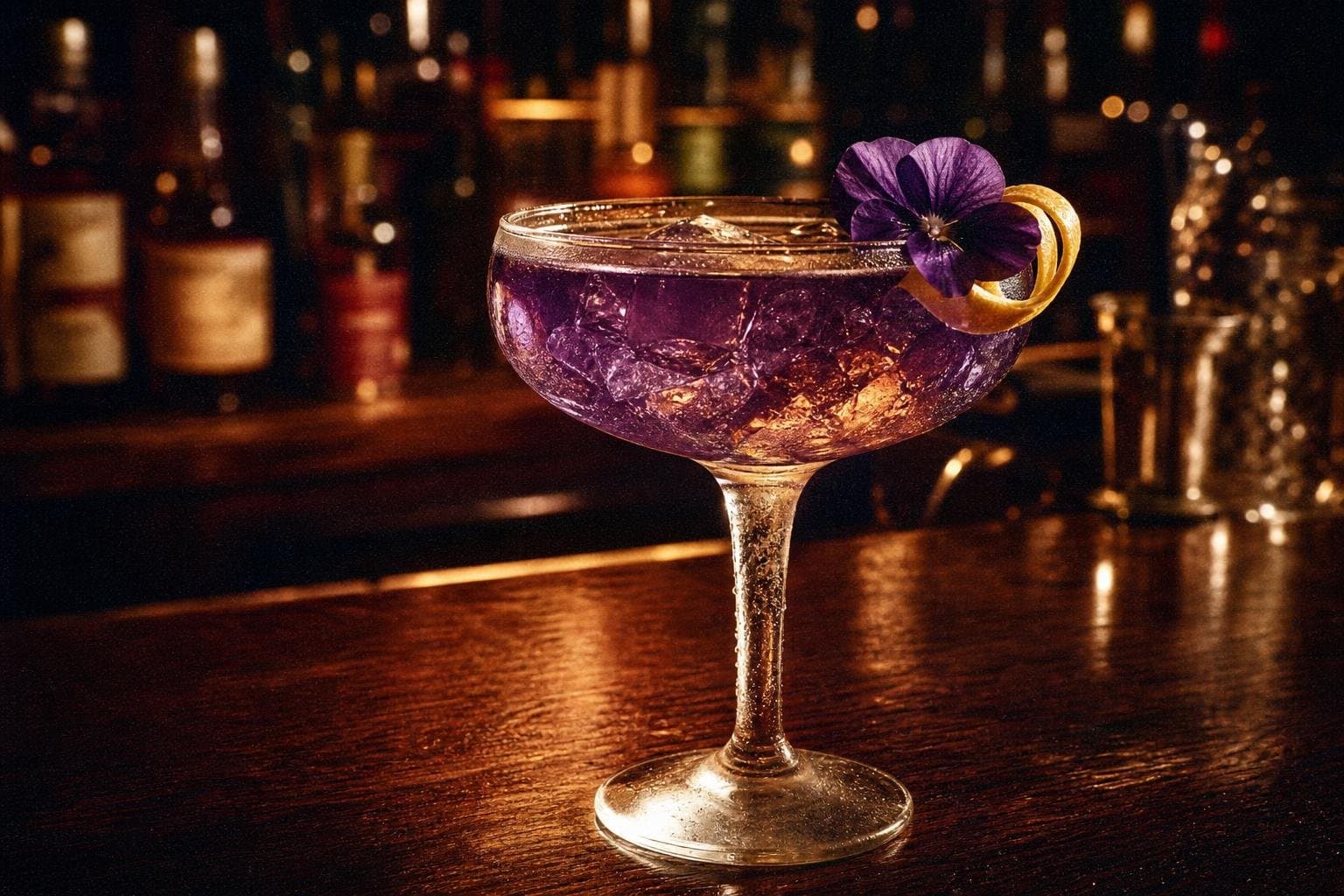

The Aviation spent fifty years as a gray drink. Not metaphorically — literally gray, or at best a wan, washed-out lavender, because the crème de violette that gives it color and floral depth had quietly vanished from American back bars. Bartenders kept making the drink anyway, working from Hugo Ensslin's 1916 recipe (which TheKitchenPursuits traces to his Recipes for Mixed Drinks) while omitting the one ingredient that made it distinctive. The result was a gin sour with maraschino. Fine. Not the point.
When crème de violette came back into wider availability in the 2000s, the story that attached itself to the return was tidy: the craft cocktail revival demanded historical accuracy, bartenders tracked down a lost ingredient, the Aviation was restored to its purple glory. Clean narrative. Mostly true. Also missing about half the picture.
The Absence Was Never Total
Here's what the resurrection story tends to skip: crème de violette never actually disappeared from production. It became hard to find in the United States — poorly imported, rarely distributed, absent from most wholesale catalogs — but European producers kept making it. This matters because "lost ingredient" and "poorly distributed ingredient" are different problems with different implications. One requires rediscovery; the other requires a distributor willing to bother.
The distinction is worth holding onto because it changes what the "resurrection" actually was. It wasn't archaeologists brushing dirt off a forgotten artifact. It was the American craft cocktail market becoming large and serious enough that importing a niche Victorian liqueur became commercially viable. The demand created the supply chain, not the other way around.
LipTouchFoods traces the liqueur's origins to late 19th-century Alpine production — violet flowers macerated in neutral grape spirit, sweetened, filtered — a process that remained essentially unchanged through the decades when American bartenders couldn't get their hands on it. The recipe didn't need rescuing. The import relationship did.
What the Aviation Myth Obscures
The Aviation became the flagship argument for crème de violette's return, and that's both accurate and limiting. Accurate because the drink genuinely needs the liqueur — without it, you're missing the color, the floral register, and the slight bitterness that keeps the maraschino from going cloying. Limiting because it turned crème de violette into a single-cocktail ingredient in the minds of most bartenders who stocked it.
VinePair's timeline of bar industry darlings makes a useful observation about how spirits earn lasting relevance: the ones that stick are the ones that can "play a supporting role in a cocktail or perform a liquid soliloquy" — meaning they have utility beyond one canonical application. Crème de violette's problem, post-revival, is that it mostly got filed under Aviation and left there. Bars that stocked it used it for one drink. Bars that didn't stock it pointed to the Aviation's limited menu presence as justification for not ordering it. A self-sealing argument.
The liqueur has more range than that. Its floral bitterness works in stirred drinks alongside aged spirits in ways that most bartenders haven't seriously explored, because the Aviation framing positioned it as a bright, citrus-adjacent ingredient rather than a modifier with genuine depth.
The Bottles That Came Back (and What They Cost You)
A few producers now have meaningful American distribution. Rothman & Winter Orchard Violette is the one most bartenders encountered first — specialty shop availability, roughly $30–40 depending on market. Giffard Crème de Violette runs in a similar range and is somewhat more widely distributed, findable at better-stocked spirits retailers. Both are still specialty-shop territory rather than widely available; you're not grabbing either at a grocery store chain, and online ordering remains the most reliable route in many markets.
The quality gap between producers is real and worth caring about. Some versions lean synthetic-floral in a way that reads as perfume rather than flower. The better bottles have an earthy undertone beneath the sweetness — that's the actual violet coming through, not a flavor compound approximating it.
What a Victorian Liqueur Actually Teaches You
The crème de violette story is, in miniature, the story of the craft cocktail revival's relationship with history: genuine, well-intentioned, and occasionally too attached to a single canonical narrative. The Aviation is a great drink. It's also not the only argument for keeping violet liqueur on your shelf.
The more interesting question — the one worth asking now that the ingredient is accessible again — is what else it can do. Stirred with rye and a bitter amaro, the floral note becomes something stranger and more interesting than it ever is in a shaken citrus drink. That's the experiment most bars haven't run yet, because they ordered one bottle for the Aviation menu and stopped there.
The liqueur came back. The imagination around it is still catching up.