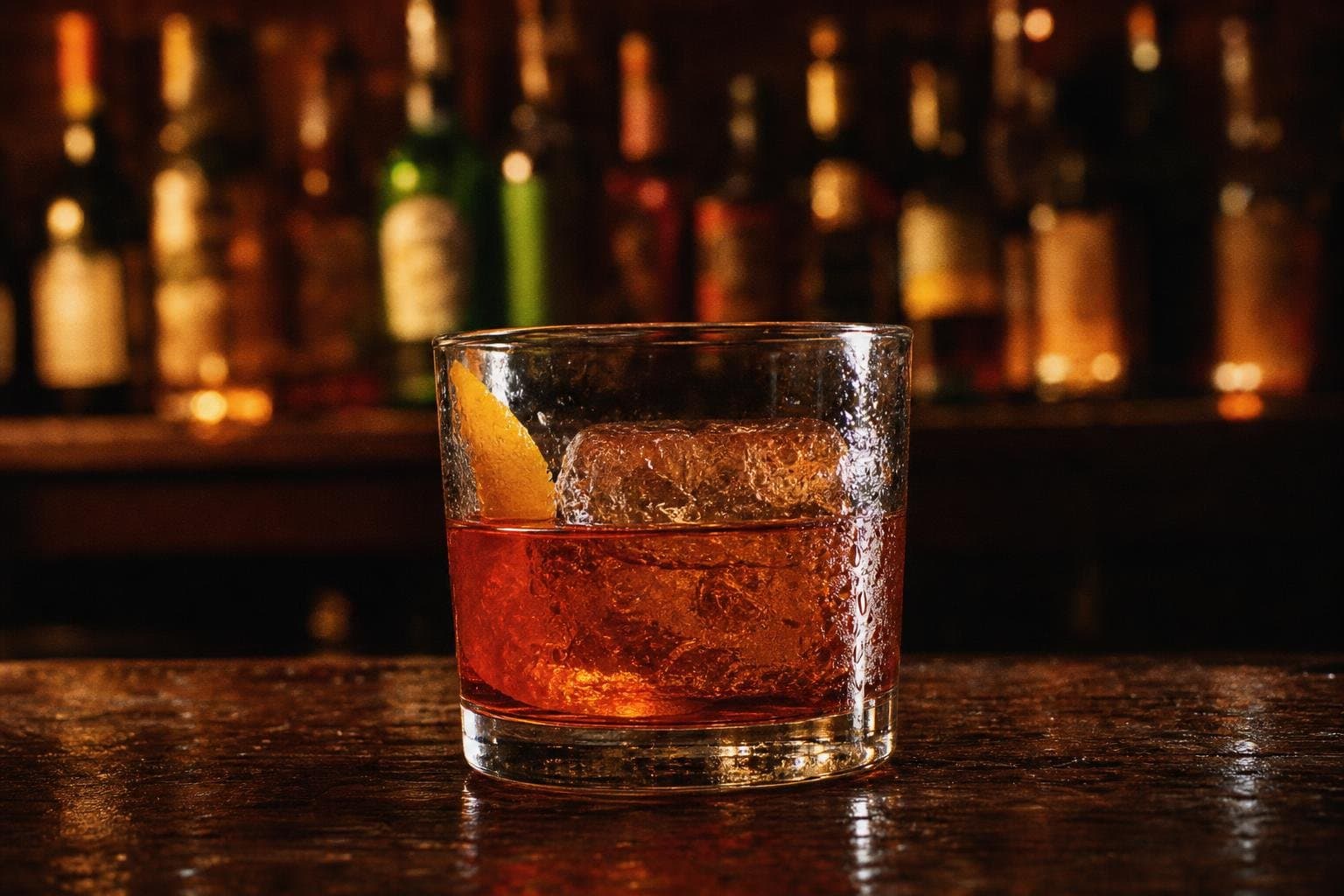

There's a drink that used to exist at every serious bar in America. It wasn't on the menu. It didn't have a name. It was whatever the bartender made you when you sat down, looked a little lost, and said "surprise me." The bartender read you — your mood, your tolerance, whether you wanted something bracing or something soft — and built something in under two minutes that cost maybe twelve dollars and tasted like they'd been thinking about it all week.
That drink is mostly gone now. In its place: a laminated menu with seventeen cocktails, each requiring a paragraph of explanation, each priced between eighteen and twenty-four dollars, each built around an ingredient that needs its own footnote. The bartender is too busy torching a citrus wheel to notice you've been sitting there for six minutes.
This is what craft cocktail culture did to itself. It started as a corrective — a serious, historically-grounded pushback against the era of sour mix and well vodka — and it succeeded so completely that it forgot what it was correcting toward. The goal was better drinks for more people. Somewhere around 2012, the goal became better drinks, full stop. The "for more people" part got quietly dropped.
The Canon Closed and Nobody Told the Customers
Robert Simonson has spent decades documenting the modern cocktail revival as it actually happened — not as brands retell it, not as oral history filtered through generations of sales managers. His account, discussed in a recent Maffeo Drinks conversation, makes a specific claim worth sitting with: the modern classic cocktail canon ran from roughly 2000 to 2012. It produced drinks that are still being ordered today by people who assume they've existed forever. After 2012, the list closed. Nothing has joined it since.
That's not a coincidence. The drinks that entered the canon — the Penicillin, the Paper Plane, the Naked and Famous — shared a quality that has become unfashionable: replicability. You could make them anywhere with ingredients that existed in most bars. They were built to travel. They were built for the everyday drinker who might encounter them in Seattle one week and Nashville the next and recognize them both times.
What replaced them was the opposite of replicable. The post-2012 craft bar moved toward house-made everything: fermented syrups, fat-washed spirits, clarified juices, dehydrated garnishes, ingredients sourced from a single farm in a single county. Beautiful work, often. Genuinely impressive technique. And completely untransferable. The drink exists only at that bar, on that night, made by that specific bartender. Which sounds romantic until you realize it's also a description of something that can't build a following beyond its own zip code.
The canon closed because the culture stopped making things that could be canonized.
The Price of Admission Became the Point
Here's what happened to the economics. A traditional craft cocktail — the kind built around fresh juice, house syrups, and a quality base spirit — runs a pour cost of roughly 25 to 30 percent, according to industry tracking cited in The Belle Isle. A highball — quality spirit, premium mixer, ice — runs 15 to 18 percent. The craft cocktail costs more to make, takes longer to build (two to three minutes versus fifteen to twenty seconds, per the same source), and requires more skilled labor. The bar charges more to cover it. The customer pays more to drink it.
None of that is inherently wrong. The problem is what happened to the price signal. When a craft cocktail costs twenty-two dollars, it stops being a drink and becomes a statement. The customer isn't just buying something to drink — they're buying membership in a culture that values this kind of thing. The drink becomes a credential. And credentials, by definition, exclude people who can't afford them or don't want to perform the affiliation.
The old house pour — the well drink, the bartender's choice, the unpretentious thing that cost eight dollars and tasted fine — was the entry point. It was how people learned what they liked. It was how bars built regulars. Craft cocktail culture didn't just raise prices; it eliminated the entry point and replaced it with a velvet rope disguised as a menu.
The British bar trade noticed this before the American one did. The Belle Isle's recent survey of UK on-trade operators found that long cocktails, spritzes, and highballs have been steadily gaining ground for several years — not because customers got less sophisticated, but because they got tired of waiting twelve minutes and paying for theater they didn't order. The data from CGA by NIQ, cited in the same piece, shows the amount people spend hasn't changed. How they spend it has. They want the quality spirit. They don't want the performance.
Technique Became the Product Instead of the Means
Walk into a cocktail lab bar in 2026. There's a rotary evaporator behind glass. A centrifuge. A dehydrator running something that smells like toasted rice. The bartender will explain all of it if you ask, and the explanation will be genuinely interesting. Club Oenologique's survey of cocktail lab bars — from Fede Cocktailab in Florence to FlipDog in London to Eve Bar in Covent Garden — frames this as transparency, as "revealing the creative process." And it is. It's also, if you're honest about it, a form of intimidation dressed up as hospitality.
When the equipment is the first thing you see, the message is clear: this is a place for people who appreciate equipment. The casual drinker — the person who just wants something cold and good after work — reads that room correctly and goes somewhere else. The craft bar has, in effect, self-selected its audience down to enthusiasts and tourists, and then wondered why it can't build the kind of neighborhood loyalty that a good dive bar accumulates without trying.
This isn't an argument against technique. Fat-washing works. Clarification works. Fermented syrups can add complexity that no commercial product replicates. The question is whether the technique serves the drink or whether the drink has become a vehicle for displaying the technique. A well-made Daiquiri — three ingredients, properly balanced, properly cold — tells you more about a bartender's actual skill than a twelve-component construction that hides every flaw behind noise. The Daiquiri has nowhere to hide. The twelve-component drink has eleven places to hide.
Punch's Best New Bartenders of 2026 feature is instructive here, and not in the way it intends to be. The drinks are genuinely creative — a Blueberry Bijou built around a house cordial made from local fruit, a Piña Colada riff using toasted-coconut-infused bourbon and acid-adjusted pineapple cordial, a tequila drink incorporating Malta India from a bartender's Puerto Rican childhood. Each one is a small thesis statement about who the bartender is and where they came from. Each one is also, practically speaking, unreproducible outside the specific bar where it was developed. The cordial requires the leftover pulp from another process. The infusion requires a specific bourbon and a specific technique. These are drinks for the people lucky enough to be in that room on that night. They are not drinks for the everyday drinker who just wants something good.
That's fine, as far as it goes. But when the entire industry's prestige economy runs on this model — when the drinks that get written about, awarded, and emulated are all of this type — the everyday drinker stops being the audience. They become an afterthought.
What Gets Lost When the Everyday Drinker Leaves
The everyday drinker is not a lesser category of person. They are, historically, the reason cocktail culture exists at all. The drinks that became classics — the Martini, the Old Fashioned, the Daiquiri, the Negroni — became classics because they were ordered by people who weren't thinking about them as cultural artifacts. They were thinking about having a drink. The drinks survived because they were good enough to be ordered again, and again, and again, by people who weren't enthusiasts.
Food & Wine's survey of classic cocktails notes something obvious that the craft world tends to forget: there's comfort in walking into a bar and ordering a Negroni or an Old Fashioned and knowing what you're going to get. That predictability isn't a failure of imagination. It's the mechanism by which drinks become part of culture rather than part of a trend cycle.
The craft cocktail world has, in its pursuit of novelty and technique, built something genuinely impressive and genuinely inaccessible. The bars are beautiful. The drinks are often extraordinary. The bartenders are more skilled than at any point in the last century. And the person who just wants a well-made drink at a reasonable price, served without a lecture, is increasingly not welcome in the room — not because anyone said so, but because every signal the room sends points elsewhere.
The irony is that the craft cocktail revival started as a populist project. It was about giving people better drinks, about respecting the customer enough to use real ingredients and real technique. It succeeded so thoroughly that it priced out the people it was trying to serve and replaced them with a smaller, wealthier, more credentialed audience that treats cocktail culture as a hobby rather than a pleasure.
The house pour didn't die because nobody wanted it. It died because the industry decided it wasn't interesting enough to make. That's a different kind of failure — not a market failure, but a values failure. And the market, as it turns out, is starting to notice. The highball is having a moment in London's busiest bars not because it's trendy but because it's good and it's fast and it doesn't ask anything of you except that you drink it. That's what the everyday drinker wanted all along.
The craft bar that figures out how to make room for that person — without abandoning the technique, without dumbing down the program, without turning the menu into a greatest-hits jukebox — is the one that will still be open in twenty years. The ones that keep building cathedrals and wondering why the pews are empty will have a harder time explaining it.


